April 9, 1862: Robert E. Lee to P. G. T. Beauregard

Pierre Gustave Toutant Beauregard was a Louisiana-born general of the Confederate States Army. He had graduated second in his class from West Point in 1838 and was an admirer of Napoleon. He achieved fame early in the Civil War for commanding the Fort Sumter bombardment and as the victor of the first battle of Manassas. He later served in the Western Theater (including Shiloh and Corinth), Charleston, and the defense of Richmond, but his career was hampered by friction with Jefferson Davis and other generals.

This telegram is from The Telegraphic History of the Civil War; a compiled album of telegrams to Beauregard from Davis, Lee, Johnston and others.
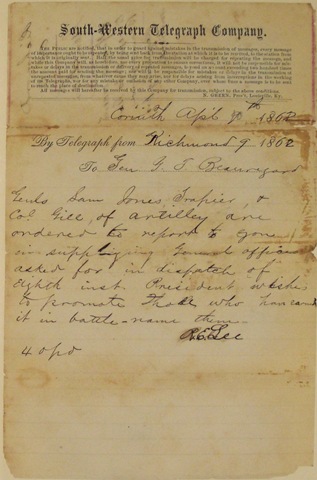
Telegram 4-9-62 Lee to Beauregard 10 mp

Transcript:

Corinth April 9th [“10” written over “9th” in pencil] 1862

By Telegraph from Richmond 9 1862

To Gen G. T. Beauregard

Genls Sam Jones, Trapier, & Col. Gill, of artillery are ordered to report to you in supplying general officers asked for in dispatch of eighth inst. President wishes to promote those who have earned it in battle—name them.

R. E. Lee

40 pd


Citation:Robert E. Lee (1807-1870), telegram to G.T. Beauregard. Richmond, 9 April 1862. In The telegraphic history of the Civil War, 1861-1865. AMs 434/16
April 8, 1862: John Adams telegram to P. G. T. Beauregard

Pierre Gustave Toutant Beauregard was a Louisiana-born general of the Confederate States Army. He had graduated second in his class from West Point in 1838 and was an admirer of Napoleon. He achieved fame early in the Civil War for commanding the Fort Sumter bombardment and as the victor of the first battle of Manassas. He later served in the Western Theater (including Shiloh and Corinth), Charleston, and the defense of Richmond, but his career was hampered by friction with Jefferson Davis and other generals.

This is one of approximately 1000 military telegrams in P.G.T. Beauregard’s papers at the Rosenbach.

AMs 1168-11 1862-04-08

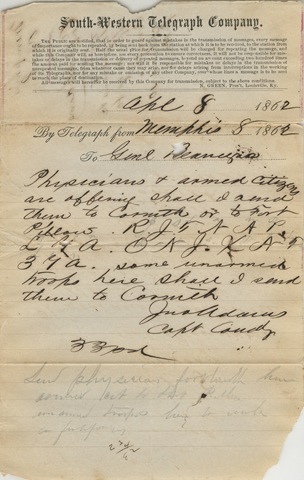
Transcript:

Apl 8, 1862

By Telegram from Memphis 8 1862

To Genl Beauregard

Physicians and armed citizens are offering should I send them to Corinth or Fort Pillow R.J.T.N.A.P.LVA. ONJ.XNTZYA. Some unarmed troops here shall I send them to Corinth.

Jno Adams

Capt. Couldy

33nd


Send physicians forthwith here. Have armed cit to Fort [Rollen?]

unarmed troops here to work on fortifications


Citation: John Adams, telegram to G. T. Beauregard. Memphis, 8 April 1862. AMs 1168/11

April 7, 1862: A.B. Cates telegram to Commander of Post

Pierre Gustave Toutant Beauregard was a Louisiana-born general of the Confederate States Army. He had graduated second in his class from West Point in 1838 and was an admirer of Napoleon. He achieved fame early in the Civil War for commanding the Fort Sumter bombardment and as the victor of the first battle of Manassas. He later served in the Western Theater (including Shiloh and Corinth), Charleston, and the defense of Richmond, but his career was hampered by friction with Jefferson Davis and other generals.

This is one of approximately 1000 military telegrams in P.G.T. Beauregard’s papers at the Rosenbach.

AMs 1168-11 1862-04-07

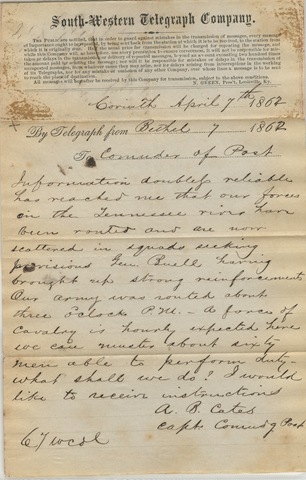
Transcript:

Corinth April 7th 1862

By telegram from Bethel 7 1862

To Commander of Post

Information doubtless reliable has reached me that our forces in the Tennessee River have been routed and are now scattered in squads seeking provisions Gen Buell having brought up strong reinforcements Our army was routed about three o’clock P.M. –a force of cavalry is hourly expected here we can muster about sixty men able to perform duty-what shall we do? I would like to receive instructions.

A.B. Cates

Capt. Commdg Post

67wcol

Citation: A.B. Cates, telegram to Commander of Post. Bethel, 7 April 1862. AMs 1168/11

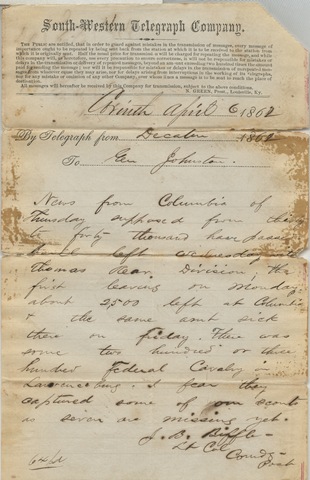
April 6, 1862: J. B. Biffle telegram to Joseph Johnston

Pierre Gustave Toutant Beauregard was a Louisiana-born general of the Confederate States Army. He had graduated second in his class from West Point in 1838 and was an admirer of Napoleon. He achieved fame early in the Civil War for commanding the Fort Sumter bombardment and as the victor of the first battle of Manassas. He later served in the Western Theater (including Shiloh and Corinth), Charleston, and the defense of Richmond, but his career was hampered by friction with Jefferson Davis and other generals.

This is one of approximately 1000 military telegrams in P.G.T. Beauregard’s papers at the Rosenbach.

AMs 1168-11 1862-04-06

Transcript:

Corinth April 6 1862

By Telegraph from Decatur 1862

To Genl Johnston

News from Columbia of Thursday supposed from thirty to forty thousand have passed. [Buell?] left Wednesday with Thomas rear division; the first leaving on Monday about 2,500 left at Columbia & the same amt sick there on Friday. there was some two hundred or three hundred federal cavalry in Lawrenceburg. I fear they captured some of your scouts as seven are missing yet.

J. B. Biffle  

Lt Col

Comdg Post


Citation:J. B. Biffle, telegram to Joseph Johnston. Decatur, Miss.; 6 April 1862. AMs 1168/11

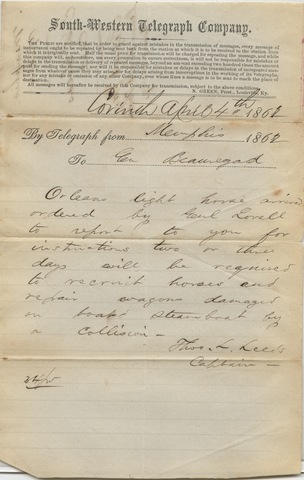
April 4, 1862: Thomas L. Leeds telegram to P. G. T. Beauregard

Pierre Gustave Toutant Beauregard was a Louisiana-born general of the Confederate States Army. He had graduated second in his class from West Point in 1838 and was an admirer of Napoleon. He achieved fame early in the Civil War for commanding the Fort Sumter bombardment and as the victor of the first battle of Manassas. He later served in the Western Theater (including Shiloh and Corinth), Charleston, and the defense of Richmond, but his career was hampered by friction with Jefferson Davis and other generals.

This is one of approximately 1000 military telegrams in P.G.T. Beauregard’s papers at the Rosenbach.

AMs 1168-11 1862-04-04

Transcript:

Corinth April 4th 1862

By telegraph from Memphis 1862

To Gen Beauregard

Orleans light horse arrived ordered by Genl Lovell to report to you you for instructions two or three days will be required to recruit horses and repair wagons damaged on board steamboat by a collision.

Thos. L. Leeds

Captain

34fw


Citation: Thomas L. Leeds, telegram to G. T. Beauregard. Memphis, 4 April 1862. AMs 1168/11

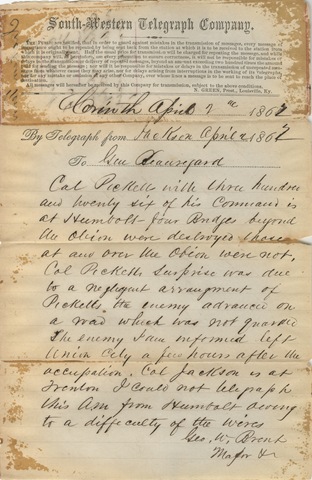
April 2, 1862: George William Brent telegram to P. G. T. Beauregard

Pierre Gustave Toutant Beauregard was a Louisiana-born general of the Confederate States Army. He had graduated second in his class from West Point in 1838 and was an admirer of Napoleon. He achieved fame early in the Civil War for commanding the Fort Sumter bombardment and as the victor of the first battle of Manassas. He later served in the Western Theater (including Shiloh and Corinth), Charleston, and the defense of Richmond, but his career was hampered by friction with Jefferson Davis and other generals.

This is one of approximately 1000 military telegrams in P.G.T. Beauregard’s papers at the Rosenbach.

 AMs 1168-11 1862-04-02

Transcript:

Corinth April 2nd 1862

By telegraph from Jackson April 2nd 1862

To Gen. Beauregard

Col Pickett with three hundred and twenty six of his command is at Humbolt-four bridges beyond the Obion were destroyed those at and over the Obion were not. Col Pickett’s surprise was due to a negligent arrangement of Picketts the enemy advanced on a road which was not guarded. The enemy I am informed left Union City a few hours after the occupation. Col Jackson is at Trenton I could not telegraph this Am from Humbolt arriving owing to a difficulty of the wires.

G. W. Brent

Major


Citation: George William Brent, telegram to G. T. Beauregard. Jackson, Miss; 2 April 1862. AMs 1168/11

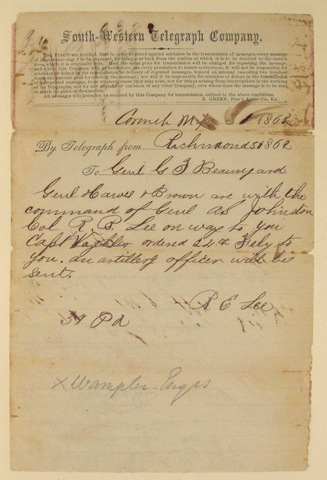
March 31, 1862: Robert E. Lee to P. G. T. Beauregard

Pierre Gustave Toutant Beauregard was a Louisiana-born general of the Confederate States Army. He had graduated second in his class from West Point in 1838 and was an admirer of Napoleon. He achieved fame early in the Civil War for commanding the Fort Sumter bombardment and as the victor of the first battle of Manassas. He later served in the Western Theater (including Shiloh and Corinth), Charleston, and the defense of Richmond, but his career was hampered by friction with Jefferson Davis and other generals.

This telegram is from The Telegraphic History of the Civil War; a compiled album of telegrams to Beauregard from Davis, Lee, Johnston and others.

Telegram 3-31-62 Lee to Beauregard 10 mp

Transcript:

Corinth Miss 31 1862

By Telegraph from Richmond 31 1862

To Genl G T Beauregard

Genl Hawes & Brown are with the command of Genl AS Johnston. Col R. B. Lee on way to you. Capt Waghler ordered 24th July to you. An artillery officer will be sent.

R E Lee

31 Pd

Note: Another hand has crossed out “Waghler” and wrote in pencil at the bottom “Wampler—Engrs,” perhaps the Confederate engineer John Morris Wampler, 1830-1863.


Citation:Robert E. Lee (1807-1870), telegram to G.T. Beauregard. Richmond, 31 March 1862. In The telegraphic history of the Civil War, 1861-1865. AMs 434/16
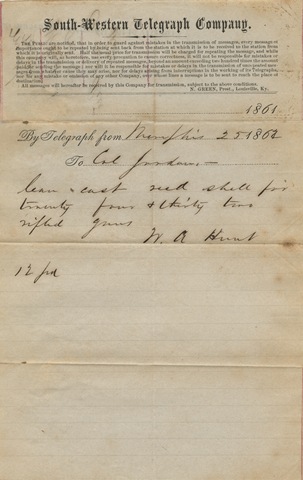
March 25, 1862: W. A. Hunt to Thomas Jordan

Pierre Gustave Toutant Beauregard was a Louisiana-born general of the Confederate States Army. He had graduated second in his class from West Point in 1838 and was an admirer of Napoleon. He achieved fame early in the Civil War for commanding the Fort Sumter bombardment and as the victor of the first battle of Manassas. He later served in the Western Theater (including Shiloh and Corinth), Charleston, and the defense of Richmond, but his career was hampered by friction with Jefferson Davis and other generals.

This is one of approximately 1000 military telegrams in P.G.T. Beauregard’s papers at the Rosenbach.

AMs 1168-11 1862-03-25

  Transcript:

By telegraph from Memphis 25, 1862

To Col. Jordan

[tenn] cast need shell for twenty four & thirty two rifled guns.

W. A. Hunt


Citation:W. A. Hunt, telegram to Thomas Jordan. Memphis; 25 March 1862. AMs 1168/11

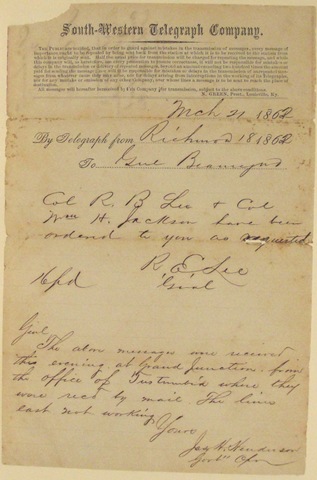
March 21, 1862: Robert E. Lee to P.G.T. Beauregard

Pierre Gustave Toutant Beauregard was a Louisiana-born general of the Confederate States Army. He had graduated second in his class from West Point in 1838 and was an admirer of Napoleon. He achieved fame early in the Civil War for commanding the Fort Sumter bombardment and as the victor of the first battle of Manassas. He later served in the Western Theater (including Shiloh and Corinth), Charleston, and the defense of Richmond, but his career was hampered by friction with Jefferson Davis and other generals.

This telegram is from The Telegraphic History of the Civil War; a compiled album of telegrams to Beauregard from Davis, Lee, Johnston and others.

Telegram 3-21-62 Lee to Beauregard 10 mp

Transcript:

March 21 1862

By Telegraph from Richmond 18 1862

To Genl Beauregard

Col R. B Lee & Col Wm H. Jackson have been ordered to you as requested.

R.E. Lee

Genl


Genl

The above messages were received this evening at Grand Junction from the office of Tustumbia where they were recd by mail. The lines east not working.

Yours

Jas H. Henderon

Gov”t Opr.


Citation:Robert E. Lee (1807-1870), telegram to G.T. Beauregard. 21 March 1862. In The telegraphic history of the Civil War, 1861-1865. AMs 434/16
March 15, 1862: Telegram to Generals Polk and Beauregard

Pierre Gustave Toutant Beauregard was a Louisiana-born general of the Confederate States Army. He had graduated second in his class from West Point in 1838 and was an admirer of Napoleon. He achieved fame early in the Civil War for commanding the Fort Sumter bombardment and as the victor of the first battle of Manassas. He later served in the Western Theater (including Shiloh and Corinth), Charleston, and the defense of Richmond, but his career was hampered by friction with Jefferson Davis and other generals.

This is one of approximately 1000 military telegrams in P.G.T. Beauregard’s papers at the Rosenbach.

AMs 1168-11 1862-03-15

Transcript:

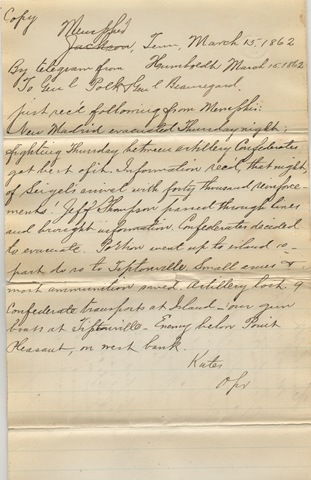
Memphis, Tenn,  March 15. 1862

By telegram from Humboldt March 15, 1862

To Genl Polk + Genl Beauregard

Just sent following from Memphis.

New Madrid evacuated Thursday night

Fighting Thursday between artillery Confederates got best of it

Information read that night of Siegel’s arrival with forty thousand reinforcements Jeff Thompson passed through lines and brought information. Confederates decided to evacuate. Portion went up to island 10 part do so to Tiptonville. Small arms + most ammunition saved. Artillery lost. 9 confederate transports at island our gun boats at Tiptonville. Enemy below Point Pleasant on west Bank.

Kater

Opr

Citation:Kater, telegram to Leonidas Polk and G. T. Beauregard. Humboldt.,15 March 1862. AMs 1168/11