October 30, 1863: Alexander Biddle to Julia Williams Rush Biddle

Alexander Biddle was a member of the prominent Philadelphia Biddle family and was married to Julia Williams Rush,  the granddaughter of Dr. Benjamin Rush.  Biddle served with the 121st Pennsylvania Volunteer Infantry, beginning in September 1862. Starting out as a major, he would participate in Fredericksburg and Gettysburg, among other engagements, and would leave the service as a lieutenant colonel. (He was commissioned, but never mustered, as colonel)
Rush IV-30-36 Oct 30, 1863 p1 A Biddle ALS to JWR Rush IV-30-36 Oct 30, 1863 p2 A Biddle ALS to JWR

Transcript:

Camp at Bristow Station

Oct 30th 1863 Friday

Dear Wife,

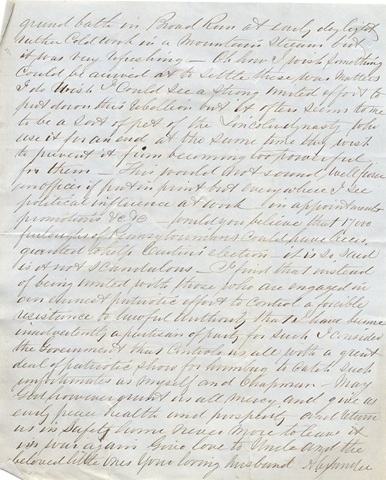
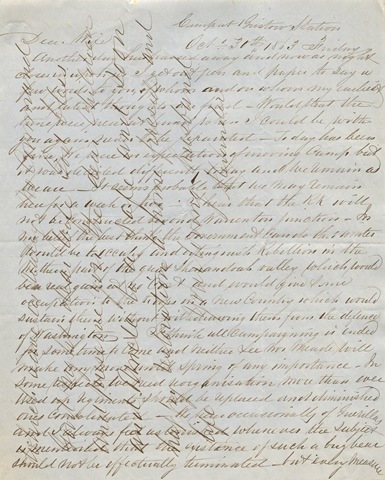
Another day has passed away and now as night closes in upon us I get out pen and paper to say a few words to you, of whom and on whom my earliest and latest thoughts are fixed. Would that the time was near at hand when I could be with you again, never to be separated. Today has been fine, we were in expectation of moving Camp, but it was decided differently today and we remain as we are. It seems probably that we may remain here for a week or two. I hear that the RR will not be constructed beyond Warrenton Junction—In my belief the best thing the Government can do this winter would be to occupy and extinguish Rebellion in the Northern part of the great Shenandoah valley which would be a real gain at no cost and would give some occupation to the troops in a new country which would sustain them without withdrawing them from the defence of Washington. I think all campaigning is ended for some time to come and neither Lee nor Meade will make any move until spring of any importance. In some respects we need reorganisation more than ever. Used up regiments should be replaced and diminished ones consolidated. We hear occasionally of Guerillas and I always feel astonished whenever the subject is mentioned that the existence of such a bugbear should not be effectually terminated—but every measure of war in this army has its political reason as well as its military one. I would be glad to see a little power in the hands of some driving soldier who would carry on war for a month without regard to politics. I think he might bring about a healthy change of sentiment in the South. We ought to fight them now exactly as we would fight English, French or Spaniards.

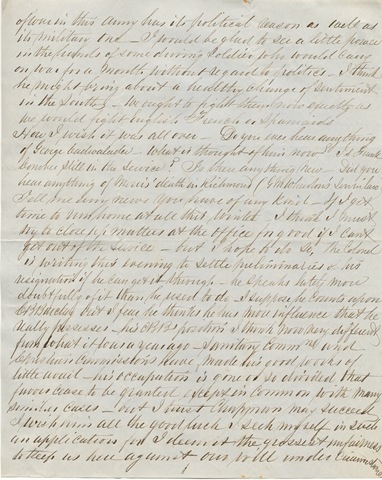
How I wish it was all over— Do you ever hear anything of George Cadwalader— What is thought of him now? Is Frank Conover still in the service? Is there anything new—Did you hear anything of Morris’ death in Richmond (GM Wharton’s son in law) Tell me any news you have of any kind—if I get time to run home at all this Winter— I think I must try to close up matters at the office for good if I can’t get out of the service—but I hope to do so. The Colonel is writing this evening to settle preliminaries of his resignation if he can get it through—he speaks lately more doubtfully of it than he used to do. I suppose he counts upon CB Barclay but I fear he thinks he has more influence that he really possesses- his CBB position I think now very different from what it was a year ago. Sanitary Comm and Christian commissions have made his good works of little avail—his occupation is gone on so divided that favors cease to be granted except in common with many similar cases—but I trust Chapman may succeed. I wish him all the good luck I seek myself in such a application for I deem it the grossest unfairness to keep us here against our will under circumstances which have us really no command. Good night dear Wife, God bless and preserve you, the dear children and Uncle to a safe and soon happy restoration to home fireside and life.

Your loving husband,

Alexander

Citation: Alexander Biddle (1819-1899), autograph letter signed to Julia Williams Rush Biddle, 30 October 1863. Rush IV:30:36

October 28, 1863: Alexander Biddle to Julia Williams Rush Biddle

Alexander Biddle was a member of the prominent Philadelphia Biddle family and was married to Julia Williams Rush,  the granddaughter of Dr. Benjamin Rush.  Biddle served with the 121st Pennsylvania Volunteer Infantry, beginning in September 1862. Starting out as a major, he would participate in Fredericksburg and Gettysburg, among other engagements, and would leave the service as a lieutenant colonel. (He was commissioned, but never mustered, as colonel)

Rush IV-30-36 Oct 28, 1863 p1 A Biddle ALS to JWR Rush IV-30-36 Oct 28, 1863 p2 A Biddle ALS to JWR

Transcript (excerpt):

Camp at Bristow Station

Wednesday October 28th, 1863

Dear Wife,

I have had no letter from you today. We are still at this point and the movement of the army is yet uncertain as far as we know. I hardly know what to say to you—We are under orders to be ready to move and are so, but no indication of it which affects us has yet appeared. The nights have become quite cold- this morning we had about the fifth of an inch of ice covering our water bucket which had been exposed since the evening before. We have no intimation of winter quarters as yet but if this weather continues I think our leader must think of it. The RR which supplies the Corps lying at Warrenton has to wagon about 10 miles from Gainesville. You told me in one of your recent letters that Gen McCall spoke to you of me. Please remember me to all friends. I wish I could only get home to be with you again. I do think there is so much political maneuvering in this army that I sometimes think very hardly of it. I cannot but think that I see the hand of Providence in almost every step we take and that all our efforts are but vanity without his aid. Of course it must and always is so—but there is no possibility of supposing with so much apparent folly always before our eyes that any thing but interposition can shield us from evil. In other words I think and believe that the army is little better than a political machine and that Jeff Davis with his despotic power- knowledge of educated officers and military requirements has really less to encounter than we believe when the vast material and expenditure we have wasted is considered. Chapman a few moments since said to me– I really believe excepting this (our) regiment every superior and inferior commander above and below me is liable to the charge of being a drinker. So it is. Can you credit it [?]. Is it not shocking [?]. Chapman soon makes his effort to go home and hopes to succeed. We will see . I hope I shall soon follow- May God grant us a speedy return to peace and a settlement of all our troubles with a safe return to home. You cannot conceive how I long for that time to come—when I may lay aside all thoughts of war and military matters and again turn to the quiet thoughts of peace and home affairs. How the dear little ones must have grown and changed—I oftentimes think of dear Aleck and the chills—how I wish I could be with him and go over our lessons together as I used to do. I think now of that as an entertainment of which I know nothing to surpass. May God bless you dear wife and mercifully lead me soon back to you and put an end to our absence. Kiss the dear children and give love to Uncle and all at home. Your loving husband,

Alexander

I must tell you a story of one of our officers who was wounded in the foot and taken prisoner in a house at Gettysburg. A Mississippi officer came in and demanded his sword, which he gave, but the officer demanded his belt too which he objected to as robbery but had to assent to—he however spoke of the circumstance next day to two Georgia officers and pointed out the Mississippian who happened to approach at the time—they both upbraided him and finally pummeled him for so doing—The same officer two days after saw the Union skirmishes enter the town and having remembered that a North Carolina Colonel had taken up his quarters next door, he although wounded in the foot hastened in to him and demanded his sword, taking him prisoner and replacing his captured weapon by the Colonel’s—Was not this pretty well done—

Citation: Alexander Biddle (1819-1899), autograph letter signed to Julia Williams Rush Biddle, 28 October 1863. Rush IV:30:36
October 27, 1863: Alexander Biddle to Julia Williams Rush Biddle

Alexander Biddle was a member of the prominent Philadelphia Biddle family and was married to Julia Williams Rush,  the granddaughter of Dr. Benjamin Rush.  Biddle served with the 121st Pennsylvania Volunteer Infantry, beginning in September 1862. Starting out as a major, he would participate in Fredericksburg and Gettysburg, among other engagements, and would leave the service as a lieutenant colonel. (He was commissioned, but never mustered, as colonel)

Rush IV-30-36 Oct 27, 1863 p1 A Biddle ALS to JWR Rush IV-30-36 Oct 27, 1863 p2 A Biddle ALS to JWR

Transcript:

Camp at Bristow Station

October 27th 1863 Tuesday

Dear Wife,

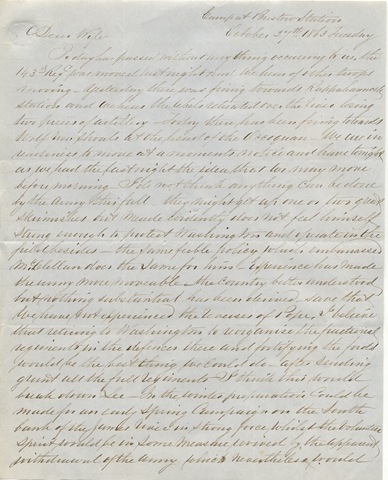
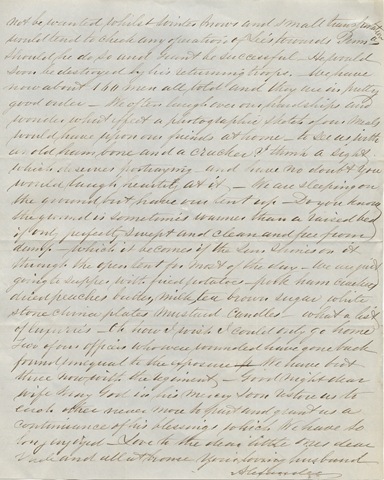
Today has passed without anything occurring to us, the 143rd Reg. was moved last night and we hear of other troops moving. Yesterday there was firing towards Rappahannock Station and we knew the Rebels retreated over the river losing two pieces of artillery. Today there has been firing towards Wolf Run shoals at the head of the Occiquan. We are in readiness to move at a moment’s notice and have tonight as we had the last night the idea that we may move before morning. I do not think anything can be done by the army this fall—they might get up one or two great skirmishes but Meade evidently does not feel himself strong enough to protect Washington and operate in the field besides—the same feeble policy which embarrassed McClellan does the same for him. Experience has made the army more moveable- the Country better understood but nothing substantial has been derived—save that we have not experienced the reverses of Pope. I believe that retiring to Washington to reorganise the fractioned regiments in the defenses there and fortifying the fords would be the best thing we could do—after sending Grant all the full regiments. I think this would back down Lee. In the winter preparation could be made for an early spring campaign on the South bank of the James river in strong force whilst the volunteer spirit would be in some measure revived by the apparent withdrawal of the army which nevertheless would not be wanted whilst winter snows and small [transportation?] would tend to check any operations of Lee’s towards Penn. Should he do so and Grant be successful he would soon be destroyed by his returning troops. We have now about 160 men all told and they are in pretty good order. We often laugh over our hardships and wonder what effect a photographic shot of our meals would have upon our friends at home—to see us with an old ham bone and a cracker I think a sight which deserves portraying—and have no doubt you would laugh heartily at it. We are sleeping on the ground but have our tent up. Do you know the ground is sometime warmer than a raised bed if only perfectly swept and clean and free from damp—which it becomes if the sun shines on it through the open tent for most of the day. We are just going to supper with fried potatoes, pork ham crackles, dried peaches, butter, milk, tea, brown sugar, white stone china plates, mustard, candles- what a list of luxuries. Oh how I wish I could only go home. Two of our officers who were wounded have gone back. Found unequal to the exposure. We have but three now with the regiment—Good night dear wife, may God in his mercy soon restore us to each other never more to part and grant us a continuance of his blessings which we have so long enjoyed. Love to the dear little ones dear Uncle and all at home.

Your loving husband,

Alexander

Citation: Alexander Biddle (1819-1899), autograph letter signed to Julia Williams Rush Biddle, 27 October 1863. Rush IV:30:36

October 26, 1863: Alexander Biddle to Julia Williams Rush Biddle

Alexander Biddle was a member of the prominent Philadelphia Biddle family and was married to Julia Williams Rush,  the granddaughter of Dr. Benjamin Rush.  Biddle served with the 121st Pennsylvania Volunteer Infantry, beginning in September 1862. Starting out as a major, he would participate in Fredericksburg and Gettysburg, among other engagements, and would leave the service as a lieutenant colonel. (He was commissioned, but never mustered, as colonel)

Rush IV-30-36 Oct 26, 1863 p1 A Biddle ALS to JWR Rush IV-30-36 Oct 26, 1863 p2 A Biddle ALS to JWR

Transcript:

Camp near Bristow Station

Monday October 26th, 1863

Dear Wife,

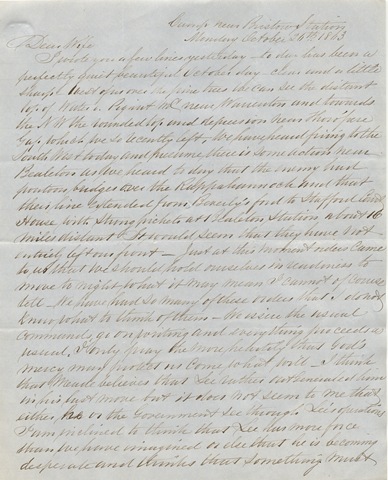
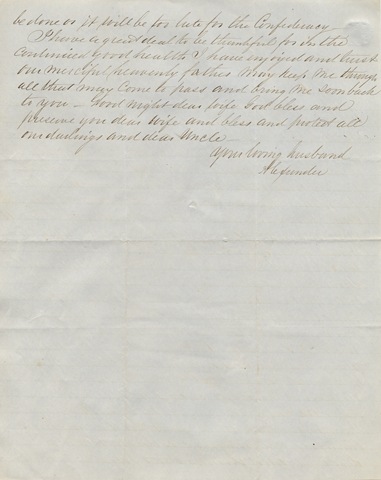
I wrote you a few lines yesterday—today has been a perfectly quiet beautiful October day—clear and a little sharp. West of us over the pine trees we can see the distant tops of Waters [& ?] Pignut Mt near Warrenton and towards the NW the rounded top and depression near Thorofare Gap, which we so recently left. We have heard firing to the South West today and presume there is some action near Bealeton, as we heard to day that the enemy had pontoon bridges over the Rappahannock and that their line extended from Beverly’s ford to Stafford Court House with strong pickets at Bealeton Station about 16 miles distant. It would seem that they have not entirely left our front. Just at this moment order came to us that we should hold ourselves in readiness to move to night. What it may mean I cannot of course tell—We have had so many of these orders that I do not know what to think of them. We issue the usual commands, go on writing and everything proceeds as usual. I only pray the more heartily that God’s mercy may protect us come what will. I think that Meade believes that Lee rather outgeneraled him in his last move but it does not seem to me that either he or the Government see through Lee’s operations. I am inclined to think that Lee has more forces that we have imagined or else that he is becoming desperate and thinks that something must be done or it will be too late for the Confederacy. I have a great deal to be thankful for in the continued good health I have enjoyed and trust our merciful heavenly father may keep me through all that may come to pass and bring me soon back to you—Good night dear wife. God bless and preserve you dear wife and bless and protect all our darlings and dear Uncle—

Your loving husband,
Alexander

Citation: Alexander Biddle (1819-1899), autograph letter signed to Julia Williams Rush Biddle, 26 October 1863. Rush IV:30:36
October 25, 1863: Alexander Biddle to Julia Williams Rush Biddle

Alexander Biddle was a member of the prominent Philadelphia Biddle family and was married to Julia Williams Rush,  the granddaughter of Dr. Benjamin Rush.  Biddle served with the 121st Pennsylvania Volunteer Infantry, beginning in September 1862. Starting out as a major, he would participate in Fredericksburg and Gettysburg, among other engagements, and would leave the service as a lieutenant colonel. (He was commissioned, but never mustered, as colonel)

Rush IV-30-36 Oct 25, 1863 p1 A Biddle ALS to JWR Rush IV-30-36 Oct 25, 1863 p2 A Biddle ALS to JWR

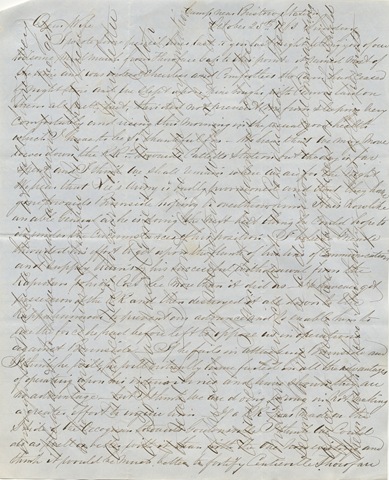
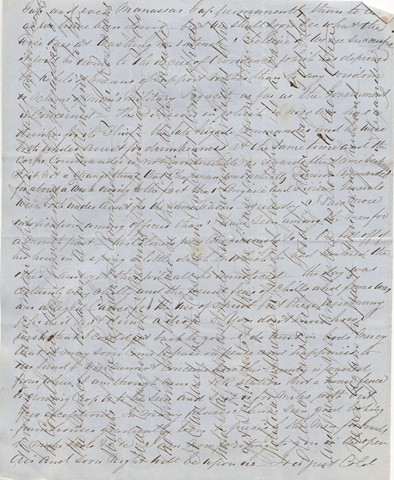
Transcript:

Camp near Bristow Station

October 25th 1863 Sunday

Dear Wife,

I wrote some pencil lines last to you last night telling you of our toilsome mud march from Thorofare Gap to this point. It rained most of the time and was indeed cheerless and comfortless. The rain had ceased by night time and we slept upon pine boughs with canvas laid on them, all pretty wet. This did not prevent me from sleeping very comfortably and rising this morning in the usual good health which I have to be so thankful for. We hear that we may move lower down the RR towards Catletts Station, but the day is far spent and I think we shall remain where we are for the night. We hear that Lee’s army is badly provisioned and that they have gone towards Burnside hoping to overthrow him. He is now like an able General as he is doing the next best thing he could hope to do under the circumstances of his position. I believe Meade thwarted his effort to get upon the flank of his line of Communication and supply trains by his successful withdrawal from the Rapidans which cost Lee more than it did us. He however got possession of the RR and then destroyed it all down to the Rappahannock to prevent our advance and so enable him to use the force he had before left to oppose us in operations against Burnside. If he fails in attacking Burnside, and I think he will, he will virtually have failed in all the advantages of operating upon his interior lines and have shown they are no advantage- but I think we are doing wrong in not making a greater effort to injure him. If a RR was made on the S side of the Occoquan towards Gordonsville I think we could do as well or better with it than with the one now existing and think it would be much better to fortify Centreville, Thorofare Gap, and even Manassas Gap permanently than to do as we have been doing—but we shall see what the wise ones at Washington intend. I believe if we are successful it will be owing to the decree of Providence which has deprived the Rebels of means of support rather than to any wisdom or scheme of man’s military sagacity as far as the Government is concerned. The Division in which I know am has a drinker for its Chief- the late Brigade commander and he were both under arrest for drunkenness at the same time and the corps commander is not invulnerable as regards the same weakness. Is it not a strange thing that Chapman was actually Division Commander for about a week owing to the fact that Brigade and Division Generals were both under arrest for the same reason- Yesterday I saw more intoxication among officers than I have seen among the men for a month past- two Colonels were conspicuously so- One fell off of his horse in leaping a little ditch to which he had [bantered?] the other- and yet this will all be unnoticed. The day was certainly very chilly and the usual fear of chills and fever was an alleged cause for the use of spirit but there were many who did not drink a drop. You don’t know how I wish that I could get back to you. I do trust in God’s mercy that it may soon come to pass in peace and happiness to our land- You cannot conceive how this country is wasted from where I am though near a RR station not a house fence or growing crop is to be seen and so it is for miles with but few exceptions. In many places I have seen good looking farmhouses gradually torn to pieces by the men for boards to make beds etc etc. I am now writing to you in the open air and soon night will be upon us. It is just cold enough to make a fire at all times very pleasant to have near at hand. We get to be connoisseurs of timber now that there are no fence rails to burn up. Your letter of 20th has just come in and I stop to read it. I don’t give up my intention of pressing my resignation when I see any chance—I am not an admirer of the military service as it is conducted. There seems to me to be a disposition in all commanding officers to screen their staff officers or rather shield them with their authority- this often permits ignorant young men who hold staff appointments to consult their own convenience in the prejudice of the service by delaying and not attending to the wants of the Regimental commander. I see Rosecrans was charged with screening his subordinates. I do not think this will ever be the case with Meade. It can rarely be the case when competent army officers hold staff appointments but ignorant civilians who get such posts for the sake of ease and name through political influence or personal friendship do a vast deal of mischief. Goodbye dear wife. God bless and preserve you and restore us soon to each other never again to part. Your loving husband,

Alexander

Citation: Alexander Biddle (1819-1899), autograph letter signed to Julia Williams Rush Biddle, 25 October 1863. Rush IV:30:36
October 24, 1863: Alexander Biddle to Julia Williams Rush Biddle

Alexander Biddle was a member of the prominent Philadelphia Biddle family and was married to Julia Williams Rush,  the granddaughter of Dr. Benjamin Rush.  Biddle served with the 121st Pennsylvania Volunteer Infantry, beginning in September 1862. Starting out as a major, he would participate in Fredericksburg and Gettysburg, among other engagements, and would leave the service as a lieutenant colonel. (He was commissioned, but never mustered, as colonel)

Rush IV-30-36 Oct 24, 1863 p1 A Biddle ALS to JWR

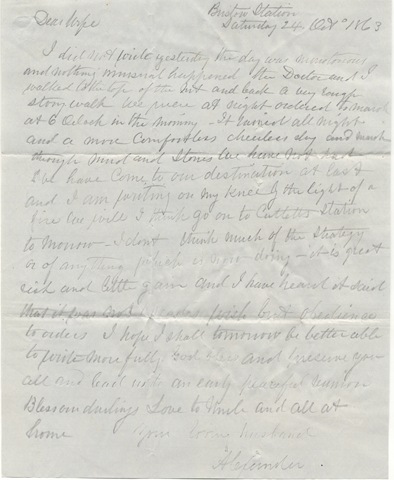
Transcript:

Bristow Station

Saturday 24 Oct 1863

Dear Wife,

I did not write yesterday. The day was monotonous and nothing unusual happened. The Doctor and I walked to the top of the Mt. and back, a very long tough stony walk. We were at night ordered to march at 6 o’clock in the morning. It rained all night and a more comfortless, cheerless day and march through mud and stones we have not had. We have come to our destination at last and I am writing on my knee by the light of a fire. We will I think go on to Catlett’s Station tomorrow. I don’t think much of the strategy or of anything which is our doing—it is great risk and bitter gain and I have hear it said that it was not Meade’s wish but obedience to orders. I hope I shall tomorrow be better able to write more fully. God bless and preserve you all and lead with an early peaceful reunion. Bless our darlings, Love to Uncle and all at home, Your loving husband,

Alexander

Citation: Alexander Biddle (1819-1899), autograph letter signed to Julia Williams Rush Biddle, 24 October 1863. Rush IV:30:36
October 22, 1863: Alexander Biddle to Julia Williams Rush Biddle

Alexander Biddle was a member of the prominent Philadelphia Biddle family and was married to Julia Williams Rush,  the granddaughter of Dr. Benjamin Rush.  Biddle served with the 121st Pennsylvania Volunteer Infantry, beginning in September 1862. Starting out as a major, he would participate in Fredericksburg and Gettysburg, among other engagements, and would leave the service as a lieutenant colonel. (He was commissioned, but never mustered, as colonel)

Rush IV-30-36 Oct 22, 1863 p1 A Biddle ALS to JWR Rush IV-30-36 Oct 22, 1863 p2 A Biddle ALS to JWR

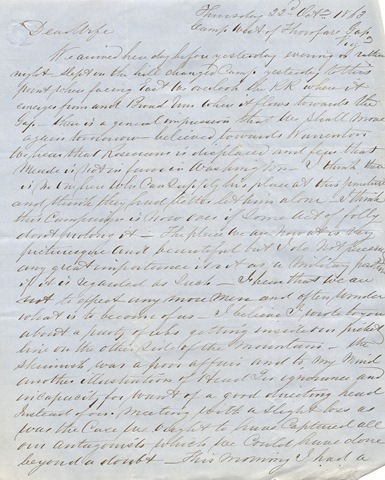
Transcript:

Thursday 22 Oct 1863

Camp West of Thorofare Gap, Virg.

Dear Wife,

We arrived here day before yesterday evening or rather night. Slept on the hill, changed camp yesterday to this point where facing East we overlook the RR where it emerges from and Broad run where it flows towards the Gap. There is a general impression that we shall move again tomorrow- believed towards Warrenton. We hear that Rosecrans is displaced and fear that Meade is not in favor in Washington- I think there is no one here who can supply his place at this juncture and think they had better let him alone. I think this campaign is now over if some act of folly don’t prolong it. The place we are now at is very picturesque and beautiful but I do not perceive any great importance in it as a military position if it is regarded as such. I hear that we are not to expect any more men and wonder what is to become of us. I believe I wrote to you about a party of Rebs getting inside our picket line on the other side of the mountains- the skirmish was a poor affair and to my mind another illustration of Head Qts ignorance and incapacity for want of a good directing head Instead of our meeting with a slight loss as was the Case we ought to have captured all our antagonists which we could have done beyond a doubt—This morning I had a grand bath in Broad Run at early daylight. Rather cold work in a mountain’s stream but it was very refreshing- Oh how I wish something could be arrived at to settle these war matters. I do wish I could see a strong united effort to put down this rebellion, but it often seems to me to be a sort of pet of the Lincoln dynasty who use it for an end at the same time they wish to prevent it from becoming too powerful for them. This would not sound well from an officer if put in print, but everywhere I see political influence at work—in appointments, promotions, etc. etc.—Would you believe that 17,000 furloughs of Pennsylvanians could have been granted to help Curtin’s election—it is so, said is it not scandalous—I find that instead of being united with those who are engaged in an earnest patriotic effort to control a forcible resistance to lawful authority, that I have become inadvertently a partisan of party for such I consider the Government thus controls us all with a great deal of patriotic show for humbug to catch such unfortunates as myself and Chapman—May God however grant us all mercy and give us early peace, health and prosperity, and return us in safety home never more to leave it in war again. Give love to Uncle and the beloved little ones. Your loving husband, Alexander

Citation: Alexander Biddle (1819-1899), autograph letter signed to Julia Williams Rush Biddle, 22 October 1863. Rush IV:30:36
October 21, 1863: Alexander Biddle to Julia Williams Rush Biddle

Alexander Biddle was a member of the prominent Philadelphia Biddle family and was married to Julia Williams Rush,  the granddaughter of Dr. Benjamin Rush.  Biddle served with the 121st Pennsylvania Volunteer Infantry, beginning in September 1862. Starting out as a major, he would participate in Fredericksburg and Gettysburg, among other engagements, and would leave the service as a lieutenant colonel. (He was commissioned, but never mustered, as colonel)

Rush IV-30-36 Oct 21 1863 p1 A Biddle ALS to JWR Rush IV-30-36 Oct 21 1863 p2 A Biddle ALS to JWR

Transcript:

Wednesday 21 Oct 1863

West of Thorofare Gap

Dear Wife,

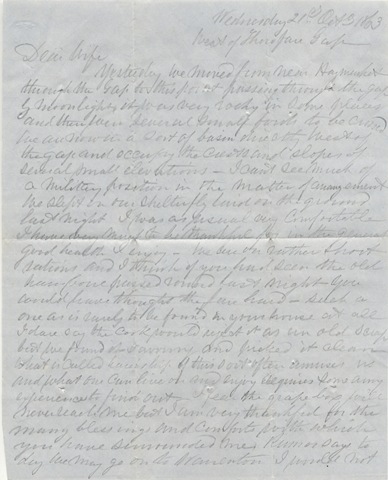
Yesterday we moved from near Haymarket through the Gap to this point, passing through the gap by moonlight, it was very rocky in some places and there were several small fords to be crossed. We are now in a sort of basin west of the gap and occupy the crests and slopes of several small elevations. I can’t see much of a military position in the matter of arrangement. We slept on the shelter fly laid on the ground last night. I was as usual very comfortable. I have very much to be thankful for in the general good health I enjoy. We are on rather short rations and I think if you had seen the old hambone passed around last night you would have thought the fare hard- such a one as is rarely to be found in your house at all. I dare say the cook should reject it as an old scrap but we found it savory and picked it clean. What is called hardship of this sort often amuses us and what we can live on and enjoy requires some army experience to find out. I fear the grape box will never reach me but I am very thankful for the many blessings and comforts with which you have surrounded me. Rumor says to day we may go on to Warrenton. I would not be surprised if Lee had entirely withdrawn West of the Blue Ridge intending to advance in force if Meade came away moderately far from Centreville- He seems inclined to do so. I am most heartily sick of this backwards and forwards sham fighting. It would be far better to reorganize, strengthen, and drill the Army near Washington and then move rapidly and decidedly than to take up positions at a distance from our point of supplies before a point naturally defensible and easily rendered impregnable but such is the usual policy of Commanders. I should be glad to see Lincoln call for 500,000 men instead of 300,000. One in the Army can hardly be a believer in strenuous military excitation to end the war when the labors of the Washington diplomats seem to be devoted to every thing else but keeping up the force of the Regiments. Know that no attention has been given to our representations in regards to our position- they seem again to weaken themselves by permitting officers to retire- too much taken up with the spoils of office to do anything to make the service effective. Goodbye dear wife, In hopes God will so will it that I may return at an early day to you, never again to part. Kiss and bless my little darlings for me and grant us an early return to each other. Love to Uncle and all at home. Scribbling on my haversack sitting in the sunshine in the field on top of a high hill, Your loving husband, Alexander

Citation: Alexander Biddle (1819-1899), autograph letter signed to Julia Williams Rush Biddle,  21 October 1863. Rush IV:30:36

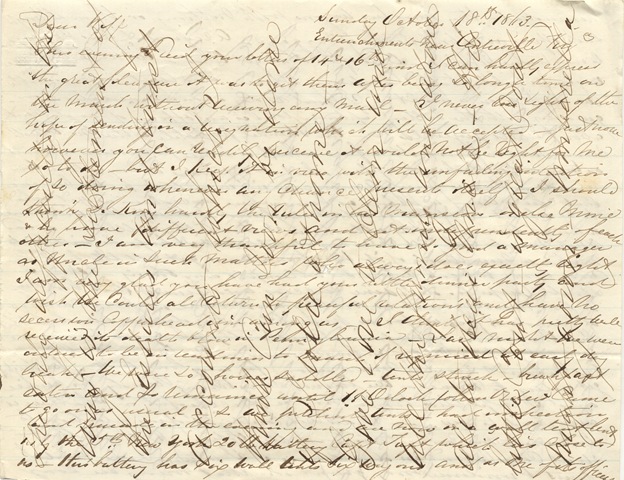
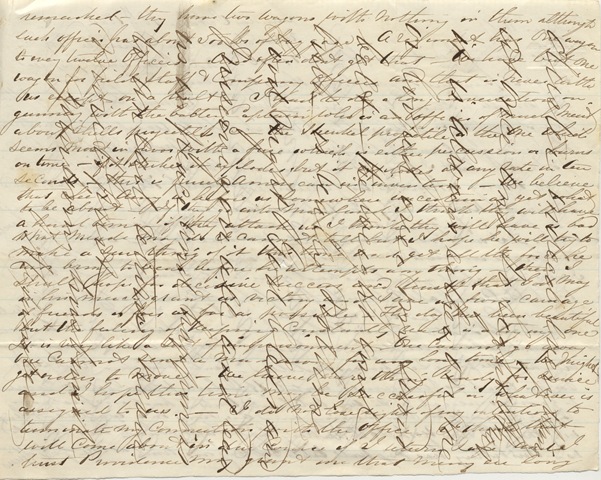
October 18, 1863: Alexander Biddle to Julia Williams Rush Biddle

Alexander Biddle was a member of the prominent Philadelphia Biddle family and was married to Julia Williams Rush,  the granddaughter of Dr. Benjamin Rush.  Biddle served with the 121st Pennsylvania Volunteer Infantry, beginning in September 1862. Starting out as a major, he would participate in Fredericksburg and Gettysburg, among other engagements, and would leave the service as a lieutenant colonel. (He was commissioned, but never mustered, as colonel)

Rush IV-30-36 Oct 18, 1863 p1 A Biddle ALS to JWR Rush IV-30-36 Oct 18, 1863 p2 A Biddle ALS to JWR

Transcript:

Sunday October 18th 1863

Entrenchments near Centerville Virg

Dear Wife,

This evening I read your letters of 14th and 16th and I can hardly express the great pleasure it was to get them after being so long a time on the march without receiving any mail. I never lose sight of the hope of sending in a resignation which will be accepted. Just now however you can readily perceive it would not be right for me to do so­—but I keep it in view with the unfading intention of so doing whenever any chance presents itself. I should think Dr. King hardly the ruler in his mansion, or else Mme and he have different views and got independently of each other. I am very thankful to have so good a manager as Uncle in such matters, who always does exactly right. I am very glad you have had your little dinner party and wish we could all return to peaceful relations and have no secession Copperheadism among us. I think it has pretty well received its death blow in Pennsylvania- Last night we were ordered to be in readiness to march if required at early day break. We were 20 horses saddled- tents stuck- breakfast eaten and so remained until 11 O’clock when orders came to go on as usual. So we pitched tents, had inspection, and parade in the evening and are now in a wall tent lent us by the 5th New York 20th Battery Capt Taft which is close to us- His battery has six wall tents six wagons and as one first Officer remarked- they have two wagons with nothing in them although each officer has about 500 lbs of baggage. A regiment has one wagon to every twelve officers and often don’t get that. We have but one wagon for field staff and Company officers and that is never with us except on a halt. I had today a long conversation on gunnery with the battery Captain who is an officer of much meat about shells projectiles, &c. The Shenkel projectile is the one which seems most in favor with a fuse which is either percussion or burns on time- if it strikes it explodes but it explodes at any rate in ten seconds. This is pretty American in its invention- We believe that Lee’s army is before us somewhere uncertain as yet what to be about. If they go into Maryland I think they will have a hard time- if they attack us I think they will have as bad. What Meade may do I cannon tell but I hope he will try to make a sure thing of it this time and get all the force he can bring to bear before he attempts anything. Then I shall hope for decisive success and trust that God may in his mercy grant us victory and save us from carnage of friends or foes as far as possible. The day has been beautiful but the feeling of keeping constantly ready is a trying one. Is it very like a bout of imprisonment– one cannot go away, one cannot send a Man away for any long time. We might get orders to move- we leave everything ready for service and I hope this time may be successful in whatever is assigned to us. I do not lose sight of my intention to terminate my connection with the office. I think that will come about in a due course if I return safe and I trust Providence may grant me that mercy ere long.

The only difficulty in the way is the Southernmost of the estates and trust accounts which I think can soon be done if I were at home- Give love to Clem and all the family and above all to dear Uncle- His little coat is great coat night gown, umbrella, duster, indeed everything at once and so light that it is always either on me or looped over my sword belt. The weight and bulk is really nothing. Good night God bless and preserve you all and lead us in peace and happiness to an early return never more to part.

Your Loving Husband,

Alexander

Citation: Alexander Biddle (1819-1899), autograph letter signed to Julia Williams Rush Biddle, 18 October 1863. Rush IV:30:36

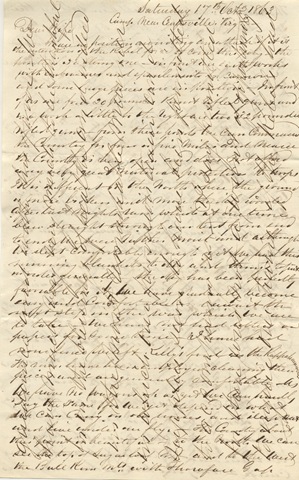
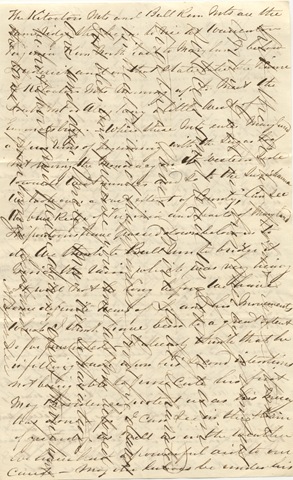
October 17, 1863: Alexander Biddle to Julia Williams Rush Biddle

Alexander Biddle was a member of the prominent Philadelphia Biddle family and was married to Julia Williams Rush,  the granddaughter of Dr. Benjamin Rush.  Biddle served with the 121st Pennsylvania Volunteer Infantry, beginning in September 1862. Starting out as a major, he would participate in Fredericksburg and Gettysburg, among other engagements, and would leave the service as a lieutenant colonel. (He was commissioned, but never mustered, as colonel)

Rush IV-30-36 Oct 17, 1863 p1 A Biddle ALS to JWR Rush IV-30-36 Oct 17, 1863 p2 A Biddle ALS to JWR

Transcript:

Saturday 17th Oct 1863

Camp near Centerville, Virg

Dear Wife,

We are in positions awaiting an attack if it is the intentions of the Rebel force to come this way—The position is a strong one- in front are earth works with embrasures and epaulements for cannons and some large pieces are in position. In front of us are four 20 pounders, Parrot rifle guns and in a wood a little to the right are two 32 pounder rifle guns- from these points We can command the country for as far as five miles and nearer the country is very open and does not afford any very great material protection to troops. It is different to the North where the ground is more broken and more thickly wooded. After last night’s storm which at one time blew straight through our tent from end to end we were rather moist and although we slept comfortably enough yet we had this morning blankets to dry and things to put in order generally. The day has been perfectly favorable for it, we have gradually become easy and comfortable and await the next step in the war which we are to take. We have not had letters or papers for some time. I have had none since we left Kelly’s ford on the Rappahannock. The men have been employed cleaning their pieces and are generally comfortable. As we have no wagons as yet, we can hardly say the same for we yet depend on what we can carry on our  horses and  sleep sit and live under our fly. The country about this point is beautiful. To the North we can see the top of Sugarloaf Mt. and to the west the Bull Run Mts with Thorofare Gap, the Ketocton Mts and Bull Run Mts all the same ridge they begin to rise at Warrenton Virginia run North East to Maryland before Frederick and in that state take the name of Ketocton Mts running up to meet the South Mt or Allegheny a little west of Emmetsburg. Where these Mts enter Maryland [a ?? turns of] beginning  with the Sugarloaf Mt, having the Monocacy on the western side towards Westminster and so to the Susquehanna we look over a vast extent of country. Can see the Blue ridge of Virginia and parts of Maryland  The pontoons have passed down below us to day, we think to Bull Run to bridge it Since the rain which was very heavy. It will not be long before we have some defense because of Lee and his movements which I think have been to a great extent so far frustrated- I already think that he is falling back upon his second intentions not being able to  prosecute his first. May providence protect us as his mercy has done- for I can see in this storm of yesterday as well as with weather we have had a powerful aid to our cause. May our labors be under his guidance and with his favor. We have much very very much to be thankful for in the blessings of health and indeed in the most remarkable manner in which our provision train and supplies seem to have been permitted to accompany us. I say permitted for there was not a want of opportunity to injure our trains if the Rebels had hit the right point and time. May God in his mercy grant us success and lead us soon again together, never more to be separated in health and happiness. Good bye dearest, God bless and preserve you and all my beloved ones and dear Uncle. May our separation be but short and peace again exist throughout the land.

Your loving husband,

Alexander

Citation: Alexander Biddle (1819-1899), autograph letter signed to Julia Williams Rush Biddle, 17 October 1863. Rush IV:30:36