November 11, 1863: Alexander Biddle to Julia Williams Rush Biddle

Alexander Biddle was a member of the prominent Philadelphia Biddle family and was married to Julia Williams Rush,  the granddaughter of Dr. Benjamin Rush.  Biddle served with the 121st Pennsylvania Volunteer Infantry, beginning in September 1862. Starting out as a major, he would participate in Fredericksburg and Gettysburg, among other engagements, and would leave the service as a lieutenant colonel. (He was commissioned, but never mustered, as colonel)
Rush IV-30-37 Nov 11 p 1 A Biddle ALS to Julia William Rush Rush IV-30-37 Nov 11 p 2&3 A Biddle ALS to Julia William Rush Rush IV-30-37 Nov 11 p 2&3 A Biddle ALS to Julia William RushRush IV-30-37 Nov 11 p 4 A Biddle ALS to Julia William Rush

Transcript:

Camp at Cedar Run Ridge

Hd Qts 121st SPV

Wednesday, Nov. 11, 1863

Dear Julia,

Today I got your letter of 7th, which I received with great joy as I always do. I was too glad to hear of Myra and her family. I think Blair is right in opposing the Radical abolition party which I see now gets the name of Charcoal. I see by the paper that it was Stuart’s Cavalry which attacked our pickets near Thoroghfare Gap and that it was his men which were directly in our front. You have my letter which mentions the report of part of the 7th Maryland being captured on that night. The whisky-blackberry cordial and the little flask are all safe, as yet unused in my bags. I do not think that I have touched spirituous liquor since I came back to camp, excepting perhaps two glasses of ale which we one day had. I have been very anxious to see the various reports of the Generals of the Gettysburgh battle and hope they may soon come out. We still have stories of guerillas or prowling parties of the enemy’s marauding cavalry. […] I should be very glad to see some definitive decisions result and pray that God may soon grant it to us. You know next year will be the canvas for the next president and the election will in November. I always dread any political combinations with army movements which they are sure to embarrass and and hope none will arise. Good bye dear wife God bless, preserve and keep you and my beloved ones to a safe return to each other. Give love to Uncle and kiss all my darlings for me. Good night again dear wife. Your loving husband,

Alexander

Citation: Alexander Biddle (1819-1899), autograph letter signed to Julia Williams Rush Biddle,11 November 1863. Rush IV:30:37

November 9, 1863: Alexander Biddle letter to Julia Williams Rush Biddle

Alexander Biddle was a member of the prominent Philadelphia Biddle family and was married to Julia Williams Rush,  the granddaughter of Dr. Benjamin Rush.  Biddle served with the 121st Pennsylvania Volunteer Infantry, beginning in September 1862. Starting out as a major, he would participate in Fredericksburg and Gettysburg, among other engagements, and would leave the service as a lieutenant colonel. (He was commissioned, but never mustered, as colonel)Rush IV-30-37 Nov 9 p1 A Biddle ALS to Julia William Rush

Rush IV-30-37 Nov 9 p 2&3 A Biddle ALS to Julia William Rush Rush IV-30-37 Nov 9 p 2&3 A Biddle ALS to Julia William Rush

Rush IV-30-37 Nov 9 p 4 A Biddle ALS to Julia William Rush

Transcription:

Camp at Cedar Run Bridge near Catlett

Monday Nov 9th 1863

Dear Wife,

The mail soon goes out and I write in a great hurry to send this by it. I yesterday got your letter and [Nannies?] You need not fear dear wife any less feeling on the subject of [Sunday than?] you have found in me. I should be little profited and very insensible to the mercy of our heavenly father if I should not feel and perceive his merciful guardianship in every day of my life. Not only in every day but in scenes of danger where others have been swept away for all I know as good in his eyes as can be. I trust in the mercy which has protected me to do so to the end and to restore me to you but trust you will find me in every respect more sensible of my duties towards the supreme being who has blessed me on this earth above measure

Yesterday we heard that three wagons had been taken by guerillas near here this morning that a telegraph operator was missing. Last night we heard that there was a force of guerillas somewhere within a mile or two of Camp and were on the look out for them all last night. After dark General Solomon Meredith of Indiana who commands a brigade in our first division came in and remained with us night he had his son and some forty men with a Captain Battison and Lieut Jarnegan of the 13th high cavalry as an escort. He the General is a cousin of Wm M. and has been an Indiana politician all his days. We had much talk with him and got a good deal of news from him and gave him some in return. Last night 1827 prisoners passed us on the Cars. They had only 40 men to guard them and they rattled the Cars over the road at a great rate this tells of considerable success in our front. I hope it is a prelude to a great success. I have to write in such a hurry that I scribbled but hope to write more fully today. Love to the dear little ones, dear Uncle, and God bless you my best loved guide and comforter. Your loving husband

Alexander

Remember me to Nannie Helen and thank for her letter.

Citation: Alexander Biddle (1819-1899), autograph letter signed to Julia Williams Rush Biddle,9 November 1863. Rush IV:30:37

November 7, 1863: Alexander Biddle letter to Julia Williams Rush Biddle

Alexander Biddle was a member of the prominent Philadelphia Biddle family and was married to Julia Williams Rush,  the granddaughter of Dr. Benjamin Rush.  Biddle served with the 121st Pennsylvania Volunteer Infantry, beginning in September 1862. Starting out as a major, he would participate in Fredericksburg and Gettysburg, among other engagements, and would leave the service as a lieutenant colonel. (He was commissioned, but never mustered, as colonel) Rush IV-30-37 Nov 7 p1 A Biddle ALS to Julia William Rush Rush IV-30-37 Nov 7 p2&3 A Biddle ALS to Julia William Rush Rush IV-30-37 Nov 7 p2&3 A Biddle ALS to Julia William RushRush IV-30-37 Nov 7 p4 A Biddle ALS to Julia William Rush

Transcription:

Camp at Cedar Run Ridge

Near Cattletts Stations

November 7th 1863

Dear wife,

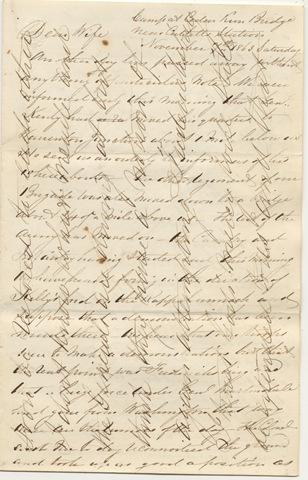
Another day has passed away without anything of particular note. We were informed early this morning that General Kealy has moved his quarters to Warrington Junction about 1 mile below us. He sent us an orderly to inform us of his whereabouts. The other regiment of our brigade was also moved down to a bridge about 3/4 mile above us. The rest of the army has moved on the cavalry and infantry having started east this morning. We have heard firing in the direction of Kelly’s Ford on the Rappahannock and suppose that a demonstration has been made there. We hear that our troops were to make a demonstration but that the lead point was Fredericksburg and that a huge force under General Martindale had gone from Washington that way those are the rumors of the day. The colonel [with me?] to day reconnoitered the ground and took up as good a position as we could in case we should be attacked by raiders.

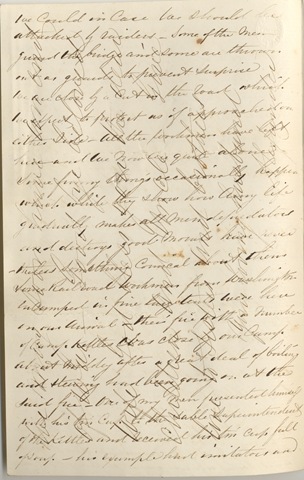
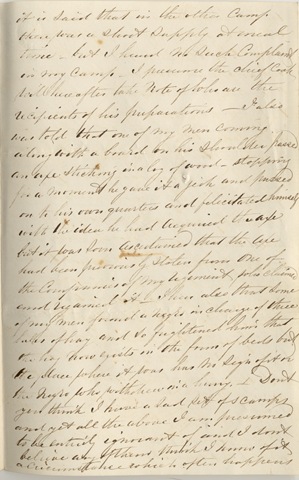
Some of the men guard the bridge and some are thrown out as guards to prevent surprise. We are close by a cut in the road which we expect to protect us if approached on either side. All the workmen have left here and we are now quite alone. Some funny things occasionally happen which while they show how army life gradually makes all men [depredators?] and destroys good morals have nevertheless something comical about them. Some railroad workmen from Washington encamped in five large tents were here on our arrival. Their fire with a number of camp kettles was close by our camp…about midday after a great deal of boiling and stewing had been going on at the said fire…one of my men presented himself with his tin cup to the sable superintendent of the kettles and received his tin cup full of soup…his example had imitators and it is said that in the other camp there was a short supply at meal time. But I heard no such complaint in my camp. I presume the chief cook will hence after take note of who are the recipients of his preparations. I also was told that one of my men coming along with a board on his shoulder passed an axe sticking in a log of wood… stopping for a moment he gave it a jerk and passed on to his own quarters and felicitated himself with the idea he had acquired the axe but it was soon ascertained that the axe had been previously stolen from one of the companies of my regiment who claimed and regained it. I heard also that some of my men found a negro in charge of three bales of hay and so frightened him that the hay now exists in the form of beds but the place where it was has no sign of it or the negro who withdrew in a hurry.

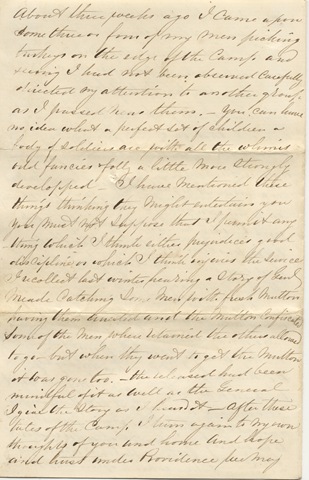
Don’t you think I have a sad set of scamps and yet all the above I am presumed to be entirely ignorant of and I don’t believe any of them think I know of it a circumstance which often happens. About three weeks ago I came where some three or four of my men picking turkeys on the edge of the camp and seeing I had not been observed carefully directed my attention to another group as I passed near them. You can have no idea what a perfect set of children a body of soldiers are with all the whims odd fancies & folly a little more strongly developed. I have mentioned these things thinking they might entertain you. You might not supposed that I permit anything which I think either prejudices good discipline or which I think injures the service. I recollect last winter hearing a story of Gen Meade catching some men with fresh mutton having them arrested and the mutton confiscated. Some of the men were retained the others allowed to go. But when they went to get the mutton it was gone too. The released had been mindful of it as well as the General. I give the story as I heard it. After these tales of the camp I turn again to my own thoughts of you and home and hope and trust under Providence we may soon be restored to each other. I don’t know what Meade and the Generals are driving at but think they have a notion of again attempting Fredericksburg. I trust God’s mercy will still be extended to us and that we may soon have an end of war. Good bye beloved wife god bless you the dear children and uncle. Give love to sisters and brothers

Your loving husband

Alexander

Citation: Alexander Biddle (1819-1899), autograph letter signed to Julia Williams Rush Biddle,7 November 1863. Rush IV:30:37

November 6, 1863: Alexander Biddle to Julia Williams Rush Biddle

Alexander Biddle was a member of the prominent Philadelphia Biddle family and was married to Julia Williams Rush,  the granddaughter of Dr. Benjamin Rush.  Biddle served with the 121st Pennsylvania Volunteer Infantry, beginning in September 1862. Starting out as a major, he would participate in Fredericksburg and Gettysburg, among other engagements, and would leave the service as a lieutenant colonel. (He was commissioned, but never mustered, as colonel)

Rush IV-30-37 Nov 6 p1 A Biddle ALS to Julia William Rush Rush IV-30-37 Nov 6 p2&3 A Biddle ALS to Julia William Rush Rush IV-30-37 Nov 6 p2&3 A Biddle ALS to Julia William RushRush IV-30-37 Nov 6 p4 A Biddle ALS to Julia William Rush

Transcript:

Camp at Ridge below Catlett’s

Station, Friday Nov. 6, 1863

Dear Wife,

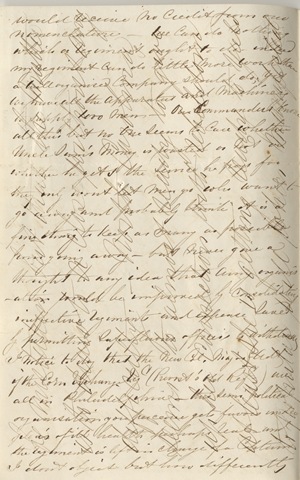
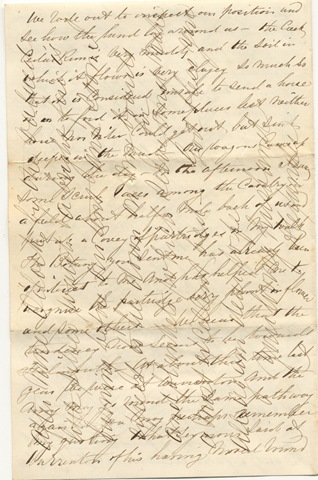
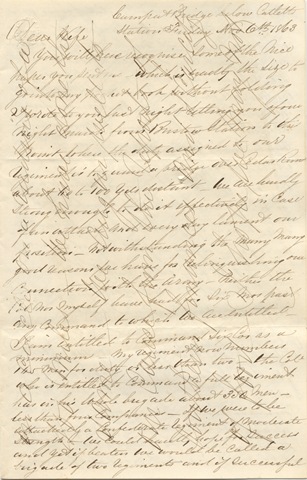
You will here recognize some of the nice paper you sent me which is exactly the size to go into my pocket book without folding. I wrote to you last night telling you of our night march from Bristow Station to this point where the duty assigned to our regiment is to guard a bridge over Cedar Run about 60 to 100 yards distant. We are hardly strong enough to do it effectively in case of an attack and every day lament our position—not withstanding the many many good reasons we have for relinquishing our connection with the army. Neither the Col nor myself have had for six months past any command to which we are entitled. I am entitled to command six Cos as a minimum- my regiment now numbers 165 men for duty or less than two. The Col. who is entitled to command a full Regiment has in his whole brigade about 350 men- less than four companies. If we were to be attacked by a confederate Regiment of moderate strength we could hardly hope for success and yet if beaten we would be called a brigade of two regiments and if successful would receive no credit from our nomenclature. We can do nothing which a regiment ought to do. Indeed my regiment can do little more work than a well organized company should do, yet we have the apparatus and machinery to supply 1000 men. Our commander knows all this but no one seems to care whether Uncle Sam’s money is wasted or not and whether he gets the service he pays for. They only won’t let men go who want to go away and probably think it is a fine thing to keep as many as possible from going away- but never give a thought to any idea that army organization would be improved by consolidating ineffective regiments and expense saved by permitting superfluous officers to withdraw. I notice today that the new Col. Maj. & [Adt?] of the Corn Exchange Reg. (Provost’s old Reg) are all in Philadelphia- this semi political organization you perceive gets favors under pleas of ill health perhaps real and the Regiment is left in charge of a Captain. I don’t object but how differently people view things—suppose Chapman, I and Hall were all to come home together for any cause but the misfortunes of a battle field—what would we be likely to think of it ourselves or suppose the world would think of it.

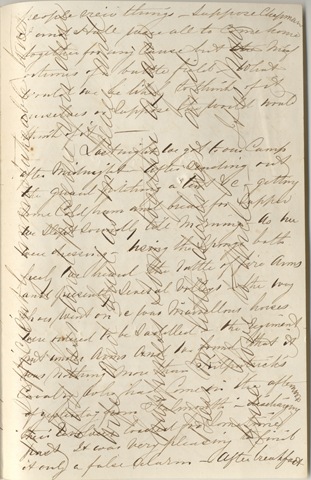
Last night we got to our camp after midnight after sending out the guard pitching a tent- &c Getting some cold ham and bread for supper we slept soundly till morning. As we were dressing- using the sponge bath freely we heard the rattle of fire arms and presently several volleys. The way shoes went on & four marvelous horses were readied to be saddled. The regiment put under arms and we found that it was nothing more than Kilpatrick’s cavalry who had come in the afternoon of yesterday from Falmouth discharging their revolvers loaded for sometime past. It was very pleasing to find it only a false alarm. After breakfast we rode out to inspect our position and see how the land lay around us—the Creek Cedar Run is very muddy and the soil in which it flows is very clayey, so much so that it is considered unsafe to send a horse in or to ford it on some places but neither horse nor rider could get out, but sink deeper in the mud. Our wagons came up during the day. In the afternoon I saw some scrub jays among the Cavalry in a field about half a mile back of us and put up a covey of partridge in my walk. The Botany you sent me has already been of interest to me and has helped me to recognise the partridge berry plant in flower and some others. We hear that the tendency now seems to be towards Falmouth—at about this time last year we were at Warrenton and the Army may go mind the same pathway again. You may perhaps remember my quoting what Seymour said at Warrenton of his having moved round in a circle on a radius of a 100 miles. We have done the same. We augur well to our cause from the reports of southern finances and scarcity of food. I hope we may not be mistaken but that the matter is to draw to a close without any difficulty. North Carolina seems to almost ready to give up her connections with rebeldom, at least she is getting ready to yield to popular will when manifested in sufficiently unmistakable tones. God bless and preserve you dear wife and lead us in peace and happiness soon together again. Bless my little darlings and give love to Uncle. It is now after nine o’clock by the valued little silver watch. A bright fire is burning before our tent and soon I expect to lie down on my boards and blankets which serve and make a most excellent bed. God bless you all again dear wife,

Your loving husband,

Alexander

Citation: Alexander Biddle (1819-1899), autograph letter signed to Julia Williams Rush Biddle,6 November 1863. Rush IV:30:37

November 5, 1863: Alexander Biddle to Julia Williams Rush Biddle

Alexander Biddle was a member of the prominent Philadelphia Biddle family and was married to Julia Williams Rush,  the granddaughter of Dr. Benjamin Rush.  Biddle served with the 121st Pennsylvania Volunteer Infantry, beginning in September 1862. Starting out as a major, he would participate in Fredericksburg and Gettysburg, among other engagements, and would leave the service as a lieutenant colonel. (He was commissioned, but never mustered, as colonel)

Rush IV-30-37 Nov.5 p1 A Biddle ALS to Julia William Rush Rush IV-30-37 Nov.5 p2 A Biddle ALS to Julia William Rush

Transcript:

Camp at High Bridge Near Catlett’s Station

November 5, 1863, Thursday

Dear Wife,

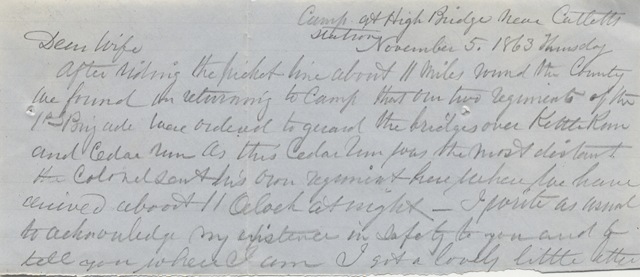
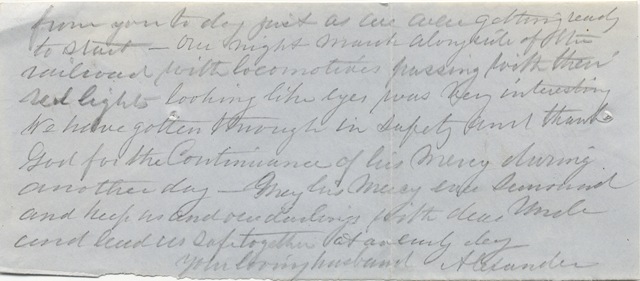
After riding the picket line about 11 miles round the County we found on returning to camp that our two regiments of the 1st Brigade were ordered to guard the bridges over Kettle Run and Cedar Run. As this Cedar run was the most distant, the Colonel sent his own regiment here when we have arrived about 11 O’clock at night. I write as usual to acknowledge my existence in safety to you and to tell you where I am. I got a lovely little letter from you to day just as we were getting ready to start. Our night march along side of the railroad with locomotives passing with their red lights- looking like eyes was very interesting. We have gotten through in safety and thank God for the Continuance of his Mercy during another day. May his Mercy ever surround and keep us and our darlings with dear Uncle and lead us safe together at an early day.

Your loving husband,

Alexander

Citation: Alexander Biddle (1819-1899), autograph letter signed to Julia Williams Rush Biddle,5 November 1863. Rush IV:30:37

November 4, 1863: Alexander Biddle to Julia Williams Rush Biddle

Alexander Biddle was a member of the prominent Philadelphia Biddle family and was married to Julia Williams Rush,  the granddaughter of Dr. Benjamin Rush.  Biddle served with the 121st Pennsylvania Volunteer Infantry, beginning in September 1862. Starting out as a major, he would participate in Fredericksburg and Gettysburg, among other engagements, and would leave the service as a lieutenant colonel. (He was commissioned, but never mustered, as colonel)

Rush IV-30-37 Nov.4 p1 A Biddle ALS to Julia William Rush Rush IV-30-37 Nov.4 p2 A Biddle ALS to Julia William Rush

Transcript:

Camp at Bristow Station

Wednesday November 4th 1863

Dear Wife,

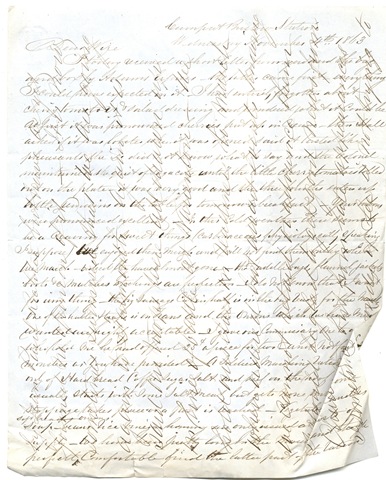
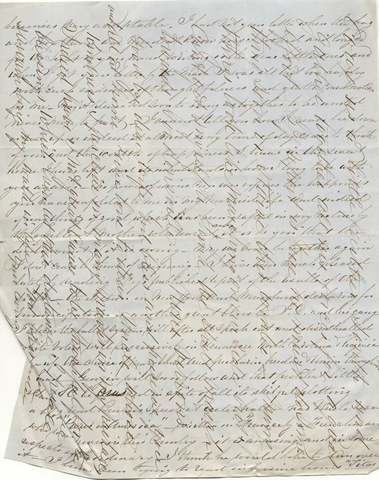
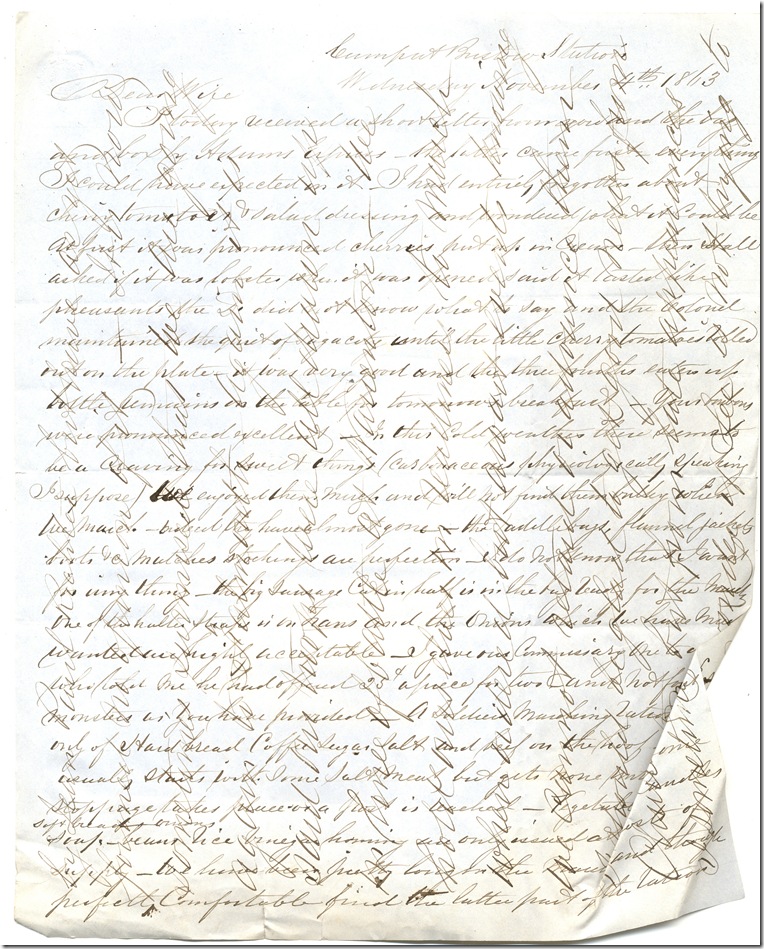
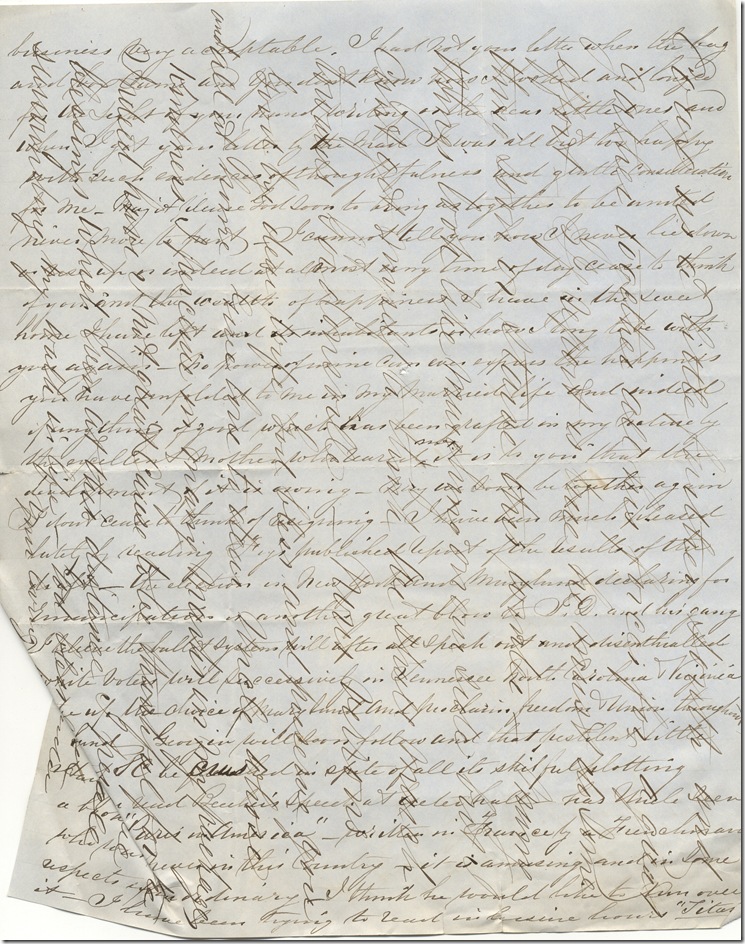
I today received a short letter from you and the bag and box by Adams Express. The latter came first- everything I could have expected in it. I had entirely forgotten about cherry tomatoes and salad dressing and wondered what it could be. At first it was pronounced cherries put up in cream—then Stall asked if it was lobster, when it was opened, said it tasted like pheasants, the D. did not know what to say and the Colonel maintained the quiet of sagacity until the little cherry tomatoes rolled out on the plate—it was very good and the three fourths eaten up but thee remains on the table for tomorrow’s breakfast. Your bonbons were pronounced excellent—In this cold weather there seems to be a craving for sweet things (carbonaceous, physiologically speaking, I suppose). We enjoyed them much and will not find them badly when we march—indeed they have almost gone. The saddle bags, flannel jackets, boots and matches, stockings are perfection. I do not know that I want for anything—the big sausage cut in half is in the bag ready for the march. One of the halter straps is on Frans, and the onions, which I have much wanted, were highly acceptable. I gave our Commissary one today who told me he had offered 25 ¢ a piece for two and not for such monsters are you have provided. A soldier’s marching rations consist only of hard bread, coffee, sugar, salt and beef on the hoof—He usually starts with some salt meat but gets none until some stoppage takes place or a post is reached. Vegetables, candles, soft bread, onions, soups, beans, rice, vinegar, hominy are only issued at posts of supply. We have been pretty long on the march and though perfectly comfortable find the latter part of the rations business very acceptable. I had not your letter when the bag and the box came and you don’t know how I looked and longed for the sight of your hand writing or the dear little ones and then I got your letter by the mail I was all but too happy with such evidences of thoughtfulness and gentle consideration for me. May it please God soon to bring us together to be united never more to part. I cannot tell you how I never lie down or rise up or indeed at almost any time of day cease to think of you and the wealth of happiness I have in the sweet home I have left and its inhabitants in how I long to be with you again. No power of mine can ever express the happiness you have unfolded to me in my married life and indeed of any thing of good which has been grafted in my nature by the excellent mother who reared me, it is to you that the development of it is owing. May we soon be together again. I don’t cease to think of resigning—I have been much pleased lately by reading [Foy’s?] published report of the results of the draft—the election in New York and Maryland declaring for Emancipation is another great blow to J.D. and his gang. I believe the ballot systems will after all speak out and disenthralled white voters will successively in Tennessee, North Carolina, Virginia, take up the advice of Maryland. Georgia will soon follow and that pestilent little state of SC will be crushed in spite of all its skillful plotting. Have you read Beecher’s speech at Exeter Hall—has Uncle seen a book “Paris in America”—written in France by the Frenchman who was never in this country—It is amusing and in some aspects extraordinary. I think he would like to run over it—I have been trying to read in leisure hours “Titan” by Jean Paul Richter but have as yet formed no opinion of it. It is now sometimes surmised that we are going again to Falmouth—Again it is said our troops were all drawn up in line of battle at Warrenton—We hold ourselves in readiness to march when ordered but await events knowing we cannot retard or advance them. I should be glad to get good news from Charleston but from late appearances I sometimes wonder if Lee is not trying to coax us a little farther South and gather together all his forces for a great effort. If report is true he must do something soon or starve this winter. Many things look like marching on our side but I can’t get myself to think we shall march towards Gordonville- Nous verrons. Goodbye dear wife, God bless and preserve you all at home. Give love to dear Uncle whose kindness I perceive in many marks in my package. Indeed have I not great cause to be thankful for the blessings which even at this distance I perceive surrounding my walk in life. God bless you all,

Your loving husband,

Alexander

Citation: Alexander Biddle (1819-1899), autograph letter signed to Julia Williams Rush Biddle,4 November 1863. Rush IV:30:37

November 3, 1863: Alexander Biddle to Julia Williams Rush Biddle

Alexander Biddle was a member of the prominent Philadelphia Biddle family and was married to Julia Williams Rush,  the granddaughter of Dr. Benjamin Rush.  Biddle served with the 121st Pennsylvania Volunteer Infantry, beginning in September 1862. Starting out as a major, he would participate in Fredericksburg and Gettysburg, among other engagements, and would leave the service as a lieutenant colonel. (He was commissioned, but never mustered, as colonel)

Rush IV-30-37 Nov. 3 p1 A Biddle ALS to Julia William Rush Rush IV-30-37 Nov. 3 p2 A Biddle ALS to Julia William Rush

Transcript:

Camp at Bristow Station

Tuesday 3d November 1863

Dear Wife,

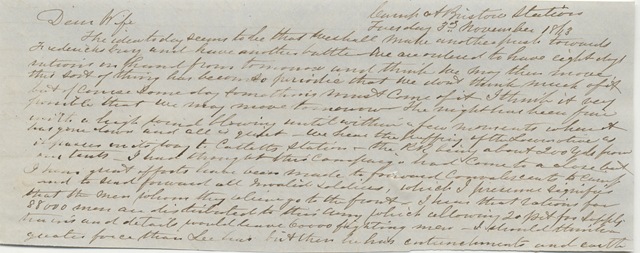
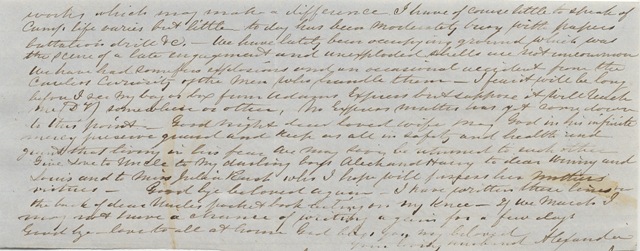
The idea to day seems to be that we shall make another push towards Fredricksburg and have another battle. We are indeed to have eight days rations in hand from tomorrow and think we may then move. This sort of thing has become so periodic that we don’t think much of it but of course some day something must come of it. I think it very possible that we may move tomorrow. The night has been fine with a high wind blowing until within a few moments when it has gone down and all is quiet. We hear the puffing of the locomotive as it passes on its way to Catlett’s station– the RR being about 200 yds from our tents. I had thought this company had come to a close but I hear great efforts have been made to forward convalescents to camp and to send forward all invalid soldiers, which I presume signifies that the men whom they relieve go to the front. I hear that rations for 88,000 men are distributed to this army which allowing 20 pct for supply trains and details would leave 60,000 fighting men. I should think a greater force than Lee has, but then he has entrenchments and earth works which make a difference. I have of course little to speak of Camp. Life varies but little—today has been moderately busy with papers, battalion drill etc. We have lately been occupying ground which was the scene of a late engagement and unexploded shells are not uncommon. We have had some few explosions and an occasional accident from the careless curiosity of the men who handle them. I fear it will be long before I see my bag or box from Adams express but suppose it will reach me (DV) somewhere or other. No Express matter has yet come down to this point. Good night dear loved wife, may God in his infinite mercy preserve, guard and keep us all in safety and health and grant that living in his fear we may soon be returned to each other. Give love to Uncle, to my darling boys Aleck and Harry, to dear Winny and Louis and to Miss Julia Rush who I hope will possess her mother’s virtues. Good bye beloved again—I have written these lines on the back of dear Uncle’s pocketbook resting on my knee. If we march I may not have a chance of writing again for a few days. Goodbye—Love to all at home. God bless you my beloved,

Your loving husband, Alexander

Citation: Alexander Biddle (1819-1899), autograph letter signed to Julia Williams Rush Biddle,3 November 1863. Rush IV:30:37
November 2, 1862: Alexander Biddle to Julia Williams Rush Biddle

Alexander Biddle was a member of the prominent Philadelphia Biddle family and was married to Julia Williams Rush,  the granddaughter of Dr. Benjamin Rush.  Biddle served with the 121st Pennsylvania Volunteer Infantry, beginning in September 1862. Starting out as a major, he would participate in Fredericksburg and Gettysburg, among other engagements, and would leave the service as a lieutenant colonel. (He was commissioned, but never mustered, as colonel)

Rush IV-30-37 Nov 2 p1 A Biddle ALS to Julia William Rush

Rush IV-30-37 Nov. 2 p2 A Biddle ALS to Julia William Rush

Transcipt:

Camp at Bristow Station

November 2d 1863, Monday

Dear Wife,

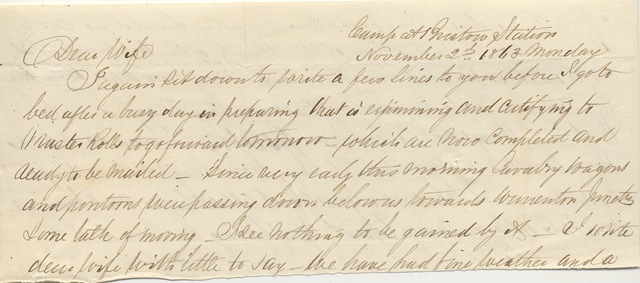
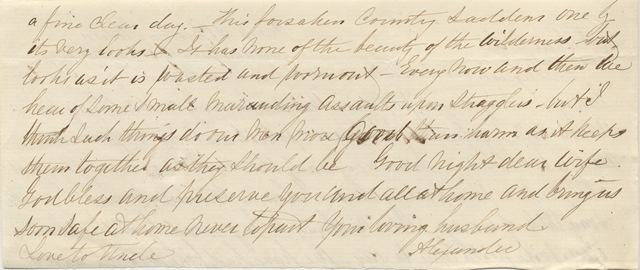
I again sit down to write a few lines to you before I go to bed after a busy day in preparing, that is examining and certifying to Master Rolls, to go forward tomorrow—which are now completed and ready to be mailed. Since very early this morning Cavalry Wagons and pontoons were passing down below us towards Warrenton Junction some talk of moving. I see nothing to be gained by it. I write dear wife with little to say- we have had fine weather and a fine clear day. This forsaken country saddens one by its very looks. It has none of the beauty of the wilderness but looks as it is wasted and worn out. Every now and then we hear of some small marauding assaults upon stragglers but I think such things do our men more good than harm as it keeps them together as they should be. Good night dear wife, God bless and preserve you and all at home and bring us soon safe at home never to part. Love to Uncle. Your loving husband, Alexander

Citation: Alexander Biddle (1819-1899), autograph letter signed to Julia Williams Rush Biddle, 2 November 1863. Rush IV:30:37
November 1, 1863: Alexander Biddle to Julia Williams Rush Biddle

Alexander Biddle was a member of the prominent Philadelphia Biddle family and was married to Julia Williams Rush,  the granddaughter of Dr. Benjamin Rush.  Biddle served with the 121st Pennsylvania Volunteer Infantry, beginning in September 1862. Starting out as a major, he would participate in Fredericksburg and Gettysburg, among other engagements, and would leave the service as a lieutenant colonel. (He was commissioned, but never mustered, as colonel)Rush IV-30-37 Nov 1 p1 A Biddle ALS to Julia William Rush Rush IV-30-37 Nov 1 p2 A Biddle ALS to Julia William Rush

Transcript:

Camp at Bristow Station

Sunday November 1st 1863

Dear Wife,

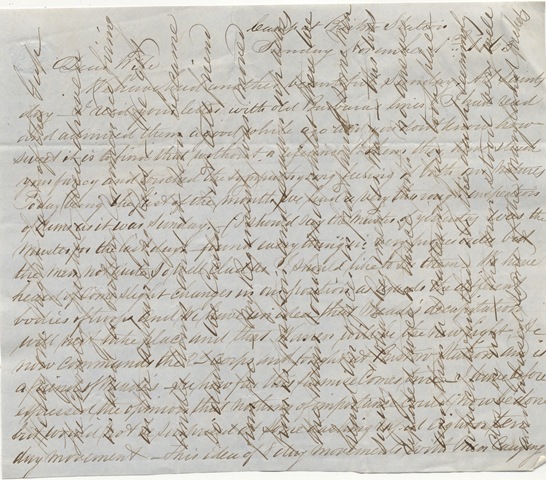
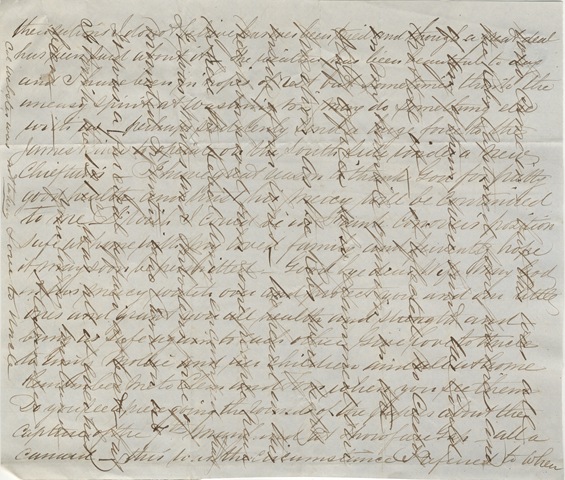
We have had another beautiful Sunday, All Saint’s Day. I read your letter with old [Barbara’s?] lines. I had read and admired them a good while ago and you don’t know how sweet it is to find that without a reference to them they have struck your fancy and touched the sympathizing feeling of both our natures. Today being the first of the month we had a very thorough inspection of arms as it was Sunday. I should say the Muster of yesterday was the Muster for the last day—found everything in very proper order but the men not quite so well clad as I should like to see them. We have heard of some slight changes in our position as regards the different bodies of troops and we have an idea that Meade’s decapitation will next take place and that Warren will be the new light, he now commands the 2d corps and fought at Bristow Station and is a friend of Meade’s. In how far this surmise comes true I have before expressed the opinion that nothing of importance could now be done but would not be surprised at some dashing [report?] eight or ten day movement. This idea of 8 day movements with men carrying their rations I do not believe has ever been tried and though a great deal has been said about it the weather has been beautiful to day and I have been in hopes of rest but sometimes think the uneasy spirit at Washington may do something else with us—perhaps suddenly send a huge force to the James River to operate on the South side under a new chieftain. I have great reason to thank God for pretty good health and trust his mercy will be continued to me. I wish I could be in Frank Conover’s position, safe at home with my loved family, and fervently hope it may soon be permitted. Good bye dear wife, may God in his mercy watch over and protect you and our little ones and grant you all health and strength and bring us safe again to each other. Give love to Uncle, to Emily, Mollie and her children, and all at home. Remember me to Clem and Tom when you see them. Do you see a piece going the round of the papers about the capture of the 7th Maryland at Thorofare Gap–all a canard- this was the circumstance I referred to when we lay one night East of the Gap. The cavalry pickets were driven in and a battery commenced firing on the advancing Rebs—We got under arms and it soon became so dark we could not tell friend from foe—My Regiment was moved from its position and drawn up along the main road and whilst there we heard an officer in front heard some men saying “What Regiment is that?” This was repeated twice or thrice with no answer and then a scattering fire too place which whistled in the dark seemingly close by us. The men stood very well and abused some of the Maryland pickets who came in—but this was all the Rebs captured- Some prisoners and if any of them were hurt we could not tell it- It reflected no credit in my humble opinion on the staff officer who examined our positions and the Rebs were right inside of our lines. We heard in this neighborhood from some people near where the Rebel army encamped that it was White’s and Imboden’s force of mounted infantry who came on us. It was a farcical affair at best—but I think the 121st was all it ever has been.

Your loving husband,

Alexander

Citation: Alexander Biddle (1819-1899), autograph letter signed to Julia Williams Rush Biddle, 1 November 1863. Rush IV:30:37
October 31, 1863:Alexander Biddle to Julia Williams Rush Biddle

Alexander Biddle was a member of the prominent Philadelphia Biddle family and was married to Julia Williams Rush,  the granddaughter of Dr. Benjamin Rush.  Biddle served with the 121st Pennsylvania Volunteer Infantry, beginning in September 1862. Starting out as a major, he would participate in Fredericksburg and Gettysburg, among other engagements, and would leave the service as a lieutenant colonel. (He was commissioned, but never mustered, as colonel)

Rush IV-30-36 Oct 31, 1863 p1 A Biddle ALS to JWR Rush IV-30-36 Oct 31, 1863 p2 A Biddle ALS to JWR

Transcript:

Camp at Bristow Station

Saturday October 31, 1863

Dear Wife,

Another day has passed away after a rainy Friday night and early this morning and mud for much of the day. The regiment was mustered for pay to day and now the wind has come out fresh and strong from the north. So much so that we have had the tent pegs tightened to keep our tent standing during the night. There seems to be an idea that we may move nearer to Warrenton junction in a day or two. I believe that Meade now has his Head Qts somewhere near there. It is very dreary and monotonous this sort of life but it seems as if there was no way of altering it for the present .You cannot conceive how it irritates me to find that almost all second class small politicians have really more influence in the army than those who have made sacrifices to support it. I don’t think there is any scheme of doing anything just now- but if the weather gets to be fine mild and clear I would not be surprised if Meade were to cook up some scheme in the next 40 days. It cannot however on either side be more than a foolish sacrifice of blood and material—If Lincoln would only turn his legions and think a little more of making them fighting men we should do better. As it is I most heartily wish I was free to leave the service and trust that I may be so before long. Give love to Mollie and all her children and to Emily and hers and to brother Clem. I have not got a line from him since the fright about the Penn. Invasions. We now have fires pretty much all day and a good deal of the night before our tents and find them pleasant. We are on or close by the battle ground at this place- which our Corps was the first to pass—it seems that D.H. Hill’s Rebel Corps has been expected to push on towards Centreville- and that he is no under arrest. I think under God’s Providence it was well for him that he didn’t do so. The feeling of the men was more like fighting at Centreville than I have seen them since Gettysburg. I hope all this will soon be over and that God may grant us an early peace and restorations to each other—Love to Uncle and all the children. Your loving husband, Alexander

Citation: Alexander Biddle (1819-1899), autograph letter signed to Julia Williams Rush Biddle, 31 October 1863. Rush IV:30:36