April 6, 1863: Alexander Biddle to Julia Williams Rush Biddle

Alexander Biddle was a member of the prominent Philadelphia Biddle family and was married to Julia Williams Rush,  the granddaughter of Dr. Benjamin Rush. A businessman and member of the First Troop Philadelphia City Calvary before the war, Biddle entered Civil War service with the 121st Pennsylvania Volunteer Infantry on September 1, 1862. Starting out as a major, he would fight at Fredericksburg, Chancellorsville, and Gettysburg, among other engagements, and would leave the service as a lieutenant colonel. (He was commissioned, but never mustered, as colonel)                  

 Rush IV-30-30 p1 A. Biddle ALS to Julia William Rush, April 6 Rush IV-30-30 p2 A. Biddle ALS to Julia William Rush, April 6 Rush IV-30-30 p3 A. Biddle ALS to Julia William Rush, April 6    Rush IV-30-30 p4 A. Biddle ALS to Julia William Rush, April 6

  Transcript (excerpt):

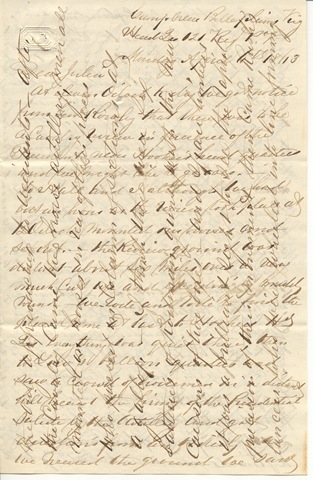
Camp near Belleplains Virg

Head Qrs 121 Reg P.V.

Monday April 6th 1863

Dear Julia

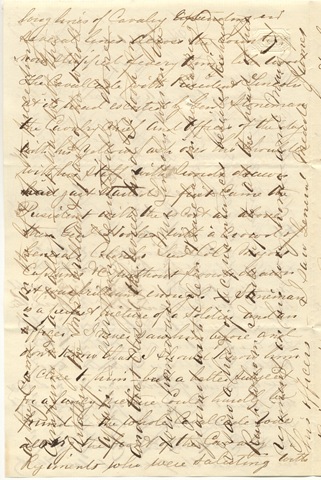
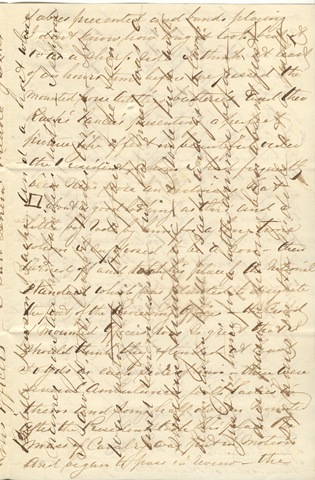
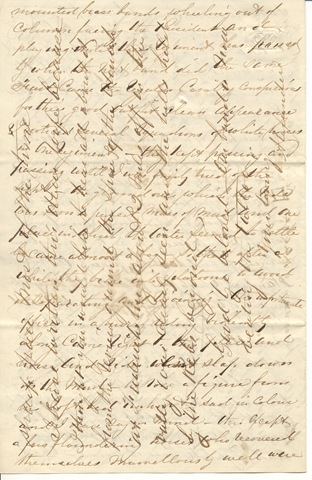
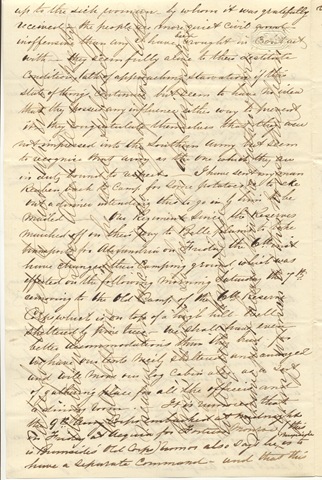
At eleven O’clock to day we got notice from Genl Rowley that there was to be a Cavalry review in presence of the President near Hooker’s head quarters and we might like to go over. So Hall and I although we had but an hour as the review took place at 12 Oclock mounted out horses and set out. the Review ground was distant about six miles over a very much cut up and exceedingly muddy round – We rode and rode to fine the place Came at last to Hooker’s Hd Qrs everything was quiet there, then to Low’s balloon quarters and saw a crowd of horsemen in a distant hill heard the firing of the Presidential salute by the Artillery and got directions from an orderly as we neared the ground we saw long lines of Cavalry extending in several lines across the country now stripped of everything like wood The Cavalcade with President Lincoln at its head escorted by Genl Stoneman the Cavalry chief and Officer of they day of the day with his yellow sash over his shoulders with his staff with swords drawn had just started – first came the President with the escort as above then Genl Hooker with a crowd of Generals Colonels Lieut Cols Majors Captains &c without swards drawn it was brilliant enough – Stoneman is a perfect picture of a soldier and an officer – I never saw him before and don’t know that I should know him if close to him – but a better subject for a fancy picture Could hardly be found…


Citation: Alexander Biddle (1819-1899), autograph letters signed to Julia Williams Rush Biddle.6 April 1863. Rush IV:30:30

February 9, 1863: Alexander Biddle to Julia Williams Rush Biddle

Alexander Biddle was a member of the prominent Philadelphia Biddle family and was married to Julia Williams Rush,  the granddaughter of Dr. Benjamin Rush.  Biddle served with the 121st Pennsylvania Volunteer Infantry, beginning in September 1862. Starting out as a major, he would participate in Fredericksburg and Gettysburg, among other engagements, and would leave the service as a lieutenant colonel. (He was commissioned, but never mustered, as colonel)

Rush IV-30-28 p1 A. Biddle ALS to Julia William Rush, Feb. 9 Rush IV-30-28 p2 A. Biddle ALS to Julia William Rush, Feb. 9 Rush IV-30-28 p3 A. Biddle ALS to Julia William Rush, Feb. 9 Rush IV-30-28 p4 A. Biddle ALS to Julia William Rush, Feb. 9

Transcript:

Head Qrs Division Picket Line

Monday February 9th 1863

Dear Julia

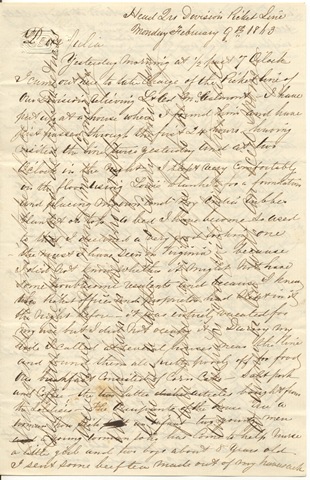
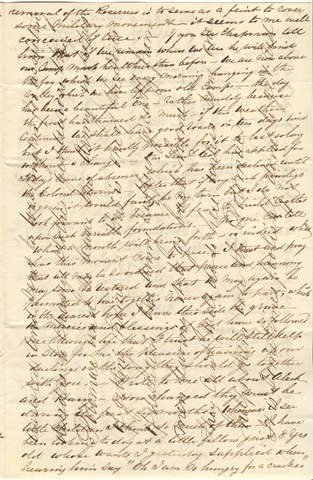
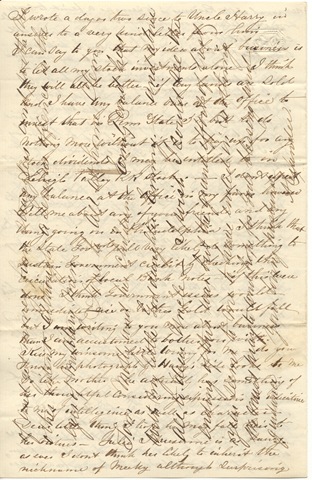
Yesterday morning at ½ past 7 O’clock I came out here to take charge of the Picket line of out Division relieving Lt Col McCalmont – I have put up at a house where I found him and have just passed through the first 24 hours having visited the line twice yesterday and at two O’clock in the night I slept very comfortably on the floor using Louis’ blanket for a foundation and placing my own and my india rubber blanket on top – a bed I have become so used to that I declined a very good looking one – the nicest I have seen in Virginia – because I did not know whether it might not have some troublesome residents and because I knew two Picket officers and proprietors had slept in it the night before – it was entirely vacated for my use but I did not occupy it. During my ride I called at several houses near the line and found them all pretty poorly off for food Our breakfast consisted of corn cakes – salt pork and coffee – the two latter dishes articles bought from the soldiers. The occupants of the house are a woman now sick an infant two young men and a young woman who has come to help nurse a little girl and two boys about 8 years old. I sent some beef tea made out of my haversack up to the sick woman by whom it was gratefully received – the people are more quiet civil and inoffensive than any I have been brought in contact with – they seem fully alive to the destitute condition, [loth?] of approaching starvation if the state of things continues but seem to have no idea that they possess any influence either way to prevent it they congratulate themselves that they were not impressed into the Southern Army but seem to recognize that army as the one which they are in duty bound to respect – I have sent my man Reuben back to Camp for some potatoes &c to eke out a dinner intending this to go in by him to be mailed…

Citation: Alexander Biddle (1819-1899), autograph letters signed to Julia Williams Rush Biddle.9 February 1863. Rush IV:30:28

January 2, 1863: Print of Libby Prison

19540795

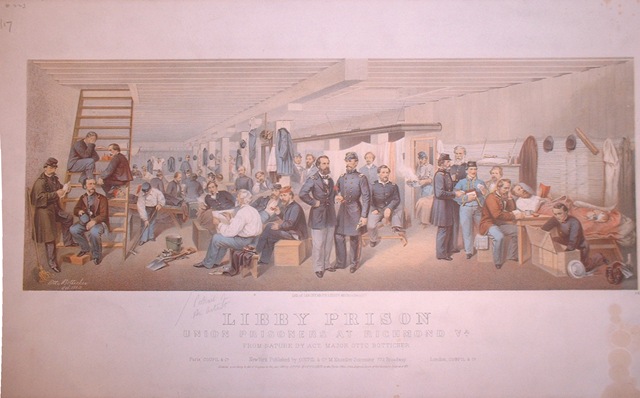
This image of Libby Prison was published in 1863.

Citation: Sarony, Major, & Knapp, lithographers, after a drawing by Otto Botticher, Libby Prison, Union prisoners at Richmond, Va from nature by Act. Major Otto Botticher. New York, 1863. 1954.795

December 30, 1862: William T. Sherman to David Porter

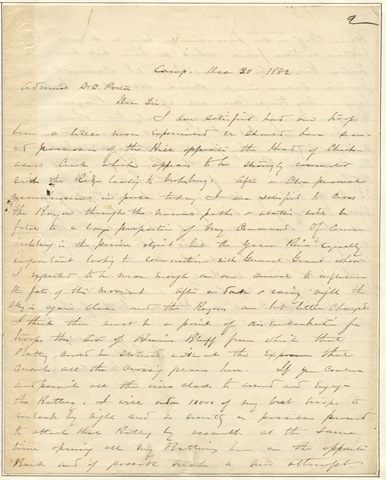
AMs 360-9 p1 William T Sherman to David D Porter AMs 360-9 p2 William T Sherman to David D Porter

Transcript:

Camp. Dec 30 1862.

Admiral D. D. Porter

Dear Sir,

I am satisfied had our troops been a little more experienced we should have secured possession of the Hill opposite the Head of Chickasaw Creek which appears to be strongly connected with the Ridge leading to Vicksburg. After a close reconnaissance in person today I am satisfied to cross the Bayou through the narrow path & attack will be fatal to a large proportion of my Command. Of course Vicksburg is the principle object but the Yazoo River is equally important looking to [connection?] with General Grant whom I expected to be near enough on our arrival to influence the fate of this movement. After a dark & stormy night the sky is again clear and the Bayou are but little changed. I think there must be a point of disembarkation for troops this side of Haines Bluff from which that Battery could be stormed with out the exposure that marks all the crossing places here. If you concur and permit all the iron clads to ascend and engage the Battery, I will order 10 000 of my best troops to embark by night and as secretly as possible proceed to attack that Battery by assault. At the same time opening all my Battery here at the opposite Bank and if possible make a new attempt. Haines Bluff in our possession we have a second footing on terra firma which we have not here. Unless Grant be near at hand I cannot promise success in a direct assault on Vicksburg. My troops are all up to the Bayou with guns covering the crossings only two which are practicables, but I have not succeeded so in making a [illeg.] . My pickets on the right reach the Mississippi River near the Bend from which they have a plain view of all the Forts. [illeg.] &c but the intervening span is one mingled web of fallen trees of giant size filled with sharpshooters with whom we are constantly skirmishing. The enemy has thrown some shells but manifestly spares his ammunition. We do the same.

I would solicit a speedy answer, as we must act with great expedition, if unsupported in this move by either Grant or Banks, both of whom should now be heard from.

I am with great respect

W. T. Sherman

Citation: William T. Sherman (1820-1891), autograph letter signed to David D. Porter. 30 December 1862. AMs 360/9

November 27, 1862: William Gladstone to Cyrus Field

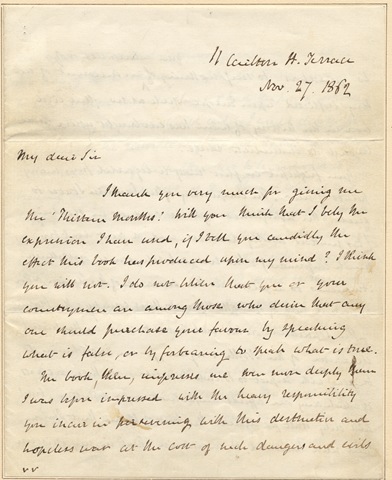
Cyrus Field was the founder of the Atlantic Telegraph Company, which laid the first trans-Atlantic telegraph cable; a project which gave him close ties with British politicians and businessmen.AMs 375-14 p1 William E Gladstone to Cyrus W Field AMs 375-14 p2 William E Gladstone to Cyrus W Field AMs 375-14 p3 William E Gladstone to Cyrus W Field AMs 375-14 p4 William E Gladstone to Cyrus W Field AMs 375-14 p5 William E Gladstone to Cyrus W Field AMs 375-14 p6 William E Gladstone to Cyrus W Field AMs 375-14 p7 William E Gladstone to Cyrus W Field

11 Wilton H. Terrace

Nov. 27. 1862

My dear Sir

I thank you very much for giving me the Thirteen Months. Will you think that I bely the expression I have used, if I tell you candidly the effect this book has produced upon my mind? I think you will not. I do not believe that you or your countrymen are among those who desire that any one should purchase your favour by speaking what is false, or by forbearing to speak what is true.

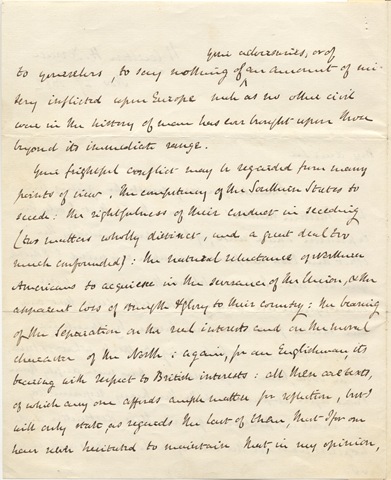
The book, then, impresses me even more deeply than I was before impressed with the heavy responsibility you incur in persevering with this destructive and hopeless war at the cost of much dangers and evils to yourselves, to say nothing of your adversaries, or of an account of misery inflicted upon Europe much as no other civil war in the history of men has brought upon men beyond its immediate range.

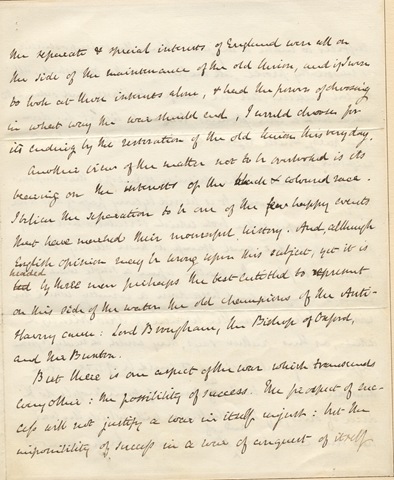
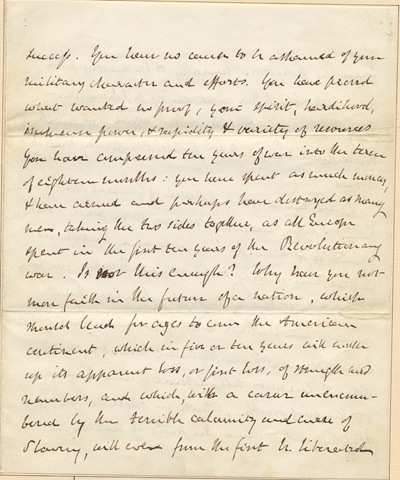
Your frightful conflict may be regarded from many points of view. The competency of the Southern States to secede: the rightfulness of their conduct in seceding (two matters wholly distinct, and a great deal too much confounded): the natural reluctance of Northern Americans to acquiesce in the severance of the Union, & the apparent loss of strength & glory to their country: the bearing of the Separation on the real interests and on the moral character of the North: again, for an Englishman, its bearing with respect to British interests: all these are texts, of which any one affords ample matter for reflection, but I will only note, as regards the last of them, that I for one have never hesitated to maintain that, in my opinion, the separate & special interests of England were all on the side of the maintenance of the old Union, and if I were to look at those interests alone, & had the power of choosing in what way the war should end, I would choose for its ending by the restoration of the old Union this very day.

Another view of the matter not to be overlooked is its bearing on the interests of the black & coloured race. I believe the separation to be one of the happy events that have reached this mournful history. And, although English opinion may be wrong upon this subject, yet it is headed by those men perhaps the best entitled to represent on this side of the water the old champions of the Anti-Slavery cause: Lord Brougham, the Bishop of Oxford, and Mr Burton.

But there is one aspect of the war which transcends every other: the possibility of success. The prospect of success will not justify a war in itself unjust: but the impossibility of success in a war of conquest of itself suffices to make it unjust. When that impossibility is reasonably proved, all the terror [horror?], all the bloodshed, all the evil passions, all the dangers to liberty and order, with which such a war abounds, come to lie at the door of the party which refuses to hold its hand, and let its neighbour be.

You know that in the opinion of Europe that impossibility has been proved. It is found by every page of this Book, and every copy of the book which circulates will carry the proof wider, and stamp it more clearly. Depend upon it, to place the matter upon a single issue, you cannot conquer and keep down a country when the women behave like the women of New Orleans, & which, as this author says, they would be ready to form regiments if such regiments could be of use. And how idle it is to talk, as some of your people do & some of ours, of the slackers with which the war has been carried on, and of its accounting for the want of success. You have no cause to be ashamed of your military character and efforts. You have proved what wanted no proof, your spirit, hardihood, [illeg.] power, & rapidity & veracity of resources. You have condensed the years of war into the term of eighteen months: you have spent as much money, & have armed and perhaps have destroyed as many men, taking the two sides together, as all Europe spent in the first ten years of the Revolutionary war. Is not this enough? Why have you not more faith in the future of a nation, which should lead for ages to come the American continent, which in five or ten years will even up its apparent loss, or first loss, of strength and numbers, and which, with a career unencumbered by the terrible calamity and curse of slavery, will even from the first be liberated from a position generally & invariably false, and will from the first enjoy & permanent gain in credit & character such as will much more than compensate for its temporary material losses.

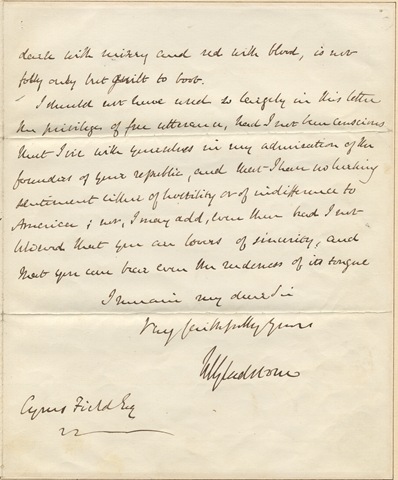
I am in short a follower of General Scott: with him I say “wayward sisters, go in peace”: immortal fame to him for his will and courageous advice, amounting to a prophecy. Finally, you have done what man could do. You have failed because you failed to do what men could not do. Laws stronger than human will are on the side of easiest self-defence. And the aim at the impossible, which in other times very be folly only, when the path of search is dealt with misery and red with blood, is not folly only but guilt to boot.

I should not leave used so largely in this letter the privilege of free utterance, had I not been conscious that I am with yourselves in my admiration of the founders of your republic, and that I have no lurking sentiment either of hostility or of indifference to America & her, I may add, even then had I not believed that you are lovers of sincerity, and that you can bear even the rudeness of its tongue

I remain […]

Very faithfully yours

W E Gladstone

Citation: W. E. (William Ewart) Gladstone (1809-1898), autograph letter signed to Cyrus W. Field. London,27 November 1862.

October 6, 1862: M’Clellan and Victory!!

The exact date for this songsheet is unknown, but it references the Battles of South Mountain and Antietam, which occurred in September 1862.

A 862mc McClellan & Victory

Transcript:

M’CLELLAN AND VICTORY!!
OR THE BATTLE OF SOUTH MOUNTAIN AND THE UPRISING OF THE KEYSTONE STATE,

TUNE–“DAN TUCKER.”

I’ll sing a song, how brave MCCLELLAN
Gave the rebel foe a drilling,
And made them beat retreat in fear,
With this tune ringing in their ear,

Clear the way “Little MAC’s” advancing,
To set your Stonewall Jackson dancing.’

The rebels driven to theft and plunder,
Thought to scare us by their thunder,
They crossed the Potomac to Hagerstown,
To scare the women up and down.

Clear the way, “Little MAC’s” coming, &c

They plundered barns and fields of corn,

Of Maryland whiskey, took a horn,
They seized each union patriot there,
But Freedom’s Eagle sung in the air.

Oh! clear the way, for “MAC’s” advancing.

Stonewall Jackson and “Brag Lee,”

Now thought their course was clear and free,
To take Pennsylvania right off hand,
And carry Philadelphia to Dixey’s Land.

Clear the way “Little MAC” is coming.

So on they marched for their grand attack,
But the mighty mind of “Little MAC,”
Their plans and dodges kept his eye on,
As still as a mouse but as cool as a lion.

Clear the way, &c.

While the Keystone boys rushed nobly forth,
To stand by the state–the prop of the North,
Brave MAC gave the foe a blow in the rear,
Which made their Stonewall quake with fear.

Singing, clear the way, brave MAC is advancing

Upon the heights of old “South Mountain,’
He made their blood flow like a fountain,
Till old secession’s wings were clipt,
And Lee confessed himself “well whipped,’

Singing, clear the way, &c.

With HOOKER, FRANKLIN, and brave BURNSIDE,
He nobly turned the battle’s tide,
And drove them across the blue Potomac,
With battered heads and an empty stomach.

Singing, clear the way, &c.

The gallant RENO nobly fell,
But millions of brave hearts toll his knell,
And honor and glory crown the pall,
Of those who for the Union fall.

Singing, clear the way, &c

At Sharpsburg next, our gallant “MAC,”
Quickly followed suit and beat them back,
He seized their Longstreet by the knob,
And shelled the corn from Howell Cobb.

Singing, clear the way, &c.

At Harpers Ferry next he sold them,
And made the place “too hot to hold them.”
He bound by death or victory,
To set old Maryland safe and free.

Singing, clear the way, &c.

Three cheers for our glorious hero, “MAC,”
And the gallant army at his back,
He’s bound to march to victory forth,
Till the Union Flag floats South and North.

Singing, clear the way, &c.

Entered according to Act of Congress in the year 1862, by J. MAGEE, 316 Chestnut St, Phila., in the District of the U.S., for the Eastern District of Penn’a.


Citataion: M’Clellan and victory!!. Philadelphia: J. Magee, 1862. A f.862mc

July 20, 1862: Gideon Pillow to His Brother

Gideon Pillow of Tennessee had been President James K. Polk’s law partner and was a brigadier general in the Confederate Army. He is best remembered for his role in the loss of Fort Donelson in February 1862, where he was second  but turned the Fort over to Simon Bolivar Buckner, so as not to be the one to surrender it to U.S Grant.

AMs 779-6 p1 Gideon Johnson Pillow to his brother AMs 779-6 p2 Gideon Johnson Pillow to his brother

Transcript:

July 20th 1862—

My Dear Brother,

The Northern Gov’t is alarmed— the people there are not volunteering as they expected. I am satisfied they will ultimately adopt the policy of seizing our Negro men wherever they can be had—with the aid of their Army—that they will arm these Negroes and place them in their Army. I am not afraid of these Negroes in the Field, but all Negroes so taken off will be lost forever to us. That this Policy is certain to be adopted in the future I entertain in no sort of doubt. I think our only safety for our men is to bring them to the Interior of the South. The women & children and old men they will not take for this use. Whenever they shall have settled their Policy, they will go to catching & gathering Negroes. From the great number to be found in Mississippi Bottom and from the facility of reaching them and of transporting them North to camps of Instruction, they will have armed bodies of men in operation in less than 30 days & they will secure the River Bottom. I intend, as soon as Cartis gets out of the way, to make an effort to get my Negroes across the River & have them brought to this Region of country.

I send this to you by [illeg]. I wrote you a few days since to send down wagons for my Family to move home. That had better be deferred until Fall and until our Army enters Tennessee and drives back the Federals.

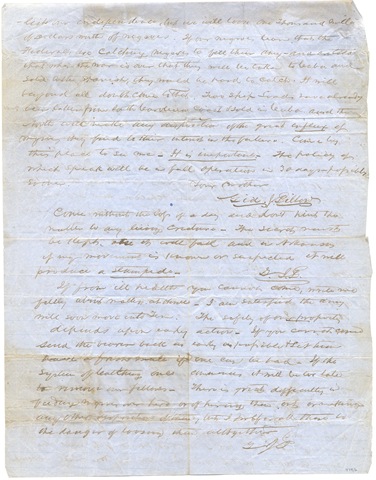
In the mean time you had better look to your Ferry Negro men—I greatly want your services to aid me in getting men out, but I do not know if it will be safe to wait until you can come. We will accomplish our independence, but we will lose one thousand milla of Dollars worth of Negroes. If our negroes learn that the Federals are collecting Negroes to fill their Army—and are told that when the war is over that they will be taken to Cuba and sold to the Spanish, they would be hard to catch. It will beyond all doubt come to that. Two ship loads have already been taken from South Carolina coast & sold in Cuba. And the North will make any deportation of the great influx of Negroes they find to their interest in the future. Come by this place to see me—It is important. The policy of which speak well be in full operation in 3 days—possibly sooner.

Your brother

Gid. J. Pillow

Come without the loss of a day and don’t hint the matter to any living creature—The secret must be kept or will fail and in Arkansas if my movement is known or suspected it will produce a stampede— G.J.P.

If from ill health you cannot come, write me fully about matters at Home—I am satisfied the Army will soon move into Tenn. The safety of our property depends upon early action—If you cannot come send the bearer back as early as possible & let him take a fresh mule if one can be had—If the system of catching ones commences it will be too late to warn our fellows—There is great difficulty in feeding Negroes over here or of hiring them out or making any other deportation of them, but I prefer all them to the danger of loosing them altogether. G.J.P.


Citation: Gideon Johnson Pillow (1806-1878), autograph letter signed to his brother. 20 July 1862. AMs AMs 779/6

July 3, 1862: Call For Troops

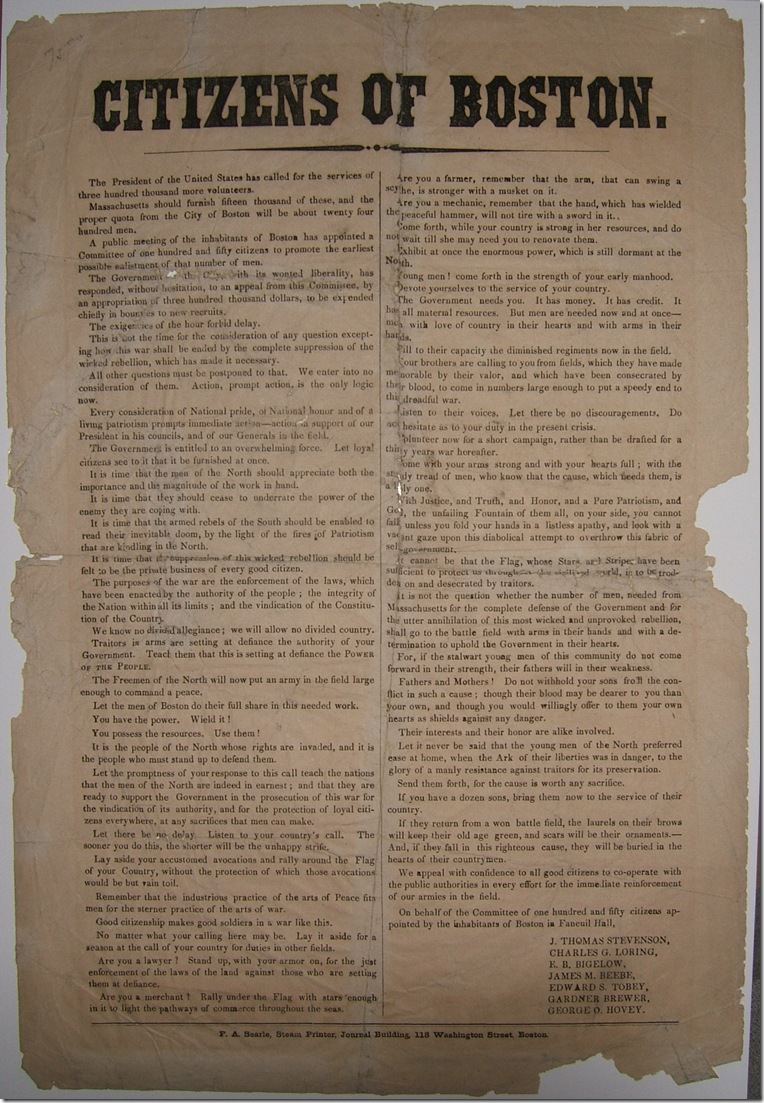
This broadside is undated but is in response to President Lincoln’s July 2, 1862 call for 300,000 troops.
A 862ci

Transcript:

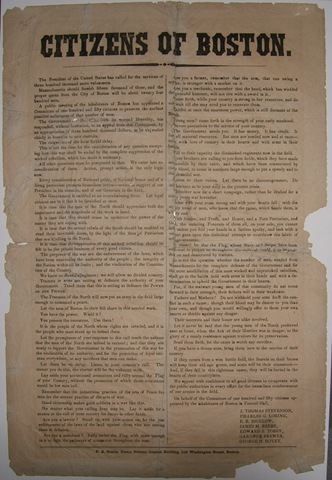
Citizens of Boston

The President of the Unites States has called for the services of three hundred thousand more volunteers.

Massachusetts should furnish fifteen thousand of these, and the proper quota from the City of Boston will be about twenty four hundred men.

A public meeting of the inhabitants of Boston has appointed a Committee of one hundred and fifty citizens to promote the earliest possible enlistment of that number of men.

The Government of the City, with its wonted liberality, has responded, without hesitation, to an appeal from this Committee, by an appropriation of three hundred thousand dollars, to be expended chiefly in bounties to new recruits.

The exigencies of the jour forbid delay.

This is not the time for the consideration of any question excepting how this war shall be ended by the complete suppression of the wicked rebellion, which has made it necessary.

All other questions must be postponed to that. We enter into no consideration of them. Action, prompt action, is the only logic now.

Every consideration of National pride, of National honor and of a living patriotism prompts immediate action-action in support of our President in his councils, and of our Generals in the field.

The Government is entitled to an overwhelming force. Let loyal citizens see to it that it be furnished at once.

It is time that the men of the North should appreciate both the importance and the magnitude of the work in hand.

It is time that they should cease to underrate the power of the enemy they are coping with.

It is time that the armed rebels of the South should be enabled to read their inevitable doom, by the light of the fires of Patriotism that are kindling in the North.

It is time that the suppression of this wicked rebellion should be felt to be the private business of every good citizen.

The purpose of the war are the enforcement of the laws, which have been enacted by the authority of the people; the integrity of the Nation within all its limits; and the vindication of the Constitution of the County.

We know no divided allegiance; we will allow no divided country,

Traitors in arms are setting at defiance the authority of your Government. Teach them that this is setting a defiance of Power of the People.

The Freemen of the North will now put an army in the fields large enough to command a peace.

Let the men of Boston do their full share in this needed work.

You have the power. Wield it!

You possess the resources. Use them!

It is the people of the North whose rights are invaded, and it is the people who must stand up to defend them.

Let the promptness of your response to this call teach the nations that the men of the North are indeed in earnest; and that they are ready to support the Government in the prosecution of this way for the vindication of its authority, and for the protection of loyal citizens everywhere, at any sacrifices that men can make.

Let there be no delay. Listen to your country’s call. The sooner you do this, the shorter will be the unhappy strife.

Lay aside your accustomed avocations and rally around the Flag of your country, without the protection of which those avocations would be but vain toil.

Remember that the industrious practice of the arts of Peace fits men for the sterner practice of the arts of war.

Good citizenship makes good soldiers in a war like this.

No matter what tour calling here may be. Lay it aside for a season at the call of your country for duties in other fields.

Are you a lawyer? Stand up, with tour armor on, for the just enforcement of the laws of the land against those who are setting them at defiance.

Are you a merchant? Rally under the Flag with stars enough in it to light the pathways of commerce throughout the seas.

Are you a farmer, remember that the arm, that can swing a scythe, is stronger with a musket on it.

Are you a mechanic, remember that the hand, which has wielded the peaceful hammer, will not tire with a sword in it.

Come forth, while tour country is strong in her resources, and do not wait till she may need you to renovate them.

Exhibit at once the enormous power, which is still dormant at the North.

Young men! Come forth in the strength of your early manhood. Devote yourselves to the service of your country.

The Government needs you. It has credit. It has all material resources. But men are needed now and at once-men with love of country in their hearts and with arms in their hands. Will to their capacity the diminished regiments now in the field. Your brothers are calling you from fields, which they have made memorable by their valor, and which have been consecrated by their blood, to come in numbers large enough to put a speedy end to this dreadful war.

Listen to their voices. Let there be no discouragements. Do not hesitate as to your duty in the present crisis.

Volunteer now for a short campaign, rather than be drafted for thirty years hereafter.

Come with your arms strong and with tour hearts full; with the steady tread of men, who know that the cause, which needs them, is a holy one.

With justice, and Truth and Honor, and a Pure Patriotism, and God, the unfailing Fountains of them all, on your side, you cannot fail unless you fold your hands in a listless apathy and look with a vacant gaze upon this diabolical attempt to overthrow this fabric of self-government.

It cannot be that the Flag, whose Stars and Stripes have been sufficient to protect us through the civilized world, is to be trodden upon and desecrated by traitors.

It is not the question whether the number of men, needed from Massachusetts for the complete defense of the Government and for the utter annihilation of this most wicked an unprovoked rebellion, shall go to the battle field with arms in their hands and with a determination to uphold the Government in their hearts.

For, if the stalwart young men of this community do not come forward in their strength, their fathers will in their weakness.

Fathers and Mothers! Do not withhold your sons from the conflict in such a cause; though their blood may be dearer to you than your own, and though you would willingly offer them your own hearts as shield against any danger.

Their interests and their honor are alike involved.

Let it never be said that young me of the North preferred ease at home, when the Ark of their liberties was in danger, to the glory of a manly resistance against traitors for its preservation

Send them forth, for the cause is worth any sacrifice.

If you have a dozen sons, bring them now to the service if their country.

If they return from a won battlefield, the laurels on their brows will keep their old age green, and scars will be their ornaments.-And, if they fall in the righteous cause, they will be buried in the hearts of their countrymen.

We appeal the confidence to all good citizens to co-operate with the public authorities in every effort for the immediate reinforcement of our armies in the field.

On behalf of the Committee of one hundred and fifty citizens appointed by the inhabitants of Boston in Faneuil Hall,

J. Thomas Stevenson,

Charles G. Loring,

E.B. Bigelow

James M. Beebe,

Edward S. Tobey,

Gardner Brewer,

George O. Hovey.


Citation: Citizens of Boston. Boston, F. A. Searle, [1862]. A 862ci
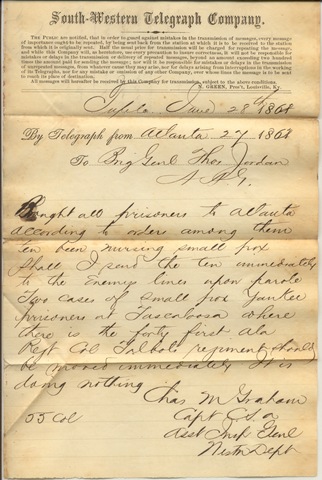
June 27, 1862: Charles M. Graham telegram to Thomas Jordan

Pierre Gustave Toutant Beauregard was a Louisiana-born general of the Confederate States Army. He had graduated second in his class from West Point in 1838 and was an admirer of Napoleon. He achieved fame early in the Civil War for commanding the Fort Sumter bombardment and as the victor of the first battle of Manassas. He later served in the Western Theater (including Shiloh and Corinth), Charleston, and the defense of Richmond, but his career was hampered by friction with Jefferson Davis and other generals.

This is one of approximately 1000 military telegrams in P.G.T. Beauregard’s papers at the Rosenbach.

AMs 1168-11 1862-06-27


Transcript:

Tupelo, June 28 1862

By Telegraph from Atlanta 27 1862

To Brig Genl Thos Jordan AAG

Brought all prisoners to Atlanta according to orders among them ten have been nursing small pox shall I send the ten immediately to the enemies lines upon parle. Two cases of small pox Yankee prisoners at Tuscaloosa where there is the forty first Ala Regt Col Talbots regiment should be moved immediately. It is doing nothing.

Chas M Graham

Capt. CSA

Asst Insp Genl

Western Dept.


Citation: Charles M. Graham, telegram to Thomas Jordan. Atlanta, 27 June 1862. AMs 1168/11

June 26, 1862: A. Gerard telegram to Thomas Jordan

Pierre Gustave Toutant Beauregard was a Louisiana-born general of the Confederate States Army. He had graduated second in his class from West Point in 1838 and was an admirer of Napoleon. He achieved fame early in the Civil War for commanding the Fort Sumter bombardment and as the victor of the first battle of Manassas. He later served in the Western Theater (including Shiloh and Corinth), Charleston, and the defense of Richmond, but his career was hampered by friction with Jefferson Davis and other generals.

This is one of approximately 1000 military telegrams in P.G.T. Beauregard’s papers at the Rosenbach.

1168-11 1862-6-26

  Transcript:

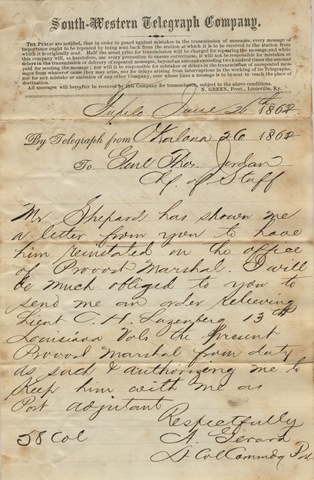
Tupelo, June 26th 1862

By telegraph from Okalona 26 1862

To Genl Thos. Jordan

Chf. of Staff

Mr. Shepard has shown me a letter from you to have him reinstated in the office of Provost Marshal. I will be much obliged to you to send me an order relieving Lieut. C. H. Luzenberg 13th Louisiana Vols  the present Provost Marshal from duty as such & authorizing me to keep him with me as Post adjutant.

Respectfully

A Gerard

Lt Col Commdg Post


Citation:A. Gerard, telegram to Thomas Jordan. Okolona, Miss.; 26 June 1862. AMs 1168/11