December 10, 1863: Herman Melville to Sophia Van Matre

Melville is writing in response to a request for a donation of autographs from his old letters to be auctioned at the Great Western Sanitary Fair in Cincinnati.  Van Matre had apparently met Melville several years earlier through his friend Sarah Morewood.            


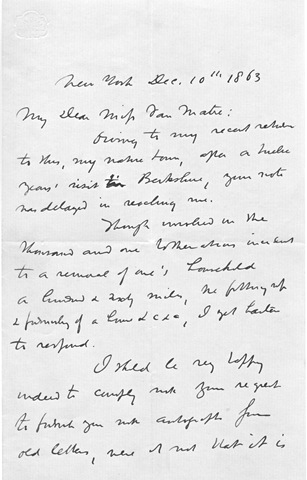
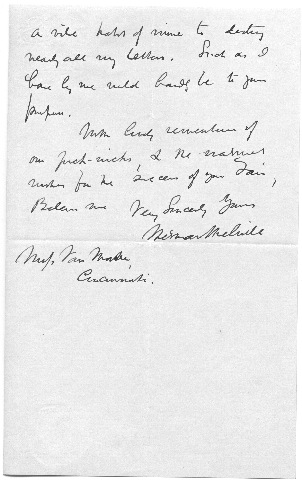
AMs 1181-1 p1 Herman Melville to Sophia Van Matre AMs 1181-1 p2 Herman Melville to Sophia Van Matre

Transcript:

New York Dec. 10th 1863

My Dear Miss Van Matre:

Owing to my recent return to this, my home town, after a twelve years’ visit to Berkshire, your note was delayed in reaching me.

Though involved in the thousand one botherations included to a removal of one’s household a hundred & sixty miles, the following up & furnishing of a home &c &c, I yet hasten to respond.

I should be very happy indeed to comply with your request to furnish you with autographs from old letters, were it not that it is a vile habit of mine to destroy nearly all my letters. Such as I have by me would hardly be to your purpose.

With lively remembrance of our pick-nicks, & [illeg.] wishes for the success of your Fair

Believe me Very Sincerely Yours

Herman Melville


Citation:

October 7, 1863: Salmon P. Chase to Cyrus Field

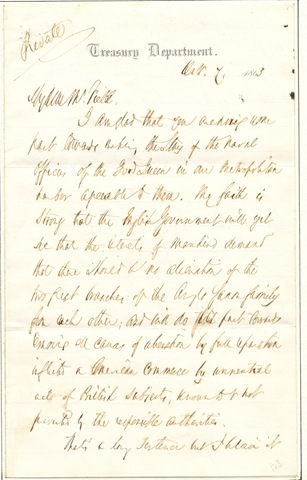
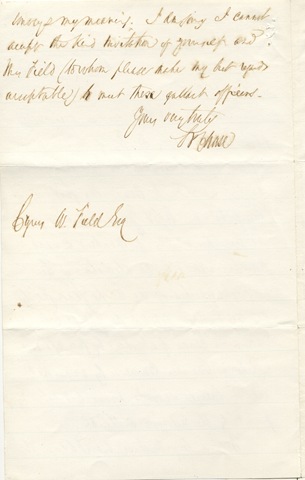
Cyrus Field was the founder of the Atlantic Telegraph Company, which laid the first trans-Atlantic telegraph cable; a project which gave him close ties with British politicians and businessmen. AMs 527-8-2 p1 Salmon P Chase to Cyrus W Field AMs 527-8-2 p2 Salmon P Chase to Cyrus W Field

Transcript:

Oct 7, 1863

My dear Mr. Field,

I am glad that you are doing your part towards making the stay of the naval officers of the Good Queen in our Metropolitan harbor agreeable to them. My faith is strong that the English Government will yet see that the interests of Mankind demand that there should be no alienation of the two right branches of the Anglo Saxon family from each other; and will do their part towards erasing all causes of alienation by full separation inflicted on American commerce by unneutral acts of British subjects known to be not prevented by the responsible authorities.

That’s a long sentence but I believe it conveys my meaning. I am sorry I cannot accept the kind invitation of yourself and Mrs Field (to whom please make my best regards acceptable) to meet these gallant officers.

Yours very truly

SP Chase


Citation: Salmon P. Chase (1808-1873), autograph letter signed to Cyrus W. Field. Washington, D. C.; 7 October 1863. AMs 527/8.2

September 11, 1863: Address to the Union State Central Committee

This is an address to the Republican Party of Pennsylvania concerning the election of the Governor of the Commonwealth and the Judge of its Supreme Judicial tribunal. The Republican candidates for 1863 were Andrew G. Curtin and Daniel H. Agnew against the Democratic candidates George W. Woodward and Walter H. Lowrie. The address places the election not simply in its local context, but in the larger national conflict of the civil war.

A 863ad

“It is not vague commonplace but solemn truth to say, that there never was a political context in America whose issues were so important and so vital to the life of the republic as are those involved in the pending canvas. In other days we prudently occupied our minds with questions of State policy, local alike in their interest and their influence; but to-day the citizens of Pennsylvania ascend to the higher and broader ground whereon the nation struggles for its life, and the ballots of free-men were never more weighty with great consequences than those now resting in their hands, containing, as they probably do, not only the question of civil war at our own homes, not only the fate of our Constitution and Union, but the destiny of free government throughout the world.”

The address goes on to explain how the Democratic candidates have publically and privately supported the South’s rebellion.

“The faction in Pennsylvania, wearing the livery of the good old Democratic party to aid rebellion waged in the interest of an aristocracy of slaveholders, thus openly avows its opinions, and in manifold ways, by speech and press, by the secret oaths of a treasonable conspiracy, by appeals to the prejudices of ignorant men, by calumnies against our brave soldiers and sailors, by denial of their rights of suffrage, and by constant misrepresentations of the aims and results of the war, endeavors to attain its purpose of assisting the armed traitors who are striking deadly blows at the heart of the republic.”

The speech concludes by calling on the citizens of Pennsylvania to remain loyal to the federal government, President Lincoln, and the republic.

“Freemen of Pennsylvania: The issue is thus distinctly presented involving the single question of loyalty to the government under which you live, and the triumph of whose arms alone can give you peace, and again open to you the avenues to that almost miraculous prosperity which attracted the wondering gaze of nations.

It only remains for all good men to perfect the local organizations of the friends of the Union, to secure full discussion of the questions in dispute, to bring every loyal vote to the polls, and to use all proper efforts in their power to secure our success. If this is done, Pennsylvania is saved to the Union, and the Union is saved to us and to our posterity.”

Citation: [Republican Party (Pa.). State Central Committee; McVeagh, Wayne], Address of the Union State Central Committee of Pennsylvania. [1863] A 863add

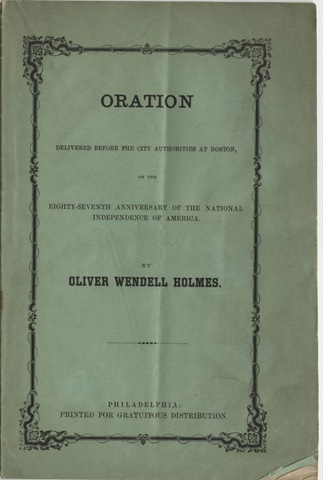
July 22, 1863: Oliver Wendell Holmes, Oration Delivered Before the City Authorities at Boston

This is the publication of a speech given on July 4, 1863 which corresponded with the eighty-seventh year of American Independence. The oration was given by Oliver Wendell Holmes in front of the city authorities of Boston. The pamphlet was published in 1863, but the exact date isn’t known.
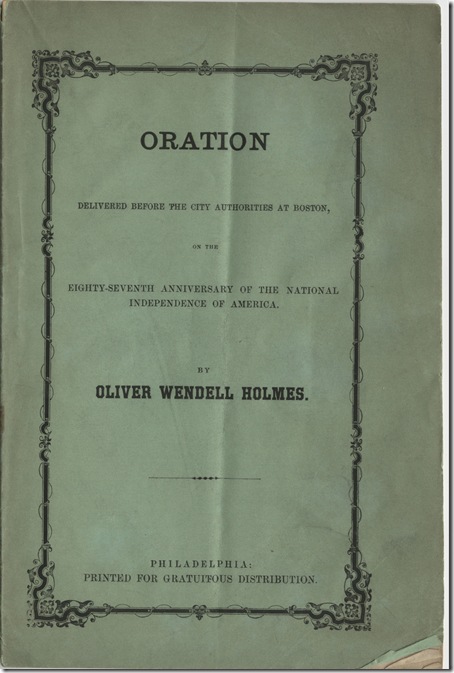
A 863o

In the speech, Holmes calmly and compassionately addresses the distress of the American citizen. He begins by explaining how his Independence Day speech must differ from previous orations.

“It is our first impulse, upon this returning day of our Nation’s birth, to recall whatever is happiest and noblest in our past history, and to join our voices in celebrating the statesmen and the heroes, the men of thought and the men of action, to whom that history owes its existence. In other years this pleasing office may have been all that was required of the holiday speaker. But to-day, when the very life of the nation is threatened, when clouds are thick about us, and men’s hearts are throbbing with passion, or failing with fear, it is the living question of the hour, and not the dead story of the past, which forces itself into all minds, and will find unrebuked debate in all assemblies…”

He mentions the frustration, the bitterness, and the disbelief the civil war has caused.

“As we look at the condition in which we find ourselves on this fourth day of July, 1863 in the 88th year of American Independence, we may well ask ourselves what right we have to indulge in public rejoicings. If the war in which we are engaged is an accidental one, which might have been avoided but for our fault; if it is for any ambitious or unworthy purpose on our part; if it is hopeless, and we are madly persisting in it; if it is our duty and in our power to make a safe and honorable peace, and we refuse to do it; if our free institutions are in danger of becoming subverted, and giving place to an irresponsible tyranny; if we are moving in the narrow circles which are to engulf us in national ruin; then we had better sing a dirge and leave this idle assemblage, and hush the noisy cannon which are reverberating through the air, and tear down the scaffolds which are soon to blaze with fiery symbols; for it is mourning and not joy that should cover the land; there should be silence, and not the echo of noisy gladness in our streets; and the emblems with which we tell our nation’s story and pre-figure its future, should be traced not in fire but in ashes.”

Holes goes on to argue, however, that the current conflict was inevitable, and necessary for maintaining the Republic.

“The war in which we are engaged is for no meanly ambitious or unworthy purpose. It was primarily, and is to this moment, for the preservation of our national existence….Not to have fought would have been to be false to liberty everywhere, and to humanity. ”

He concludes by addressing the fallen and hurt veterans whose sacrifice should carry the Republic to continued resolve.

“Citizens of Boston, sons and daughters of New England, men and women of the North, brothers and sisters in the bond of the American Union, you have among you the scarred and wasted soldiers who have shed their blood for your temporal salvation. They bore your Nation’s emblems bravely through the fire and smoke of the battle-field nay, their own bodies are scarred with bullet-wounds and striped with sabre-cuts, as if to mark them as belonging to their Country until their dust becomes a portion of the soil which they defended. In every Northern graveyard slumber the victims of this destroying struggle. Many whom you remember playing as children amidst the clover blossoms of our Northern fields, sleep under nameless mounds with strange Southern wild-flowers blooming over them.

By the wounds of living heroes, by the graves, of fallen martyrs, by the hopes of your children and the claims of your children’s children yet unborn, in the name of outraged honor, in the interest of violated sovereignty, for the sake of an imperiled Nation, for the sake of men everywhere and of our common humanity, for the glory of God and the advancement of His kingdom on earth, your country calls upon you to stand by her through good report and through evil report, in triumph and in defeat…until the flag that fell from the wall of Fort Sumter floats once more, inviolate, supreme, over all her ancient inheritance, every fortress, every capital, every ship, and this warring land is once more a United Nation!”

Citation: Oliver Wendell Holmes, Oration delivered before the city authorities at Boston on the eighty seventh anniversary of the national independence of America. Philadelphia, 1863. A 863o.
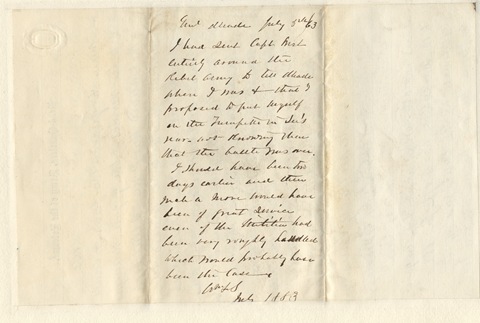
July 5, 1863: George Meade to William Farrar Smith

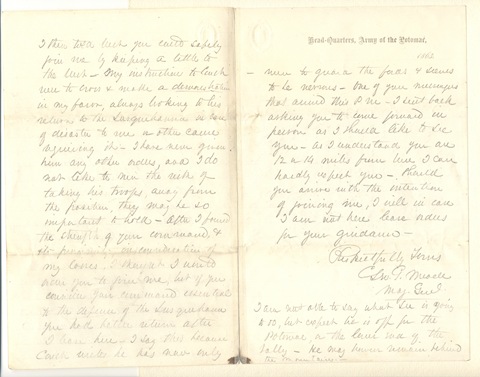
AMs 365-15 p1 Meade to William Farrar Smith  300 dpi AMs 365-15 p2-3 Meade to William Farrar Smith  300 dpi AMs 365-15 p4Meade to William Farrar Smith  300 dpi

Transcript:

Head-Quarters, Army of the Potomac

Gettysburg July 5. 8 P.M. 1863

Genl. W. F. Smith

Dear Genl.-

West left here this morning. When he arrived last night the enemy were apparently in full force before my centre & left, but had withdrawn from my right—I knew he was in a strong position awaiting my attack, which I declined to make in consequence of the bad example he had set me, in ruining himself in attacking a strong position—at the same time I feel a little nervous about your position as Couch telegraphed you were going to Cashtown, where I could not have helped you—I therefore retained but till morning, when we found the enemy had retired on the Cashtown & Fairfield walls. I then told Couch you could safely join me by keeping a little to the left—my instructions to Couch were to cross & make a demonstration in my favor, always looking to his return to the Susquehanna in case of disaster to me or other cause requiring it—I have never given him any other orders, and I do not like to run the risk of taking his troops away from the position they may be so important to hold—After I found the strength of your command, & its proximity, in consideration of my lines, I thought I invited you to join me, but if you consider your command essential to the defence of the Susquehanna you had better return after I leave here—I say this because Couch insists he has now only men to guard the forces & seems to be nervous—One of your messengers that arrived this P.M—I sent back asking you to come forward in person as I should like to see you—As I understand you are 12 or 14 miles from here I can hardly expect you—Should you arrive with the intention of joining me, I will in case I am not here leave notes for your guidance—

Respectfully yours

Geo. G. Meade

Maj. Genl.

I am not able to say what Lee is going to do, but expect he is off for the Potomac,a the lower [illeg.] of the valley. He may however remain behind the mountains.

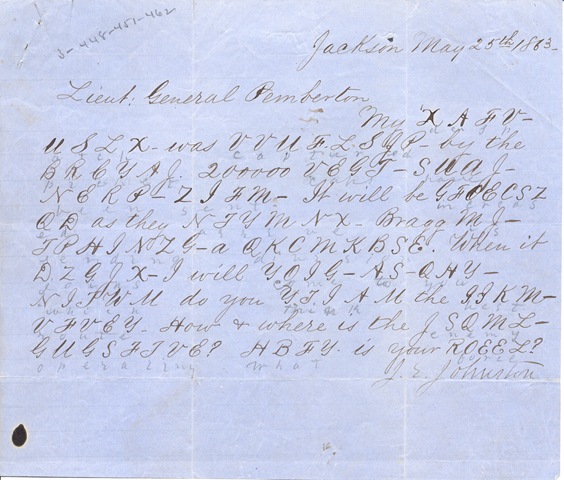
May 25, 1863: Joseph Johnston Coded Message to John Pemberton

AMs 357-14.2 p1 Joseph E. Johnston to John Clifford Pemberton

Transcript:

Jackson May 25th 1863.

Lieut: General Pemberton

My XAFVUSLX [dispatch] was VVUFLSJP[captured] by the BRCYAJ[picket]. 200000 VEGT[caps] SUAJ[have] NERP [been]ZJFM [sent]It will be GFOECSZQD [increased] as they NTYMNX[arrive] Bragg MJ [is] TPHINZG[sending] a QKCMKBSE[division]. When it DZGJX [joins] I will YOJG [come] AS [to] QHY [you] NJTWM [which]do you YTJAM [think] the JJKM [best] VFVEY [route] How & where is the JSQML[enemy] GUGSFJVE[operating]? HBFY [what] is your ROEEL [force]?

J. E. Johnston


Citation: Joseph E. Johnston (1807-1891), letter signed(cipher). Jackson, Miss; 25 May 1863. AMs 357/14.2

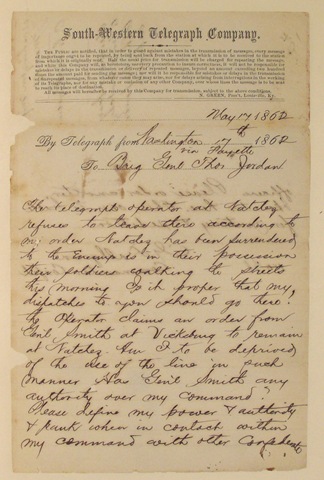
May 17, 1862: Charles Dahlgren telegram to Thomas Jordan

Pierre Gustave Toutant Beauregard was a Louisiana-born general of the Confederate States Army. He had graduated second in his class from West Point in 1838 and was an admirer of Napoleon. He achieved fame early in the Civil War for commanding the Fort Sumter bombardment and as the victor of the first battle of Manassas. He later served in the Western Theater (including Shiloh and Corinth), Charleston, and the defense of Richmond, but his career was hampered by friction with Jefferson Davis and other generals.

This is one of approximately 1000 military telegrams in P.G.T. Beauregard’s papers at the Rosenbach.

Telegram 5-17-62 Dahlgreen to Jordan 10 mp


Transcript:

May 17 1862

By Telegraph from Washington via Fayette 17th 1862

To Brig Genl Tho Jordan

The telegraph operator at Natchez refuses to leave there according to my order. Natchez has been surrendered to. the Enemy is in their possession. their soldiers walking the streets this morning. Is it proper that my dispatches to open should go there? the Operator claims an order from Gen’l Smith at Vicksburg to remain at Natchez. Am I to be deprived of the use of the line in such manner. Has Gen’l Smith any authority over my command? Please define my power & authority & rank when in contact within my command with other Confederate officers. Please order another operator here. This one is liable for mutiny & sedition.

C. Dahlgreen

Commander Confe


Citation: Charles G. Dahlgren (1811-1888), telegram to Thomas Jordan. 17 May 1862. AMs 434/16

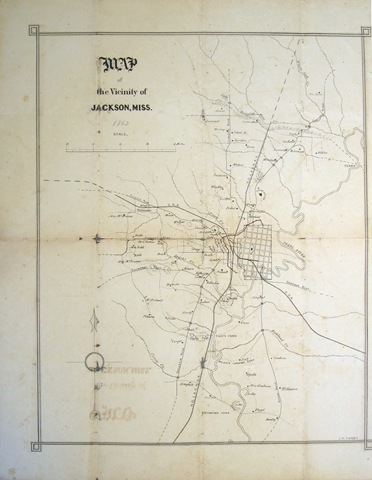
May 14, 1863: Map of Jackson, Mississippi

This map is one of twenty-four military maps and drawings in a collection of papers from Confederate General P.G.T. Beauregard. The map is dated only 1863, but the Battle of Jackson took place on May 14, 1863.


Citation:  Map of the vicinity of Jackson, Miss. [1863]. AMs 1168/11

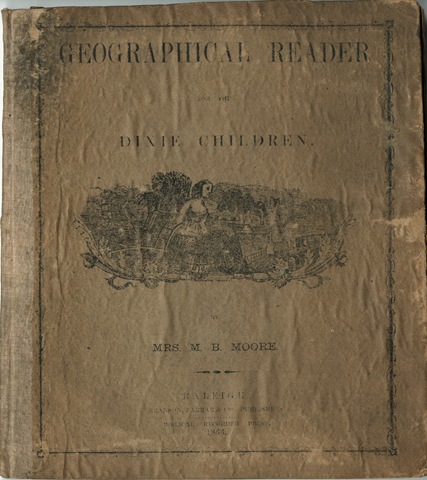
May 10, 1863: Geographical Reader for the Dixie Children

A 863 Geographical reader for Dixie Children

Excerpt:

Lesson XII

North America

The United States

  1. This was once the most prosperous country in the word. Nearly a hundred years ago it belonged to England; but the English made such hard laws that the people said they would not obey them. After a long, bloody war of seven years, they gained their independence; and for many years were prosperous and happy.
  2. In the mean time both English and American ships went to Africa and brought away many of those poor heathen negroes, and sold them for slaves. Some people said it was wrong and asked the King of England to stop it. He replied that “he knew it was wrong; but that slave trade brought much money into his treasury, and it should continue.” But both countries afterwards did pass laws to stop this trade. In a few years, the Northern States finding their climate too cold for the negro to be profitable, sold them to the people living farther South. Then the Northern States passed laws to forbid any person owning slaves in their borders.
  3. Then the northern people began to preach, to lecture, and to write about the sin of slavery. The money for which they sold their slaves, was now partly spent in trying to persuade the Southern States to send their slaves back to Africa. And when the territories were settled they were not willing for any of them to become slaveholding. This would soon have made the North much stronger than the South; and many of the men said they would vote for a law to free all the negroes in the country. The Southern men tried to show them how unfair this would be, but still they kept on.

Citation: Miss M. B. Moore, Geographical reader for the Dixie children. Raleigh, N.C.: Branson, Farrar, & Co, 1863. A 863g

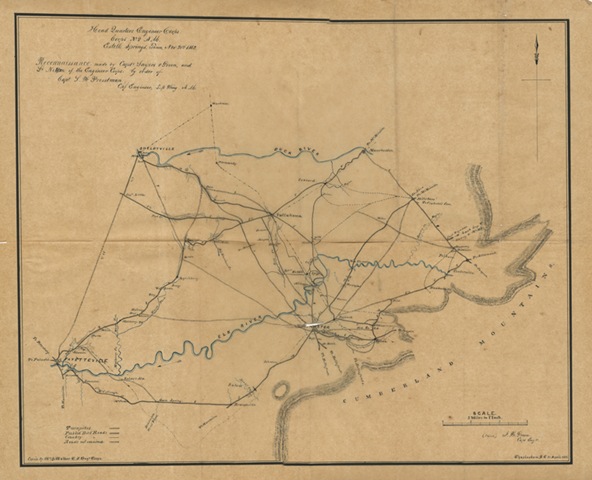
April 28, 1863: Map of North Carolina and Tennessee

1168-11 Sayers, Green, Nelson

This map of the area around Estill Springs, Tennessee, made from the reconnaissance of Captains Sayers & Green and Liuetenant Nelson of the Engineer Corps one of twenty-four military maps and drawings in a collection of papers from Confederate General P.G.T. Beauregard. The map notes that the reconnaissance was carried out November 21, 1862 and this copy of the map was created on April 28, 1863.


Citation: Reconnaissance made by Capts Sayers & Green and Lt.  Nelson of the Engineer Corps. Estelle [i.e. Estill] Springs, Tenn. 21 November 1862.Copied by William A Walker. Charleston S.C., 28 April 1863. AMs 1168/11