March 13, 1865: New York Tribune

top

Tribune (excerpt):

Page 1, Lower Half

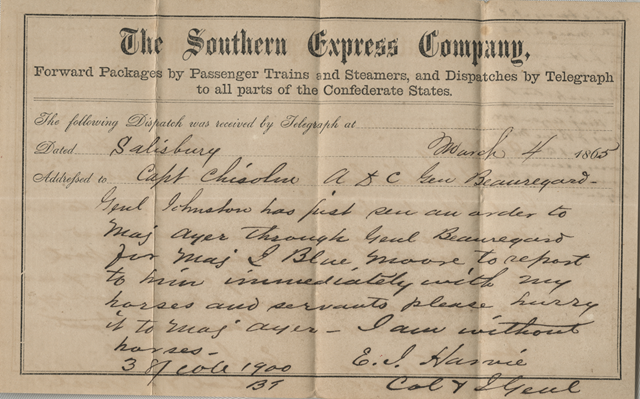
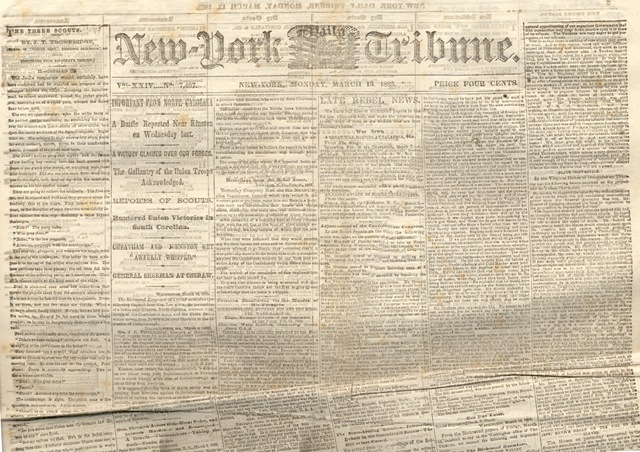
From our Special Correspondent

Wilmington, N.C., March 7, 1865

Advices deemed trustworthy have been received here from Gen. Sherman confirming reports which reached us several days since, to the effect that his main army passed into North Carolina at least four days ago. His route lay through Cheraw, S.C. The Rebel forces of Gen. Hardee are reported to be lying on the two sides of the Pedee, which river Gen. Sherman had successfully crossed, placing himself between Hardee and Beauregard. The direction taken by the Union army since entering North Carolina it would be contraband to mention. What may have occurred during the last day or two, or whether there has been any meeting of the two armies, it is not positively known here, though it is not expected that any general battle can occur for some time to come.


Citation: New York Daily Tribune. 13 March 1865. Gift of Steven and Susan Raab.
March 12, 1865: E. Willis telegram to P. G. T Beauregard

Pierre Gustave Toutant Beauregard was a Louisiana-born general of the Confederate States Army. He had graduated second in his class from West Point in 1838 and was an admirer of Napoleon. He achieved fame early in the Civil War for commanding the Fort Sumter bombardment and as the victor of the first battle of Manassas. He later served in the Western Theater (including Shiloh and Corinth), Charleston, and the defense of Richmond, but his career was hampered by friction with Jefferson Davis and other generals.

This is one of approximately 1000 military telegrams in P.G.T. Beauregard’s papers at the Rosenbach.

1168-11 1865-3-12

Transcript:

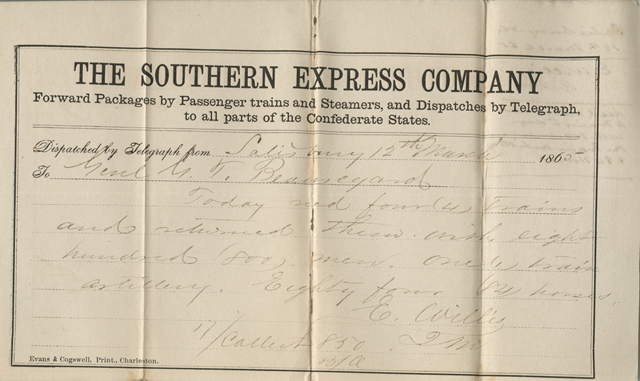
Dispatched by telegram from Salisbury 12 March 1865

To Genl G. T. Beauregard

Today  rec’d four (4) trains  and returned them with eight hundred (800) men. One (1) train artillery. Eighty four (84) horses.

E. Willis

QM


Citation: E. Willis, telegram to P. G. T Beauregard.Salisbury, 12 March 1865. AMs 1168/11

March 11, 1865: New York Tribune

top

Transcript (excerpt):

Page 1, Upper Half

Wilmington, Feb. 25, 1865.

Blockade-Running.

From small beginnings, when only two of three vessels were employed in contraband trade blockade-running grew to an immense commerce. Ships averaging from a capacity of from 500 to 1,500 and even 1,900 bales were employed. They were mostly English built vessels, and manned by English crews. Each vessel was obliged by law to bring and carry away one-third of their cargoes on account of the Confederacy. This rule was adopted within the last 12 months. Their inward cargoes were assorted, and consisted of every article which would sell most rapidly and at the highest rates. The Jews were the principal capitalists, and reaped the chief benefits of the trade. Many made large fortunes. Israelites swarmed everywhere, and astonished everybody by their numbers and activity in the business.


Citation: New York Daily Tribune. 11 March 1865. Gift of Steven and Susan Raab.
March 10, 1865: Robert E. Lee to P. G. T. Beauregard

Pierre Gustave Toutant Beauregard was a Louisiana-born general of the Confederate States Army. He had graduated second in his class from West Point in 1838 and was an admirer of Napoleon. He achieved fame early in the Civil War for commanding the Fort Sumter bombardment and as the victor of the first battle of Manassas. He later served in the Western Theater (including Shiloh and Corinth), Charleston, and the defense of Richmond, but his career was hampered by friction with Jefferson Davis and other generals.

This telegram is from The Telegraphic History of the Civil War; a compiled album of telegrams to Beauregard from Davis, Lee, Johnston and others.

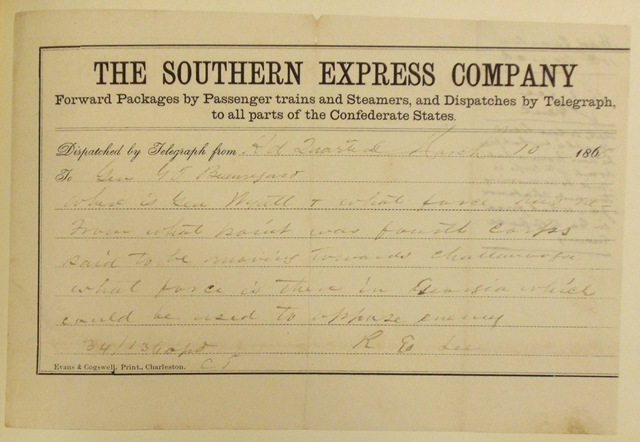
Telegram 3-10-65 Lee to Beauregard 10 mp

Transcript:

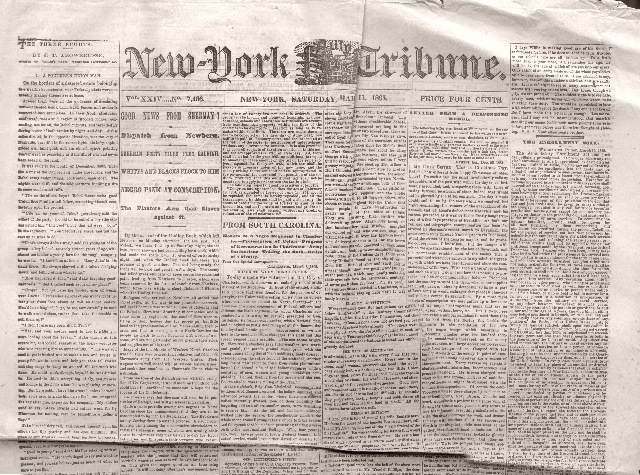
Dispatched by Telegraph from Hd Quarters March 10 1865

To Gen GT Beauregard

Where is Gen Wyatt & what force has he – from what point was fourth corps said to be moving towards Chattanooga what force is there in Georgia which could be used to oppose enemy

R. E. Lee

34/1360 pd

CT


Citation:Robert E. Lee (1807-1870), telegram to G.T. Beauregard. 10 March 1865. In The telegraphic history of the Civil War, 1861-1865. AMs 434/16

March 9, 1865: L. Mollon telegram to George W. Brent

Pierre Gustave Toutant Beauregard was a Louisiana-born general of the Confederate States Army. He had graduated second in his class from West Point in 1838 and was an admirer of Napoleon. He achieved fame early in the Civil War for commanding the Fort Sumter bombardment and as the victor of the first battle of Manassas. He later served in the Western Theater (including Shiloh and Corinth), Charleston, and the defense of Richmond, but his career was hampered by friction with Jefferson Davis and other generals.


This is one of approximately 1000 military telegrams in P.G.T. Beauregard’s papers at the Rosenbach.

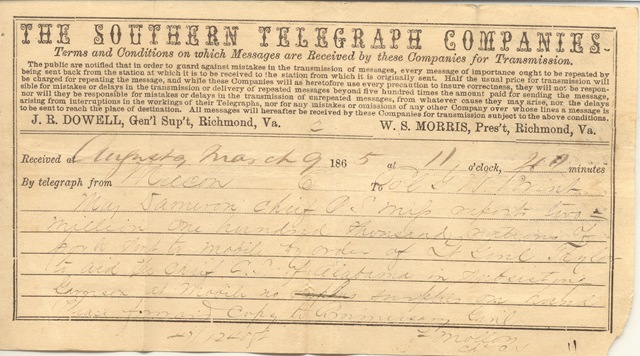
AMs 1168-11 1865-03-09


Transcript:

Received at Augusta March 9 1865 at 11 o’clock 40 minutes

By telegraph from Macon 6 to Col G.W. Brent

Maj. Dameron chief P.S. Miss reports two million one hundred thousand rations of pork sent to mobile by order of Lt Genl. Taylor to aid the chief C.S. of Alabama in subsisting Garrison at Mobile no supplies on hand Please forward copy to Commissary Genl.

L. Mollon


Citation:L. Mollon, telegram to George W. Brent. Macon, Ga.; 9 March 1865. AMs 1168/11

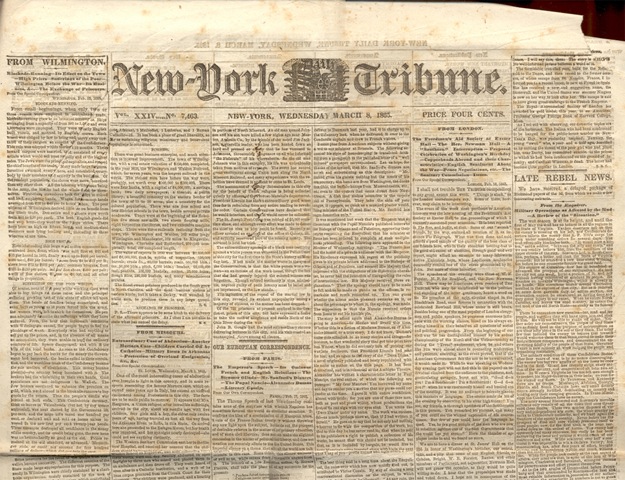
March 8, 1865: New York Tribune

top

Excerpt (transcript):

Page 1, Upper Half

Wilmington, Feb. 25, 1865.

Blockade-Running.

From small beginnings, when only two of three vessels were employed in contraband trade blockade-running grew to an immense commerce. Ships averaging from a capacity of from 500 to 1,500 and even 1,900 bales were employed. They were mostly English built vessels, and manned by English crews. Each vessel was obliged by law to bring and carry away one-third of their cargoes on account of the Confederacy. This rule was adopted within the last 12 months. Their inward cargoes were assorted, and consisted of every article which would sell most rapidly and at the highest rates. The Jews were the principal capitalists, and reaped the chief benefits of the trade. Many made large fortunes. Israelites swarmed everywhere, and astonished everybody by their numbers and activity in the business.


Citation: New York Daily Tribune. 8 March 1865. Gift of Steven and Susan Raab.
March 7, 1865: New York Tribune

top

Transcript (excerpt):

Page 1, Upper Half

The splendid successes which have lately attended the Union arms were yesterday fitly commemorated by the people of New York. Emerging from years of sacrifice and suffering, the great Empire City cast aside her mourning robes once more for the habiliments of happiness and shone out with all her old time splendor. In the telling victories recently won by the armies of the Union every one sees assurance of an early and an honorable peace. And this assurance, no less than the natural exultation which accompanies the hour of triumph, lent strength and vigor to the popular demonstration. And unquestionably it was one of the most enthusiastically unanimous exhibitions of public rejoicing that the city ever beheld.


Citation: New York Daily Tribune. 7 March 1865. Gift of Steven and Susan Raab.
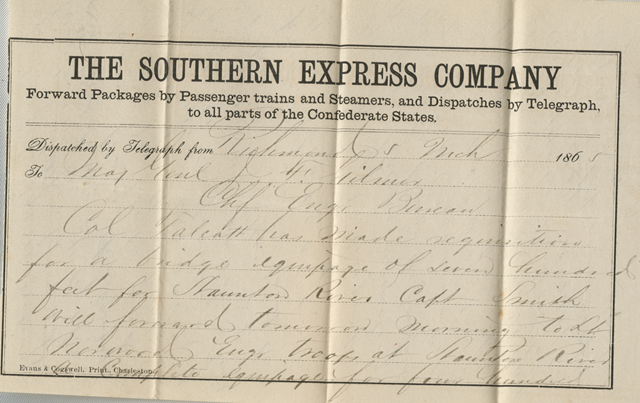
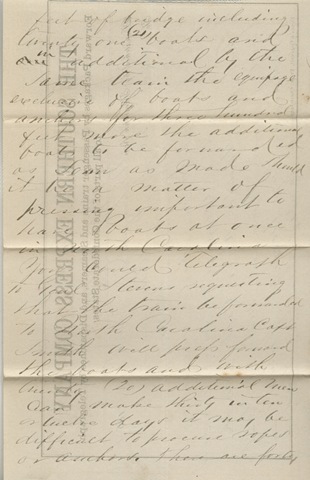
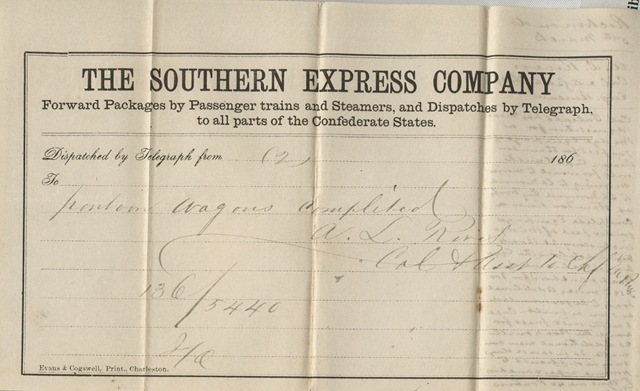
March 5, 1865: Telegram to J. F. Gilmer

Pierre Gustave Toutant Beauregard was a Louisiana-born general of the Confederate States Army. He had graduated second in his class from West Point in 1838 and was an admirer of Napoleon. He achieved fame early in the Civil War for commanding the Fort Sumter bombardment and as the victor of the first battle of Manassas. He later served in the Western Theater (including Shiloh and Corinth), Charleston, and the defense of Richmond, but his career was hampered by friction with Jefferson Davis and other generals.

This is one of approximately 1000 military telegrams in P.G.T. Beauregard’s papers at the Rosenbach.

1168-11 1865-3-5

1168-11 1865-3-5 p2

1168-11 1865-3-5 p3

Transcript:

Dispatched by telegram from Richmond 5 March 1865

To Maj. Genl. J. F. Gilmer  Chf Eng Bureau

Col. Talett has made requisition for a bridge equipage of seven hundred feet for Staunton River Capt. Smith will forward tomorrow morning to Lt. Norwood Engr troops at Staunton River & complete equipage for four hundred feet of bridge including twenty one (21) boats and in additional by the same train the equipage exclusive of boats and anchors for the hundred feet more. The additional boats to be forwarded as soon as made  should it be a matter of pressing important to have boats at once in North Carolina you could telegraph to Genl. Stevens requesting that the train be forwarded to North Carolina Capt Smith will press forward  the boats and with twenty (20) additional men can them thirty  in ten or twelve days it may be difficult to procure ropes or anchors. There are forty pontoon wagons completed.

A . L. {Roves?]

Col. & Asst to Chf Engrs


Citation: A. L. [Roves?], telegram to J. F. Gilmer. Richmond,5 March 1865. AMs 1168/11

March 4, 1865: E. J. Harris telegram to P. G. T. Beauregard

Pierre Gustave Toutant Beauregard was a Louisiana-born general of the Confederate States Army. He had graduated second in his class from West Point in 1838 and was an admirer of Napoleon. He achieved fame early in the Civil War for commanding the Fort Sumter bombardment and as the victor of the first battle of Manassas. He later served in the Western Theater (including Shiloh and Corinth), Charleston, and the defense of Richmond, but his career was hampered by friction with Jefferson Davis and other generals.

This is one of approximately 1000 military telegrams in P.G.T. Beauregard’s papers at the Rosenbach.

1168-11 1865-3-4

Transcript:

Dated Salisbury March 4 1865

Addressed to Capt Chisolm ADC Gen Beauregard

Genl Johnston has just seen an order to Maj Ayer through Genl Beauregard for Maj L Blue Moore to report to him immediately  with my horses and servants please hurry it to Maj Ayer–I am without horses.

E. J. Harris

Col & L Genl

Citation: E. J. Harris, telegram to G. T. Beauregard. Salisbury, 4 March 1865. AMs 1168/11

March 3, 1865: New York Tribune

top

Transcript (excerpt):

Page 1, Upper Half

The draft for Jersey City was commenced at Newark yesterday, and the first two wards completed. The Third and Fourth will be drawn to-day. Hoboken was also drafted yesterday.

Gen. Townsend writes to Mayor Gunther of this city that, for the present, men enlisted within the County of New York for the Regular Army, will be reported for that county only.

An important order regulating the payment of bounties has been issued from the Adjunct-General’s office at Albany. The State henceforth pays all bounties.

Lovelaceville and Hopkinsville, Ky., were visited this week by McDougald’s band of guerrillas, who robbed stores and shot Union men at their pleasure.

Gen. Grierson is to have charge of all the cavalry in the Department of the West.


Citation: New York Semi-Weekly Tribune. 3 March1865. Gift of Steven and Susan Raab.