January 25, 1865: U.S. Grant to Henry Halleck


 AMS 465-8-12

Transcript:

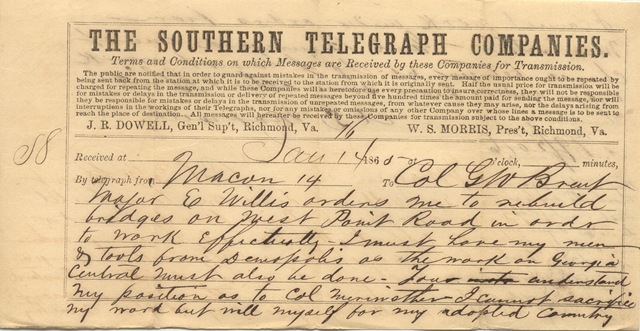
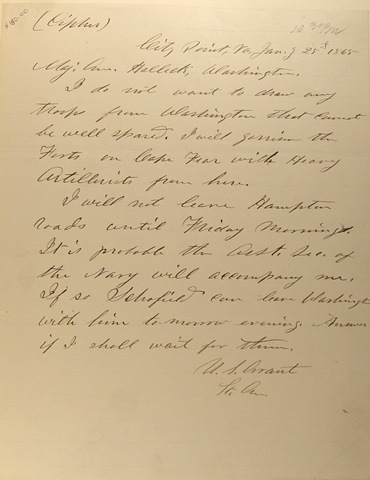
City Point, Va. Jan. 25th 1865

Maj. Gen. Halleck, Washington,

I do not want to draw any troops from Washington that cannot be well spared. I will garrison the Forts on Cape Fear with Heavy Artillerists from here.

I will not leave Hampton Roads until Friday morning. It’s probable the Asst. Sec. of the Navy will accompany me. If so Schofield can leave Washington with him to-morrow evening. Answer if I shall wait for them.

U. S. Grant

Lt. Gen.


Citation: Ulysses S. Grant (1822-1885), autograph letter signed to Henry W. Halleck. City Point, Va.; 25 January 1865. AMs 435/8.12

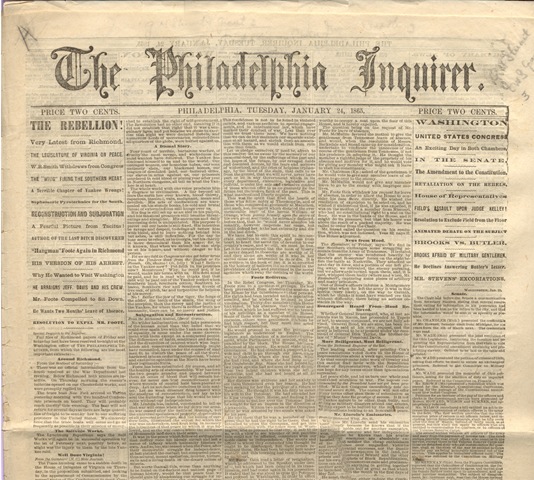
January 24, 1865: Philadelphia Inquirer

top

Transcript (excerpt):

“Habeas Corpus”

“In the Rebel House of Representative, on January 20th, the resolution against suspending the habeas corpus was voted down-43 to 26.

If we would have peace we must first gain victories. The army must have more men and new and better organization. This is the only work for congress to do. Let them do it and do it quickly. Turn peace over to Mr. Blair and Mr. Foote. Let them hob-knob over it to their heart’s content, and whether this side or the other of the Potomac makes no matter. War and war measure for the Congress of this Confederacy is the only thing now left for our Legislatures.”


Citation: Philadelphia Inquirer. Philadelphia, 24 January 1865. Gift of Steven and Susan Raab. AN .P5546

January 23, 1865: U.S. Grant to Henry Halleck

AMs 774-18 Ulysses S Grant to Henry W Halleck

Transcript:

Head Quarters Armies of the United States

City Point, Va, Jan. 23d 1865

Maj. Gen. Halleck, Washington

Order Maher to Alexandria. We will send Schofields Corps first and add this detachment to it until such time as it can be got to Sherman. It is too late now for it to reach Sherman from Pocotaligo.

U.S. Grant

Lt. Gen.


Citation: Ulysses S. Grant (1822-1885), autograph letter signed to Henry W. Halleck. City Point, Va., 23 January 1865. AMs 774/18

January 22, 1865: George W. Brent telegram to P. G. T. Beauregard

Pierre Gustave Toutant Beauregard was a Louisiana-born general of the Confederate States Army. He had graduated second in his class from West Point in 1838 and was an admirer of Napoleon. He achieved fame early in the Civil War for commanding the Fort Sumter bombardment and as the victor of the first battle of Manassas. He later served in the Western Theater (including Shiloh and Corinth), Charleston, and the defense of Richmond, but his career was hampered by friction with Jefferson Davis and other generals.

This is one of approximately 1000 military telegrams in P.G.T. Beauregard’s papers at the Rosenbach.

AMs 1168-11 1865-01-22

Transcript:

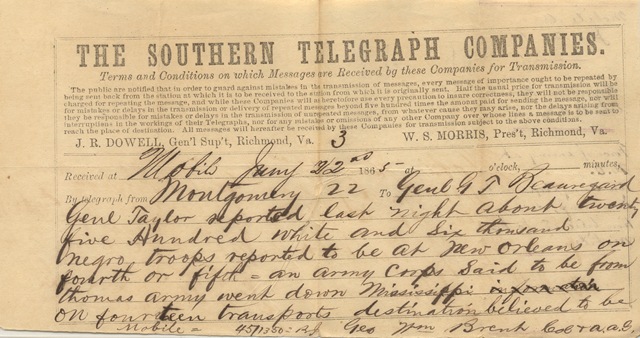
Received at Mobile Jany 22nd 1865

By telegraph from Montgomery 22 to Genl G T Beauregard

Genl Taylor deported last night about twenty five hundred white and six thousand negro troops reported to be at New Orleans on fourth or fifth=an army corps said to be from Thomas army went down Mississippi on fourteen transports destination believed to be Mobile.

Geo Wm Brent Col. & A.A.G.


Citation: George W. Brent , telegram to G. T. Beauregard. Montgomery, Ala; 22 January 1865. AMs 1168/11

January 20, 1865: U. S. Grant to Edward Ord and George Meade

AMs 774-16 Ulysses S Grant to Edward Ord and Meade

Transcript:

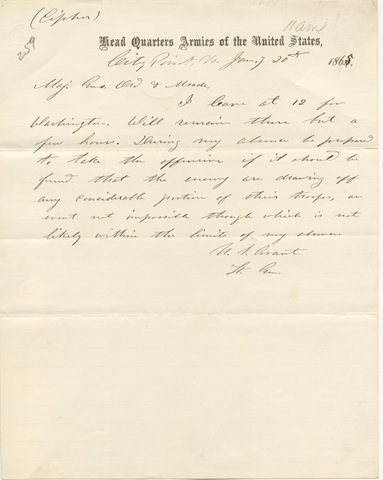
Head Quarters Armies of the United States,

City Point, Va. Jany 20th 1865

Maj Gens. Ord & Meade,

I leave at 12 for Washington. Will remain there but a few hours. During my absence be prepared to take the offensive if it should be found that the enemy are drawing off any considerable portion of their troops, an event not impossible though which is not likely within the limits of my absence.

U.S. Grant

Lt. Gen.


Citation: Ulysses S. Grant (1822-1885), autograph letter signed to Edward O.C. Ord and George G. Meade. City Point, Va.; 20 January 1865. AMs 774/16

January 19, 1865: Dabney Maury telegram to George William Brent

Telegram 1-19-65 Maury to Brent 10 mp

Transcript:

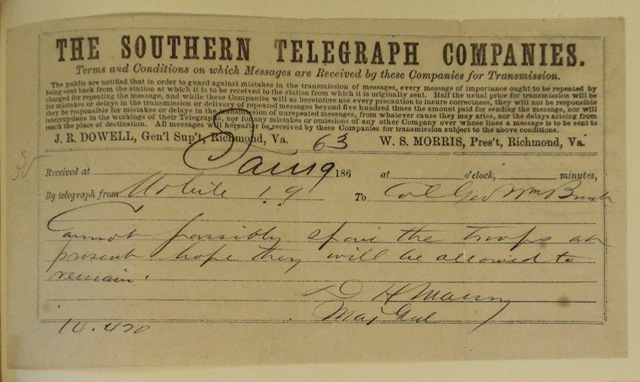
Received at Jan 19 1865

By telegraph from Mobile 19 To Col Geo Wm Brent

Cannot possibly spare the troops at present. hope they will be allowed to remain.

D H Maury

Maj Genl

14.470

Citation: Dabney Herndon Maury (1822-1900), telegram to George William Brent. Mobile, Ala.; 19 January 1865. In The telegraphic history of the Civil War, 1861-1865. AMs 434/16

January 18, 1865: Lemuel Pratt Grant telegram to George W. Brent

Pierre Gustave Toutant Beauregard was a Louisiana-born general of the Confederate States Army. He had graduated second in his class from West Point in 1838 and was an admirer of Napoleon. He achieved fame early in the Civil War for commanding the Fort Sumter bombardment and as the victor of the first battle of Manassas. He later served in the Western Theater (including Shiloh and Corinth), Charleston, and the defense of Richmond, but his career was hampered by friction with Jefferson Davis and other generals.

This is one of approximately 1000 military telegrams in P.G.T. Beauregard’s papers at the Rosenbach.

AMs 1168-11 1865-01-18

Transcript:

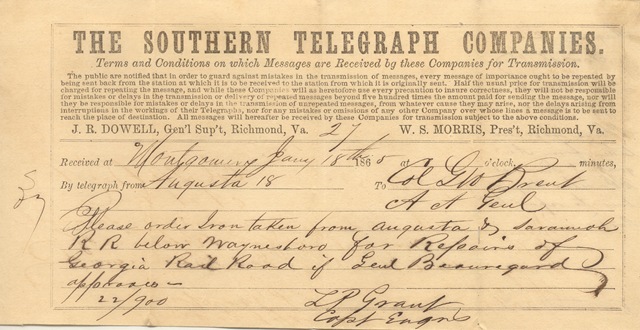
Received at Montgomery Jany 18th 1865

By telegraph from Augusta 18 To Col Geo Brent A. A. Genl

Please order iron taken from Augusta & Savannah RR below Waynesboro for Repairs of Georgia Rail Road if Genl Beauregard approves—

L. P. Grant

Capt Engrs

Citation: Lemuel Pratt Grant, telegram to George W. Brent. Augusta, Ga.; 18 January 1865. AMs 1168/11

January 16, 1865: Philadelphia Inquirer

top

Transcript (excerpt):

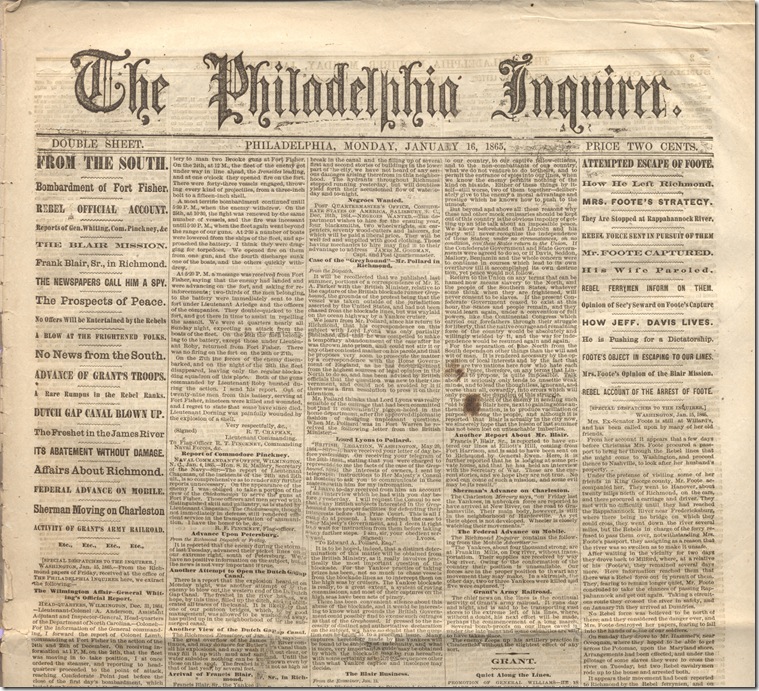
[special despatches to the Inquirer]

Washington, Jan. 15, 1865-From the Richmond Papers of Friday, received at the office if the Philadelphia Inquirer here, we extract the following:-

The Wilmington Affair-General Whiting’s Official Report.

“Headquarters, Wilmington, Dec. 31, 1864

-Lieutenant Colonel A. Anderson, Assistant Adjutant and Inspector-General, Head-quarters of the Department of North Carolina.-Colonel:-For the information of the General commanding, I forward the respect of Colonel Lamb, commanding at Fort Fisher in the action of the 24th and 25th of December. On receiving information at 1pm on the 24th, that the fleet was moving in to take position, I at once ordered the steamer, and reporting to headquarters proceeded to the point of attack, reaching Confederate Point just before the close of the first day’s bombardment, which lasted four hours and a half.”…

“…The garrison, however, at the proper moment, when the fire slackened to allow the approach of the enemy’s land force, drove them off with grape and musketry. At dark the enemy withdrew. A heavy storm set in, and the garrison were much exposed, as they were under arms all night. At three A.M. , on the 26th , a reported advance in boats was opened on with grape and shell. The garrison remained steadily awaiting a renewal of the assault or bombardment, until Tuesday morning when they were relieved by supports of Major-General Hake’s troops, and the embarkation of the army.”…

“…Very Respectfully

(signed)

W.H.C. Whiting.”


Citation: Philadelphia Inquirer. Philadelphia, 16 January 1865. Gift of Steven and Susan Raab. AN.P5446
January 14, 1865: A. S. Maxwell telegram to George W. Brent

Pierre Gustave Toutant Beauregard was a Louisiana-born general of the Confederate States Army. He had graduated second in his class from West Point in 1838 and was an admirer of Napoleon. He achieved fame early in the Civil War for commanding the Fort Sumter bombardment and as the victor of the first battle of Manassas. He later served in the Western Theater (including Shiloh and Corinth), Charleston, and the defense of Richmond, but his career was hampered by friction with Jefferson Davis and other generals.


This is one of approximately 1000 military telegrams in P.G.T. Beauregard’s papers at the Rosenbach.

 AMs 1168-11 1865-01-14 p1 AMs 1168-11 1865-01-14 p2


Transcript:

Received at Jan 14 1865

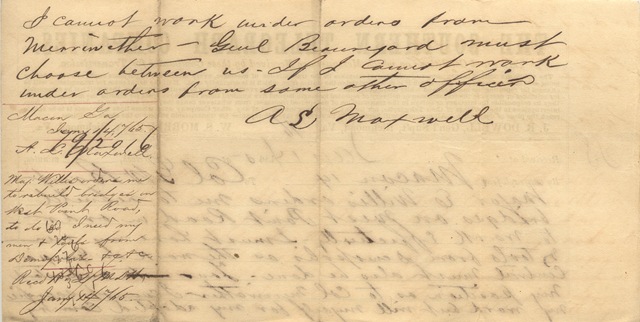
By telegraph from Macon 14 To Col. G. W. Brent

Major E. Willis orders me to rebuild bridges on West Point Road in order to work eventually I must have my men & tools from Demopolis as the work on Georgia Central must also be done. You understand my position as to Col. Meriwether I cannot sacrifice my word but will myself for my adopted country I cannot work under orders from Merriwether—Genl Beauregard must choose between us-If I cannot work under orders from some other officers.

A.S. Maxwell


Citation: A. S. Maxwell, telegram to George W. Brent. Macon, Ga.; 14 January 1865. AMs 1168/11

January 13, 1865: Dabney Maury telegram to Beauregard

Pierre Gustave Toutant Beauregard was a Louisiana-born general of the Confederate States Army. He had graduated second in his class from West Point in 1838 and was an admirer of Napoleon. He achieved fame early in the Civil War for commanding the Fort Sumter bombardment and as the victor of the first battle of Manassas. He later served in the Western Theater (including Shiloh and Corinth), Charleston, and the defense of Richmond, but his career was hampered by friction with Jefferson Davis and other generals.

This telegram is part of The Telegraphic History of the Civil War; a compiled album of telegrams to Beauregard from Davis, Lee, Johnston and others.

Telegram 1-13-65 Maury to Beauregard 10 mp

Transcript:

Jan 13 1863 [corrected to 5]

By Telegraph from M[aury?] 1863

To genl Beauregard

Hope you will visit Mobile & give me the benefit of your advice. If you can please notify me when to expect you.

D H Maury

Maj genl

23 pd 460  [illeg] Jany 13th/65 Will let you know when determined upon

G.T B

genl


Citation: Dabney Herndon Maury (1822-1900), telegram to G.T. Beauregard. 13 December 1865. In The telegraphic history of the Civil War, 1861-1865. AMs 434/16