April 12, 1861: John Henry Brown’s Journal

John Henry Brown was a painter of portrait miniatures, living and working in Philadelphia. He had met Lincoln in August of 1860 when he was commissioned to paint Lincoln’s portrait for a supporter, but although Brown liked Lincoln personally, he did not agree with Republican policies.
 

1861-04-12

Transcript:

At Miss Irwins picture. Waiting with breathless anxiety for further news from Charleston.

Citation: John Henry Brown (1818-1891), autograph journal/account book. Philadelphia, 1844-1890. AMs 574/14.1

April 11, 1861: John Henry Brown’s Journal

John Henry Brown was a painter of portrait miniatures, living and working in Philadelphia. He had met Lincoln in August of 1860 when he was commissioned to paint Lincoln’s portrait for a supporter, but although Brown liked Lincoln personally, he did not agree with Republican policies.


April 10-14, 1861

Transcript:

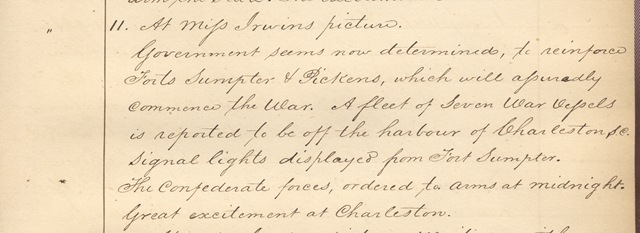
Government seems now determined, to reinforce Forts Sumpter & Pickens, which will assuredly commence the war. A fleet of seven war vessels is reported to be off the harbour of Charleston S.C. Signal lights displayed from Fort Sumpter. The Confederate forces, ordered to arms at midnight. Great excitement at Charleston.

Citation: John Henry Brown (1818-1891), autograph journal/account book. Philadelphia, 1844-1890. AMs 574/14.1
April 10, 1861: John Henry Brown’s Journal

John Henry Brown was a painter of portrait miniatures, living and working in Philadelphia. He had met Lincoln in August of 1860 when he was commissioned to paint Lincoln’s portrait for a supporter, but although Brown liked Lincoln personally, he did not agree with Republican policies.


1861-04-10

Transcript:

At Miss Irwins picture.

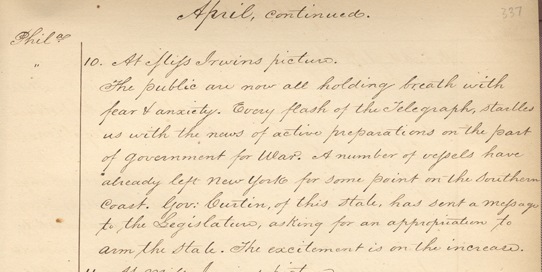
The public are now all holding breath with fear & anxiety. Every flash of the Telegraph startles us with the news of active preparations on the part of the government for War. A number of vessels have already left New York for some point on the Southern Coast. Gov. Curtin, of this state, has sent a message to the Legislature, asking for an appropriation to arm the State. The excitement is on the increase.

Citation: John Henry Brown (1818-1891), autograph journal/account book. Philadelphia, 1844-1890. AMs 574/14.1
April 9, 1861: John Henry Brown’s Journal

John Henry Brown was a painter of portrait miniatures, living and working in Philadelphia. He had met Lincoln in August of 1860 when he was commissioned to paint Lincoln’s portrait for a supporter, but although Brown liked Lincoln personally, he did not agree with Republican policies.


1861-04-09

Transcript:

At Miss Irwins picture.

The public are fearfully excited at the condition of things.

Citation: John Henry Brown (1818-1891), autograph journal/account book. Philadelphia, 1844-1890. AMs 574/14.1
April 5, 1861: John Henry Brown’s Journal

John Henry Brown was a painter of portrait miniatures, living and working in Philadelphia. He had met Lincoln in August of 1860 when he was commissioned to paint Lincoln’s portrait for a supporter, but although Brown liked Lincoln personally, he did not agree with Republican policies.

1861-04-05

Transcript:

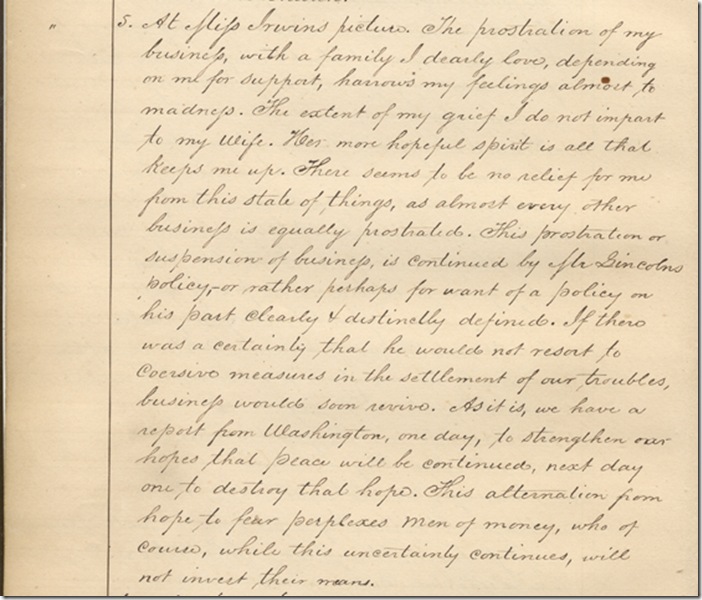
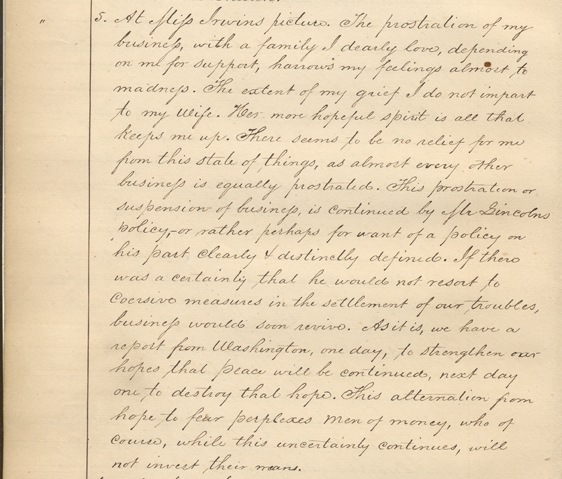
At Miss Irwin’s picture. The prostration of my business, with a family I dearly love, depending on me for support, harrows my feelings almost to madness. The extent of my grief I do not impart to my wife. Her more hopeful spirit is all that keeps me up. There seems to be no relief for me from this state of things, as almost ever other business is equally prostrated. This prostration or suspension of business, is continued by Mr. Lincolns policy, or rather perhaps for want of a policy on his part clearly & distinctly defined. If there was a certainty that he would not resort to coercive measures in the settlement of our troubles, business would soon revive. As it is, we have a report from Washington, one day, to strengthen our hopes that peace will be continued, next day one to destroy that hope. This alternation from hope to fear perplexes men of money, who of course, while this uncertainty continues, will not invest their means.

Citation: John Henry Brown (1818-1891), autograph journal/account book. Philadelphia, 1844-1890. AMs 574/14.1

March 16, 1861: John Henry Brown’s Journal

John Henry Brown was a painter of portrait miniatures, living and working in Philadelphia. He had met Lincoln in August of 1860 when he was commissioned to paint Lincoln’s portrait for a supporter, but although Brown liked Lincoln personally, he did not agree with Republican policies.

1861-03-16

Transcript:

At Mrs Pages picture. Political affairs seemingly as far from a settlement as ever.


Citation: John Henry Brown (1818-1891), autograph journal/account book. Philadelphia, 1844-1890. AMs 574/14.1
March 13, 1861: John Henry Brown’s Journal

John Henry Brown was a painter of portrait miniatures, living and working in Philadelphia. He had met Lincoln in August of 1860 when he was commissioned to paint Lincoln’s portrait for a supporter, but although Brown liked Lincoln personally, he did not agree with Republican policies.

1861-03-13

Transcript:

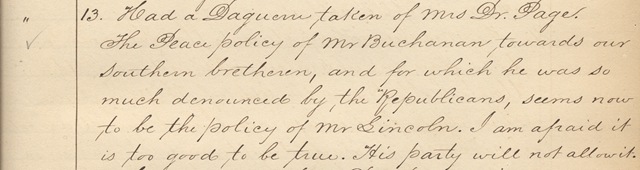
Had a Daguerre taken of Mrs Dr. Page. The Peace policy of Mr. Buchanan towards our Southern bretheren, and for which he was so much denounced by the Republicans, seems now to be the policy of Mr. Lincoln. I am afraid it is too good to be true. His party will not allow it.


Citation: John Henry Brown (1818-1891), autograph journal/account book. Philadelphia, 1844-1890. AMs 574/14.1
March 12, 1861: John Henry Brown’s Journal

John Henry Brown was a painter of portrait miniatures, living and working in Philadelphia. He had met Lincoln in August of 1860 when he was commissioned to paint Lincoln’s portrait for a supporter, but although Brown liked Lincoln personally, he did not agree with Republican policies.

1861-03-12

Transcript:

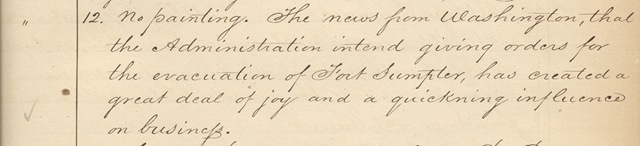
No painting. The news from Washington, that the Administration intend giving orders for the evacuation of Fort Sumpter, has created a great deal of joy and a quickening influence on business.


Citation: John Henry Brown (1818-1891), autograph journal/account book. Philadelphia, 1844-1890. AMs 574/14.1
March 7, 1861: John Henry Brown’s Journal

John Henry Brown was a painter of portrait miniatures, living and working in Philadelphia. He had met Lincoln in August of 1860 when he was commissioned to paint Lincoln’s portrait for a supporter, but although Brown liked Lincoln personally, he did not agree with Republican policies.

1861-03-07

Transcript:

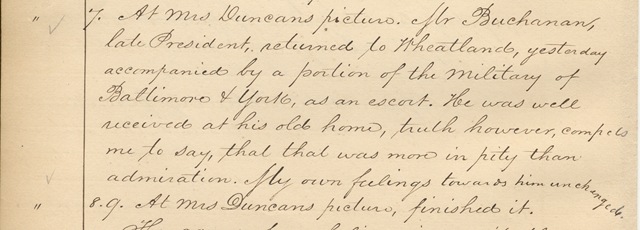
At Mrs Duncans picture. Mr. Buchanan, late President, returned to Wheatland, yesterday accompanied by a portion of the Military of Baltimore & York, as an escort. He was well received at his old home, truth however, compels me to say that that was more in pity than admiration. My own feelings towards him unchanged.


Citation: John Henry Brown (1818-1891), autograph journal/account book. Philadelphia, 1844-1890. AMs 574/14.1

March 5, 1861: John Henry Brown’s Journal

John Henry Brown was a painter of portrait miniatures, living and working in Philadelphia. He had met Lincoln in August of 1860 when he was commissioned to paint Lincoln’s portrait for a supporter, but although Brown liked Lincoln personally, he did not agree with Republican policies.

1861-03-05

Transcript:

At Mrs Duncans picture. Mr. Lincolns inaugural address is regarded by some as peaceful, by others as warlike. To me it is as clear as mud. Whatever he may mean, it certainly has failed to allay public alarm and anxiety.


Citation: John Henry Brown (1818-1891), autograph journal/account book. Philadelphia, 1844-1890. AMs 574/14.1