January 22, 1863: Henry Warner to his Parents

Henry Warner Jr. was the younger brother of John Riddle Warner, the grandfather of the poet Marianne Moore.  Henry served in  Independent Battery G from August 1862 until June 1865.These family letters are preserved as part of the Marianne Moore family papers.
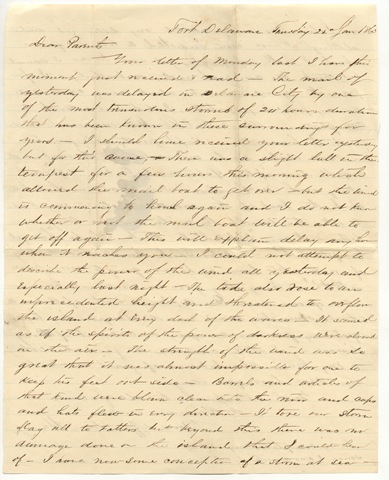
Moore VI-5-15 p1 Henry Warner to Parents 1-22-63 Moore VI-5-15 p2 Henry Warner to Parents 1-22-63

Transcript:

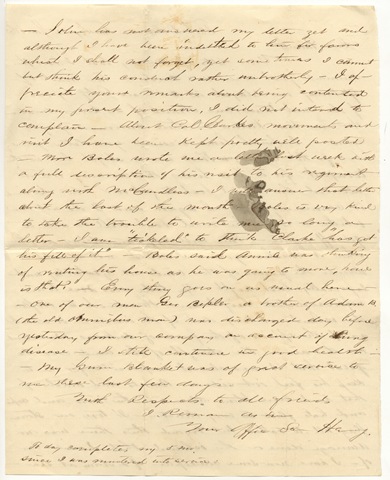
Fort Delaware Thursday 22d Jan 1863

Dear Parents

Your letter of Monday last I have this moment just received & read—The mail of yesterday was delayed in Delaware City by one of the most tremendous storms of 24 hours duration that has been known in these surroundings for years.—I should have received your letter yesterday but for this curse. There was a slight lull in the tempest for a few hours this morning which allowed the mail boat to get over—but the wind is commencing to howl again and I do not know whether or not the mail boat will be able to get off again—This will explain delay any how when it reaches you—I could not attempt to describe the power of the wind all yesterday and especially last night—The tide also rose to an unprecedented height and threatened to overflow the island at every dash of the waves—It seemed as if the spirits of the power of darkness were abroad on the air—The strength of the wind was so great that it was almost impossible for one to keep his feet out side—Barrels and articles of that kind were blown clean to the river and caps and hats flew in every direction—It tore our storm flag all to tatters but beyond this there was no damage done on the island that I could hear of—I have now some conception of a storm at sea—John has not answered my letter yet and although I have been indebted to him for favors which I shall not forget, yet some times I cannot but think his conduct rather unbrotherly—I appreciate your remarks about being contented in my present position, I did not intend to complain—About Col. Clarkes movements and visit I have been kept pretty well posted—Mr Boles wrote me a letter last week with a full description of his visit to his regiment along with McCandless—I will answer that letter about the last of the month—Boles is very kind to take the trouble to write me so long a letter—I am “tickled” to think Clarke “has got his fill of it”—Boles said Annie was thinking of renting his house as he was going to move, how is that?—Every thing goes on as usual here—One of our men Gen. Bepler a brother of Adam B. (that old [omnibus?] man) was discharged day before yesterday from our company on account of Lung disease—I still continue in good health—my Gum Blanket was of good service to me these last few days

With Respects to all friends

I remain as ever

Your affec. Son Henry

To day completes my 5 mo. since I was mustered into service

Citation: Henry Warner Jr., autograph letter to John Riddle Warner. Fort Delaware, 22 January 1863. Moore VI:5:15
January 9, 1863: Henry Warner to John Riddle Warner

Henry Warner Jr. was the youngest brother of John Riddle Warner, the grandfather of the poet Marianne Moore.  Henry served in the Pennsylvania  Independent Artillery, Battery G from August 1862 until June 1865.These family letters are preserved as part of the Marianne Moore family papers.

Moore VI-5-15 p1 Henry Warner to John Riddle Warner 1-9-63 Moore VI-5-15 p2 Henry Warner to John Riddle Warner 1-9-63 Moore VI-5-15 p3 Henry Warner to John Riddle Warner 1-9-63

Transcript:

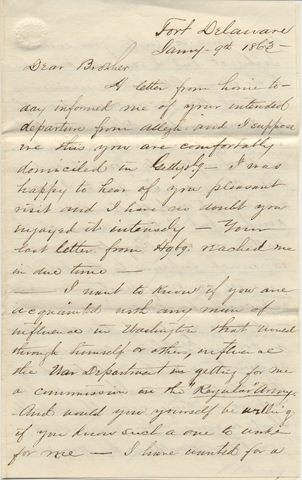
Fort Delaware

Jany 9th 1863

Dear Brother

A letter from home to-day informed me of your intended departure from Allegh. and I suppose in this you are comfortably domiciled in Gettysbg.—I was happy to hear of your pleasant visit and I have no doubt you enjoyed it intensely—Your last letter from Hrsbg. reached me in due time—

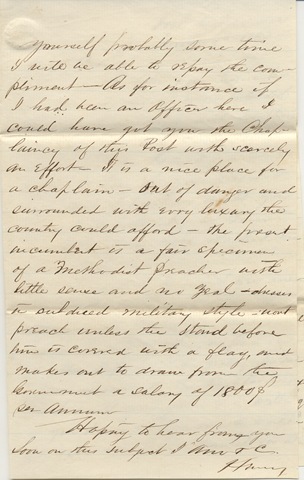
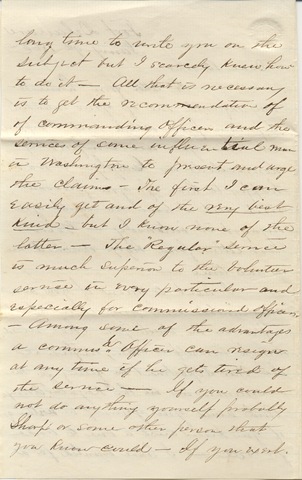
— I want to know if you are acquainted with any man of influence in Washington that would through himself or others, influence the War Department in getting for me a commission in the “Regular” Army—And would you yourself be willing if you know such a one to work for me—I have wanted for a long time to write you on the subject but I scarcely know how to do it—All that is necessary is to get the recommendation of the commanding officer and the service of some influential man in Washington to present and urge the claims—The first I can easily get and of the very best kind—but I know none of the latter—The “Regular” service is much superior to the Volunteer services in every particular and especially for commissioned officers—Among some of the advantages a commis’d officer can resign at any time if he gets tired of the service—If you could not do anything yourself probably Sharp or some other person that you know could—If you exert yourself probably some time I will be able to repay the compliment—As for instance if I had been an Officer here I could have got you the Chaplaincy of this Post with scarcely an effort—It is a nice place for a chaplain—Out of danger and surrounded with every luxury the country could afford—the present incumbent is a fair specimen of a Methodist preacher with little sense and no zeal—dresses in subdued military style—wont preach unless the stand before him is covered with a flag, and makes out to draw from the Government a salary of 1800$ per annum.

Happy to hear from you Soon on this subject I am &c

Henry

Citation: Henry Warner Jr., autograph letter to John Riddle Warner. Fort Delaware, 9 January 1863. Moore VI:5:15
December 17, 1862: Henry and Mary Warner to John Warner

Henry and Mary Warner lived in Allegheny City, Pennsylvania, now part of Pittsburgh. They are the great-grandparents of poet Marianne Moore.  By the 1860s they had three surviving children:  John, Henry, and Anne. Their letters to John, a Presbyterian minister living in Gettysburg, are preserved as part of Marianne Moore’s family papers.

 Moore VI-5-13 p1 Henry and Mary Warner to Children 12-17-62 Moore VI-5-13 p2 Henry and Mary Warner to Children 12-17-62

Transcript:

Allegheny City Wednesday December 17th 1862—Noon

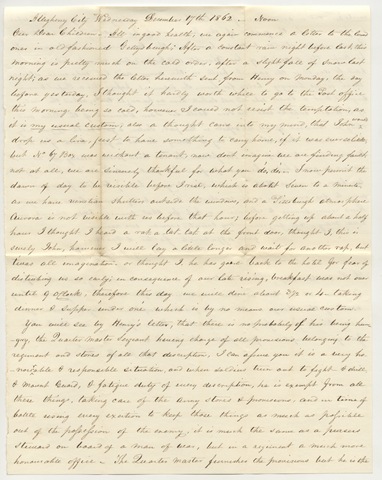
Our Dear Children—All in good health, we again commence a letter to the loved ones in old fashioned Gettysburgh; After a constant rain night before last, this morning is pretty much on the cold order, after a slight fall of snow last night; as we received the letter herewith sent, from Henry on Monday, the day before yesterday, I thought it hardly worth while to go to the Post office this morning being so cold, however I could not resist the temptation, as it is my usual custom, also a thought came into my mind, that John would drop us a line, just to have something to carry home, if it was ever so little, but No. 67 Box was without a tenant, now dont imagine we are finding fault, not at all, we are sincerely thankful for what you do’ do’—I now permit the dawn of day to be visible before I rise, which is about Seven to a minute, as we have Venetian shutters outside the windows, and a Pittsburgh atmosphere Aurora is not visible with us before that hour; before getting up about a half hour I thought I heard a rat-a-tat-tat at the front door, thought I, this is surely John, however I will lay a little longer and wait for another rap, but ‘twas all imagination—or thought I, he has gone back to the hotel for fear of disturbing us so early; in consequence of our late rising, breakfast was not over until 9 oclock, therefore this day we will dine about 3 ½ or 4—taking dinner & supper ‘under one’ which is by no means our usual custom—

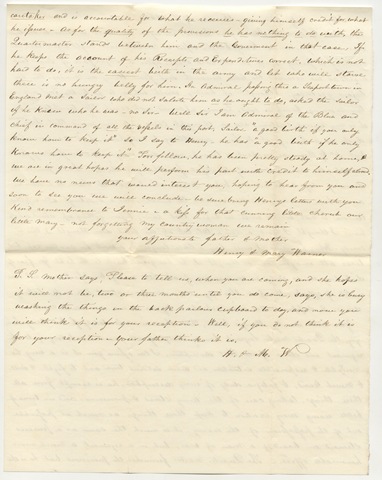
You will see by Henry’s letter, that there is no probability of his being hungry, the Quartermaster Sergeant having charge of all provisions belonging to the regiment and stores of all that description, I can assure you it is a very honourable & responsible situation, and when soldiers turn out to fight– & drill & mount guard, & fatigue duty of every description, he is exempt from all these things, taking care of the Army stores & provisions, and in time of battle using every excition to keep these things as much as possible out of the possession of the enemy, it is much the same as a pursers steward on board of a man of war, but in a regiment a much more honourable office—The Quartermaster furnishes the provisions but he is the caretaker and is accountable for what he receives—giving himself credit for what he issues—As for the quality of the provisions he has nothing to do with, the Quartermaster stands between him and the Government in that case, If he keeps the account of his Receipts and Expenditures correct, which is not hard to do, it is the easiest berth in the Army and let who will starve there is not hungry belly for him. An Admiral passing this a Seaport town in England met a sailor who did not salute him as he ought to do, asked the sailor if he knew who he was—no Sir—Well Sir I am Admiral of the Blue and Chief in Command of all the vessels in this port, Sailor—“a good berth if you only know how to keep it” so I say to Henry—he has “a good berth if he only knows how to keep it”—Poor fellow, he has been pretty steady at home, & we are in great hopes he will perform his part with credit to himself abroad. We have no news that would interest you, hoping to hear from you and soon to see you we will conclude—be sure bring Henrys letter with you Kind remembrance to Jennie—a kiss for that cunning little cherub our little Mary—not forgetting my countrywoman we remain

Your affectionate father & mother

Henry & Mary Warner

P.S. Mother says, Please to tell us, when you are coming, and she hopes it will not be two or three months until you do come, says, she is busy washing the things in the back parlour cupboard to day, and now you will think it is for your reception—Well, if you do not think it is for your reception—your father thinks it is

H. & M. W


Citation: Henry and Mary Warner, autograph letter signed to John Riddle Warner. Allegheny City [Pittsburgh], 17 December 1862. Moore VI:05:13

December 2, 1862: Henry and Mary Warner to John Warner

Henry and Mary Warner lived in Allegheny City, Pennsylvania, now part of Pittsburgh. They are the great-grandparents of poet Marianne Moore.  By the 1860s they had three surviving children:  John, Henry, and Anne. Their letters to John, a Presbyterian minister living in Gettysburg, are preserved as part of Marianne Moore’s family papers.

Moore VI-5-13 p1 Henry and Mary Warner to Children 12-2-62 Moore VI-5-13 p2 Henry and Mary Warner to Children 12-2-62

Transcript:

Allegheny City Tuesday December 2nd 1862 11 A.M.

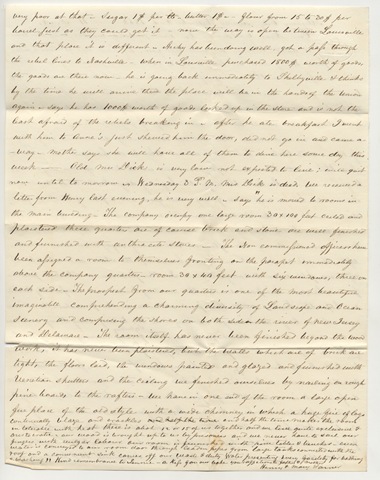
Our Dear Children—You will probably wonder why our letter is dated tuesday, we will tell you, we have not received a letter from Henry since we last wrote to you, in all probability we will receive one from him this evening, if we do, we would like to answer it on tomorrow, in our last, we stated to him, that, on the day after the receipt of his letter we would answer it, except that day happened to be on Sabbath, in that case we would answer it on Monday, if possible, to write two letters in one day is, now, more than we can conveniently do, without slighting one of them, and that is what we do not like to do, however we will not close this until tomorrow afternoon, our usual time of mailing our letter to you. On last thursday thanksgiving day Mother & I dined with Anne, we had a very nice young roast goose and a pair of chickens for dinner with all the et ceteras connected with such a meal, spent the afternoon there, took tea, and remained until bed time—kept worship at Annes request, during the afternoon and evening enjoyed ourselves much—after the old couple returned home, heated up the stove and returned to rest after we felt warm & comfortable—In the forenoon a student preached for us, he done his part well, the meetinghouse was comfortably heated, we hope the hearers acted their part as well as the preacher—the audience was not as large as it might, or ought to be, taking every thing into consideration—so ended thanksgiving day. On Saturday morning about 7 ½ oclock a rap came to the front door, your father attended, who should it be but Archy Armstrong—not having heard from him, for the last three months, we were astonished, he looked well, is in good health, and well dressed, not in rags, although from the South, had his carpet bag, good comfortable overcoat &c &c. Mother jumped round, and in less than no time had him seated before a comfortable breakfast, pork steak fresh &c &c. he ate hearty, seemed to enjoy his meal, told us of the wonderful things going on South, boarding in Nashville 15$ per week and diet very poor at that—sugar 1$ per lb, butter 1$– flour from 15 tp 30$ per barrel, just as they could get it—now the way is open between Louisville and that place it is different—Archy has been doing well, got a pass through the rebel lines to Nashville—when in Louisville purchased 1800$ worth of goods, the goods are there now—he is going back immediately to Shelbyville & thinks by the time he will arrive the place will be in the hands of the Union again—says he has 1000$ worth of goods locked up in the store and is not the least afraid of the rebels breaking in—after he ate breakfast I went with him to Anne’s just shewed him the door, did not go in and came away—Mother says she will have all of them to dine here some day this week—Old Mrs Dick is very low not expected to live; will quit now until to-morrow—Wednesday 3 P.M. Mrs Dick is dead. We received a letter from Henry last evening, he is very well—says “he is moved to rooms in the main building—The company occupy one large room 30 x 100 feet ceiled and plaistered these quarters are of course brick and stone are well finished and furnished with anthracite stoves—The non commissioned officers have been assigned a room to themselves fronting on the parapet immediately above the company quarter—room 30 x 40 feet with six windows, three on each side—The prospect from our quarters is one of the most beautiful imaginable comprehending a charming diversity of Landscape and Ocean scenery and comprising the shores on both sides the river of New Jersey and Delaware—The room itself has never been finished beyond the wood work, it has never been plaistered, but the walls which are of brick are tight, the floor laid, the windows painted and glazed and furnished with Venetian shutters and the ceiling we finished ourselves by nailing on rough pine boards, to the rafters—we have in one end of the room a large open fire place of the old style with a wide chimney in which a huge fire of logs continually blaze and crackles and half the time makes the room intolerable with heat there is about 12 or 15 of us together and we live quite exclusive & aristocratic—our wood is brought up to us by prisoners and we never have to soil our fingers with vulgar labour our room is furnished with pine tables & benches—even water is conveyed to our room door through leaden pipes from large tanks connected with the roof and a convent sink carries off our waste & dirty water presenting every facility for bathing & washing” Kind remembrance to Jennie—a kiss for our babe Your affectionate father & mother

Henry & Mary Warner

Citation: Henry and Mary Warner, autograph letter signed to John Riddle Warner. Allegheny City [Pittsburgh], 2 December 1862. Moore VI:05:13

November 26, 1862: Henry and Mary Warner to John Warner

Henry and Mary Warner lived in Allegheny City, Pennsylvania, now part of Pittsburgh. They are the great-grandparents of poet Marianne Moore.  By the 1860s they had three surviving children:  John, Henry, and Anne. Their letters to John, a Presbyterian minister living in Gettysburg, are preserved as part of Marianne Moore’s family papers.

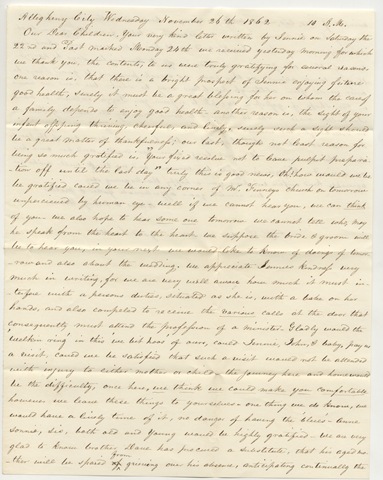
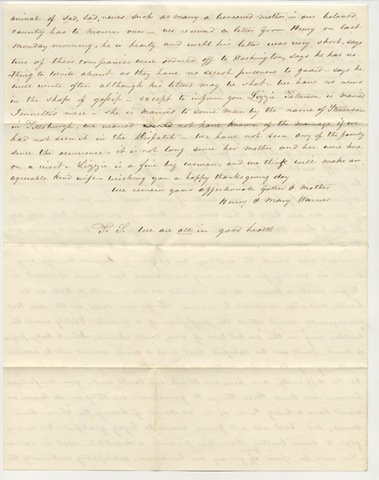
Moore VI-5-12 p1 Henry and Mary Warner to Children 11-26-62

Moore VI-5-12 p2 Henry and Mary Warner to Children 11-26-62

Transcript:

Allegheny City Wednesday November 26th 1862 10 A.M.

Our Dear Children, Your very kind letter written by Jennie on Saturday the 22nd and Post Marked Monday 24th we received yesterday morning for which we thank you, the contents, to us were truly gratifying for several reasons. One reason is, that there is a bright prospect of Jennie enjoying future good health, surely it must be a great blessing for her on whom the care of a family depends to enjoy good health—another reason is, the sight of your infant offspring thriving, cheerful, and lively, surely such a sight should be a great matter of thankfulness; our last, though not least reason for being so much gratified is, “Your fixed resolve not to leave pulpit preparation off until the last day” truly this is good news, Oh! how would we be gratified could we be in any corner of Mr. Finneys church on tomorrow—unperceived by human eye—well if we cannot hear you, we can think of you—we also hope to hear some one tomorrow we cannot tell who, may he speak from the heart to the heart—we suppose the bride & groom will be to hear you, in your next we would like to know of doings of tomorrow and also about the wedding. We appreciate Jennies kindness very much in writing, for we are very well aware how much it must interfere with a persons duties, situated as she is, with a babe on her hands, and also compeled to receive the various calls at the door that consequently must attend the profession of a minister—Gladly would the ‘welkin ring’ in this ‘we bit hoos’ of ours, could Jennie, John, & baby, pay us a visit, could we be satisfied that such a visit would not be attended with injury to either mother or child—the journey here and home would be the difficulty, once here, we think we could make you comfortable however we leave these things to yourselves—one thing we do know, we would have a lively time of it, no danger of having the ‘blues’—Anne, sonnie, Sis, both old and young would be highly gratified—we are very glad to know brother Dave has procured a substitute, that his aged mother will be spared from grieving over his absence, anticipating continually the arrival of sad, sad news such as many a bereaved mother in our beloved country has to mourn over—we received a letter from Henry on last Monday morning, he is hearty and well his letter was very short, says two of their companies were ordered off to Washington, says he has nothing to write about as they have no secesh prisoners to guard—says he will write often although is letters may be short—we have no news in the shape of gossip—except to inform you Lizzie Patterson is married Jennettes niece—she is married to some man by the name of Stevenson in Pittsburgh, we would not have known of the marriage if we had not seen it in the Dispatch—we have not seen any of the family since the occurrence—it is not long since her mother and her were on a visit—Lizzie is a fine big woman, and we think will make an agreeable kind wife—wishing you a happy thanksgiving day

We remain your affectionate father & mother

Henry & Mary Warner

P.S. We are all in good health

Citation: Henry and Mary Warner, autograph letter signed to John Riddle Warner. Allegheny City [Pittsburgh], 26 November 1862. Moore VI:05:12

November 19, 1862: Henry and Mary Warner to John Warner

Henry and Mary Warner lived in Allegheny City, Pennsylvania, now part of Pittsburgh. They are the great-grandparents of poet Marianne Moore.  By the 1860s they had three surviving children:  John, Henry, and Anne. Their letters to John, a Presbyterian minister living in Gettysburg, are preserved as part of Marianne Moore’s family papers.

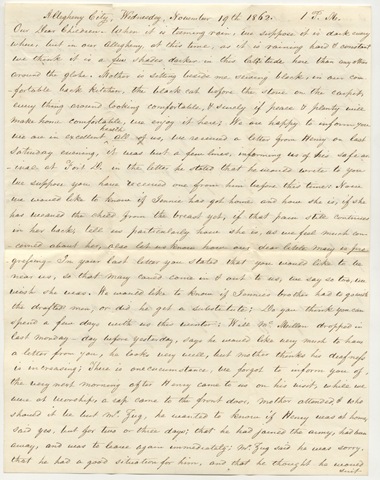
Moore VI-5-12 p1 Henry and Mary Warner to Children 11-19-62

 Moore VI-5-12 p2 Henry and Mary Warner to Children 11-19-62 

  Transcript:

Allegheny City, Wednesday, November 19th 1862. 1 P.M.

Our Dear Children—When it is teeming rain, we suppose it is dark every where, but in our Allegheny, at this time, as it is raining hard & constant we think it is a few shades darker in this latitude here than any other around the globe. Mother is sitting beside me sewing black, in our comfortable back kitchen, the black cat before the stove on the carpet, every thing around looking comfortable, & surely if peace & plenty will make home comfortable, we enjoy it here; We are happy to inform you we are in excellent health all of us, we received a letter from Henry on last Saturday evening, it was but a few lines, informing us of his safe arrival at Fort D. in the letter he stated that he would write to you we suppose you have received one from him before this time; Now we would like to know if Jennie has got home and how she is, if she has weaned the child from the breast yet, if that pain still continues in her back, tell us particularly how she is, as we feel much concerned about her, also let us know how our dear little Mary is progressing—In your last letter you stated that you would like to be near us, so that Mary could come in & out to us, we say so too, we wish she was. We would like to know if Jennies brother had to go with the drafted men, or did he get a substitute; Do you think you can spend a few days with us this winter: Will McMillen dropped in last Monday—day before yesterday, says he would like very much to have a letter from you, he looks very well, but Mother thinks his deafness is increasing; There is one circumstance, we forgot to inform you of, the very next morning after Henry came to us on his visit, while we were at worship, a rap came to the front door, Mother attended, & who should it be but Mr. Zug, he wanted to know if Henry was at home, said yes, but for two or three days; that he had joined the army, had been away, and was to leave again immediately; Mr. Zug said he was sorry, that he had a good situation for him, and that he thought he would suit it very well. Mother says now, how happy she would feel if he was in a situation like that, coming in and out every day, like many a young fellow here, and not be in the army—as we have had no draft in this country—Allegheny having given over her quota for this war: Mother says Will McMillen insisted very much on her, not to forget giving his love to you. I wonder if we forgot to tell you Richard Bard was married, he has been married about two months, to a widow lady whose name was Clarke from New Castle; Jonnie goes to school regularly every day, gets a No. 1 report every week, for which his grandmother gives him one cent according to a promise she made him when he commenced going to school; Sis is a fine little girl, she went to school with Jonnie until a few days ago; now the weather has changed to winter, Anne will keep her at home we think, for two or three months until the severity of winter is over. Robert is still doing very well. All communication has been cut off, between Archy and us for the last two months; We hope our countrywoman Mary has got over the fright the rebels gave her—remember us to her—we would like very much to chat with Mrs Coburn about the rebel times you have had out there—there are several more as well as Mrs Coburn would like to chat with—Miss Rebecca Campbell &c &c &c

Your affectionate father & mother

Henry & Mary Warner

Citation: Henry and Mary Warner, autograph letter signed to John Riddle Warner. Allegheny City [Pittsburgh], 19 November 1862. Moore VI:05:12

November 10, 1862: Henry and Mary Warner to John Warner

Henry and Mary Warner lived in Allegheny City, Pennsylvania, now part of Pittsburgh. They are the great-grandparents of poet Marianne Moore.  By the 1860s they had three surviving children:  John, Henry, and Anne. Their letters to John, a Presbyterian minister living in Gettysburg, are preserved as part of Marianne Moore’s family papers.

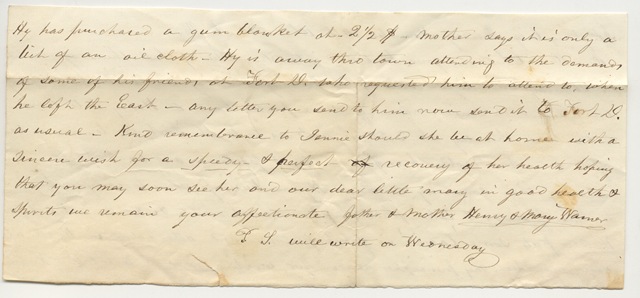
Moore VI-5-12 p1 Henry and Mary Warner to Children 11-10-62

Moore VI-5-12 p2 Henry and Mary Warner to Children 11-10-62

Transcript:

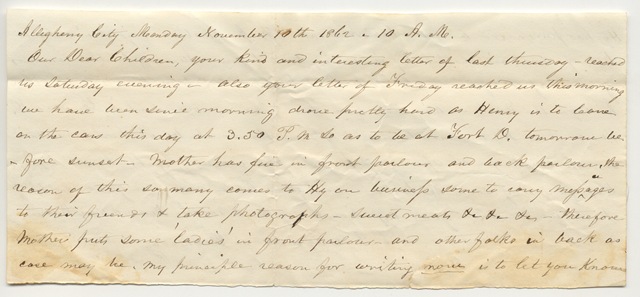
Allegheny City Monday November 11th 1862—10 A.M.

Our Dear Children, your kind and interesting letter of last thursday—reached us Saturday evening—Also your letter of Friday reached us this morning we have been since morning drove pretty hard as Henry is to leave on the cars this day at 3.50 P.M. So as to be at Fort D. tomorrow before sunset—Mother has fire in front parlour and back parlour, the reason of this so many comes to Hy on business some to carry messages to their friends & take photographs, sweet meats &c &c &c—therefore Mother puts some ‘ladies’ in front parlour—and other folks in back as case may be. My principle reason for writing now is to let you know Hy has purchased a gum blanket at 2 ½ $– Mother says it is only a bit of an oil cloth—Hy is away thro town attending to the demands of some of his friends, at Fort D. who requested him to attend to, when he left the East—any letter you send to him now send it to Fort D. as usual—Kind remembrance to Jennie should she be at home with a sincere wish for a speedy & perfect recovery of her health hoping that you may soon see her and our dear little Mary in good health & spirits we remain your affectionate father & mother Henry & Mary Warner

P.S. will write on Wednesday

Citation: Henry and Mary Warner, autograph letter signed to John Riddle Warner. Allegheny City [Pittsburgh], 10 November 1862. Moore VI:05:12

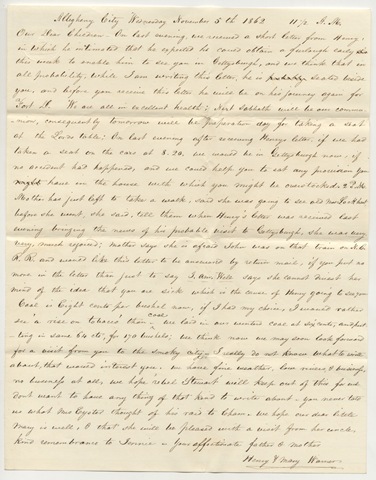
November 5, 1862: Henry and Mary Warner to John Warner

Henry and Mary Warner lived in Allegheny City, Pennsylvania, now part of Pittsburgh. They are the great-grandparents of poet Marianne Moore.  By the 1860s they had three surviving children:  John, Henry, and Anne. Their letters to John, a Presbyterian minister living in Gettysburg, are preserved as part of Marianne Moore’s family papers.

Moore VI-5-12 Henry and Mary Warner to Children 11-5-62

Transcript:

Allegheny City Wednesday November 5th 1862 11 ½ A.M.

Our Dear Children—On last evening, we received a short letter from Henry, in which he intimated that he expected he could obtain a furlough early this week to enable him to see you in Gettysburgh, and we think that in all probability, while I am writing this letter, he is seated beside you, and before you receive this letter he will be on his journey again for Fort D. We are all in excellent health; Next Sabbath will be our communion, consequently tomorrow will be preparation day for taking a seat at the Lords table; On last evening after receiving Henrys letter, if we had taken a seat on the cars at 8.20, we would be in Gettysburgh now, if no accident had happened, and we could help you to eat any provision you have in the house with which you might be overstocked. 2 P.M. Mother has just left to take a walk, said she was going to see old Mrs Lockhart, before she went, she said, tell them when Henry’s letter was received last evening bringing the news of his probable visit to Gettysburgh, she was very, very much rejoiced; Mother says she is afraid John was on that train on N.C.R.R. and would like this letter to be announced by return mail, if you put no more in the letter than just to say I Am Well says she cannot divest her mind of the idea that you are sick which is the cause of Henry going to see you Coal is Eight centers per bushel now, if I had my choice, I would rather see ‘a rise on tobacco’ than coal—we laid in our winters coal at six cents, and putting in same 64 cts, for 170 bushels; we think now we may soon look forward for a visit from you to the smoky city—I really do not know what to write about, that would interest you. We have fine weather, low rivers, & business, no business at all, we hope ‘rebel Stewart’ will keep out of this for we dont want to have any thing of that kind to write about—you never told us what Mrs Eyster thought of his raid to Cham. We hope our dear little Mary is well, & that she will be pleased with a visit from her uncle, kind remembrance to Jennie—

Your affectionate father & mother

Henry & Mary Warner


Citation: Henry and Mary Warner, autograph letter signed to John Riddle Warner. Allegheny City [Pittsburgh], 5 November 1862. Moore VI:05:12

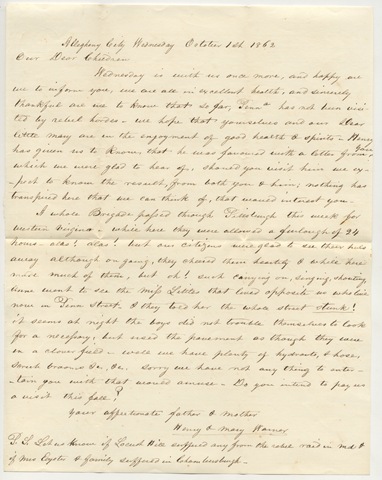
October 1, 1862: Henry and Mary Warner to John Warner

Henry and Mary Warner lived in Allegheny City, Pennsylvania, now part of Pittsburgh. They are the great-grandparents of poet Marianne Moore.  By the 1860s they had three surviving children:  John, Henry, and Anne. Their letters to John, a Presbyterian minister living in Gettysburg, are preserved as part of Marianne Moore’s family papers.

Moore VI-5-11 Henry and Mary Warner to Children 10-1-62

  Transcript:

Allegheny City Wednesday October 1st 1862

Our Dear Children

Wednesday is with us once more, and happy are we to inform you, we are all in excellent health, and sincerely thankful are we to know that so far, Penna has not been visited by rebel hordes—we hope that yourselves and our Dear little Mary are in the enjoyment of good health & spirits—Henry has given us to know, that he was favoured with a letter from you which we were glad to hear of, should you visit him we expect to know the result, from both you & him; nothing has transpired here that we can think of, that would interest you—

A whole Brigade passed through Pittsburgh this week for Western Virginia—while here they were allowed a furlough of 24 hours—alas! alas! but our citizens were glad to see their heels away although on going, they cheered them heartily & while here made much of them, but oh! such carrying on, singing, shouting, Anne went to see the Miss Littles that lived opposite us who live now in Penn Street– & they told her the whole street stunk! it seems at night the boys did not trouble themselves to look for a necessary, but used the pavement as though they were in a clover field—well we have plenty of hydrants, & hose, scrub brooms &c &c. Sorry we have not any thing to entertain you with that would amuse—Do you intend to pay us a visit this fall?

Your affectionate father & mother

Henry & Mary Warner

P.S. Let us know if Locust Hill suffered any from the rebel raid in Md & if Mrs Eyster & family suffered in Chambersburgh


Citation: Henry and Mary Warner, autograph letter signed to John Riddle Warner. Allegheny City [Pittsburgh], 1 October 1862. Moore VI:05:11

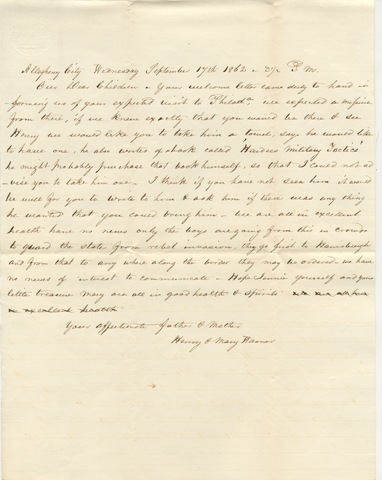
September 17, 1862: Henry and Mary Warner to John Warner

Henry and Mary Warner lived in Allegheny City, Pennsylvania, now part of Pittsburgh. They are the great-grandparents of poet Marianne Moore.  By the 1860s they had three surviving children:  John, Henry, and Anne. Their letters to John, a Presbyterian minister living in Gettysburg, are preserved as part of Marianne Moore’s family papers.

Moore VI-5-10 Henry and Mary Warner to Children 9-17-62

  Transcript:

Allegheny City Wednesday September 17th 1862—3 ½ P.M.

Our Dear Children—Your welcome letter came duly to hand informing us of your expected visit to Philada, we expected a missive from there, if we knew exactly that you would be there & see Henry we would like you to take him a towel, says he would like to have one, he also writes of a book called “Hardees Military Tacticts’ he might probably purchase that book himself, so that I could not advise you to take him one—I think if you have not seen him it would be well for you to write to him & ask him if there was any thing he wanted that you could bring him—We are all in excellent health have no news only the boys are going from this in crowds to guard the state from rebel invasion, they go first to Harrisburgh and from that to any where along the border they may be ordered—we have no news of interest to communicate—Hope Jennie & yourself and your little treasure Mary are all in good health & spirits

Your affectionate father & mother

Henry & Mary Warner

Citation: Henry and Mary Warner, autograph letter signed to John Riddle Warner. Allegheny City [Pittsburgh], 17 September 1862. Moore VI:05:10