February 19, 1862: John Henry Brown’s Journal

John Henry Brown was a painter of portrait miniatures, living and working in Philadelphia. He had met Lincoln in August of 1860 when he was commissioned to paint Lincoln’s portrait for a supporter, but although Brown liked Lincoln personally, he did not agree with Republican policies.
1862-02-19

Transcript:

At Miss Kilgours picture.

The Presidents second son, Willie, died last night, at the White House.


Citation: John Henry Brown, autograph journal/account book. Philadelphia, 1844-1890. AMs 573/14.1

February 18, 1862: John Henry Brwons’ Journal

John Henry Brown was a painter of portrait miniatures, living and working in Philadelphia. He had met Lincoln in August of 1860 when he was commissioned to paint Lincoln’s portrait for a supporter, but although Brown liked Lincoln personally, he did not agree with Republican policies.

1862-02-18

Transcript:

Commenced Miss Kilgours picture. The country in a blaze of glory at our successes last week. My own troubles of a pecuniary nature have so absorbed my mind, that I have no feeling for anything else.


Citation: John Henry Brown, autograph journal/account book. Philadelphia, 1844-1890. AMs 573/14.1
February 17, 1862: John Henry Brown’s Journal

John Henry Brown was a painter of portrait miniatures, living and working in Philadelphia. He had met Lincoln in August of 1860 when he was commissioned to paint Lincoln’s portrait for a supporter, but although Brown liked Lincoln personally, he did not agree with Republican policies.

1862-02-17

Transcript:

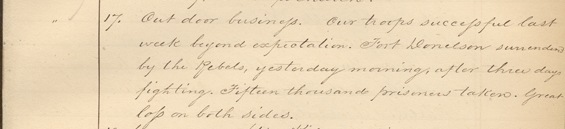
Out door busniess.  Our troops successful last week beyond expectation. Fort Donelson surrendered by the Rebels, yesterday morning, after three days fighting. Fifteen thousand prisoners taken. Great loss on both sides.


Citation: John Henry Brown, autograph journal/account book. Philadelphia, 1844-1890. AMs 573/14.1

February 14, 1861: John Henry Brown’s journal

John Henry Brown was a painter of portrait miniatures, living and working in Philadelphia. He had met Lincoln in August of 1860 when he was commissioned to paint Lincoln’s portrait for a supporter, but although Brown liked Lincoln personally, he did not agree with Republican policies.

1862-02-14

Transcript:

No painting.

Congress has passed a Treasury note bill with a clause making these notes a legal tender, another unconstitutional act.


Citation: John Henry Brown, autograph journal/account book. Philadelphia, 1844-1890. AMs 573/14.1

February 12, 1861: John Henry Brown’s Journal

John Henry Brown was a painter of portrait miniatures, living and working in Philadelphia. He had met Lincoln in August of 1860 when he was commissioned to paint Lincoln’s portrait for a supporter, but although Brown liked Lincoln personally, he did not agree with Republican policies.

1862-02-12

Transcript:

At Mr Shobers picture. The reported capture of Roanoke island by our troops has created great joy.


Citation: John Henry Brown, autograph journal/account book. Philadelphia, 1844-1890. AMs 573/14.1

February 11, 1862: John Henry Brown’s Journal

John Henry Brown was a painter of portrait miniatures, living and working in Philadelphia. He had met Lincoln in August of 1860 when he was commissioned to paint Lincoln’s portrait for a supporter, but although Brown liked Lincoln personally, he did not agree with Republican policies.

1862-02-11

Transcript:

At Mr Shobers picture.

Our troops have taken Fort Henry in Tennessee .


Citation: John Henry Brown, autograph journal/account book. Philadelphia, 1844-1890. AMs 573/14.1
November 16, 1861: Portrait by John Henry Brown

20010007002


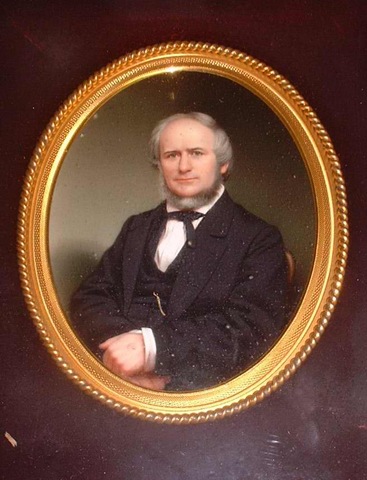
This portrait is by Philadelphia miniaturist John Henry Brown and is signed and dated 1861. Brown’s account book names the sole male sitter in 1861 (if the list is complete) as Thomas H. Powers, Esq., making him the likely subject.  A wealthy industrialist, Powers, with others in the city’s elite, was reported by the Philadelphia Tribune in 1871 as protesting race riots that resulted in the murders of several of Philadelphia’s black residents.


Brown frequently had his subject pose for a daguerreotype, freeing both parties from tedious sittings. This miniature pair is the only known extant example of a Brown portrait that is identical to its source photograph.


Citation:  John Henry Brown (1818-1891), portrait miniature. Watercolor on ivory; leather, glass, and metal frame

Philadelphia, 1861.  Purchase funded by an anonymous donor. 2001.7

November 6, 1861: John Henry Brown’s Journal

John Henry Brown was a painter of portrait miniatures, living and working in Philadelphia. He had met Lincoln in August of 1860 when he was commissioned to paint Lincoln’s portrait for a supporter, but although Brown liked Lincoln personally, he did not agree with Republican policies.

1861-11-06

Transcript:

At Mr Powers picture. Ada is quite sick with the Influenza.

The War news daily , is still as exciting as ever, it is not entirely reliable and therefore I have concluded not to notice it regularly in this journal.


Citation: John Henry Brown, autograph journal/account book. Philadelphia, 1844-1890. AMs 573/14.1

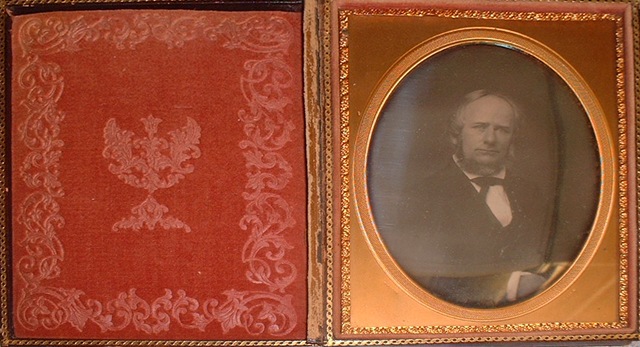
November 5, 1861: Daguerreotype, Probably of Thomas Powers

20010007001

This daguerreotype by James McClees was taken to assist miniature painter John Henry Brown in painting a portrait. Brown frequently utilized photography, freeing both parties from tedious sittings.  Brown’s account book names the sole male sitter in 1861 (if the list is complete) as Thomas H. Powers, Esq., making him the likely subject.  A wealthy industrialist, Powers, with others in the city’s elite, was reported by the Philadelphia Tribune in 1871 as protesting race riots that resulted in the murders of several of Philadelphia’s black residents.


Citation:  James E. McClees (1821-1887), portrait of male sitter. Daguerreotype; leather case. Philadelphia, 1861. 2001.7

August 26, 1861: John Henry Brown’s Journal

John Henry Brown was a painter of portrait miniatures, living and working in Philadelphia. He had met Lincoln in August of 1860 when he was commissioned to paint Lincoln’s portrait for a supporter, but although Brown liked Lincoln personally, he did not agree with Republican policies.

1861-08-26 August 31, 1861

Transcript:

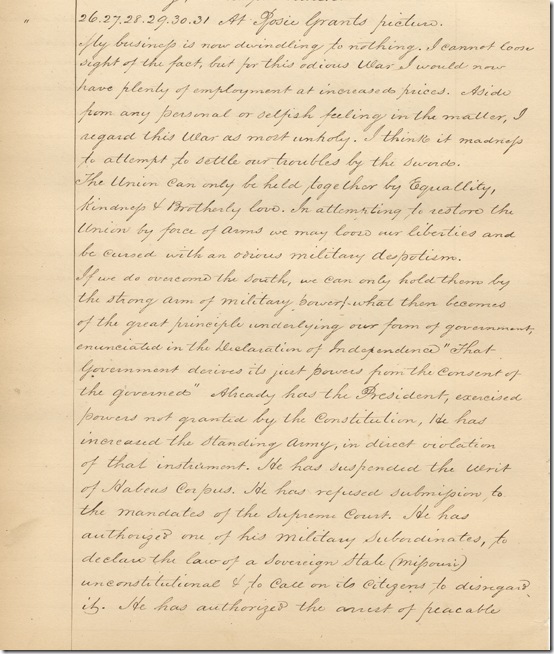
At Rosie Grants picture.

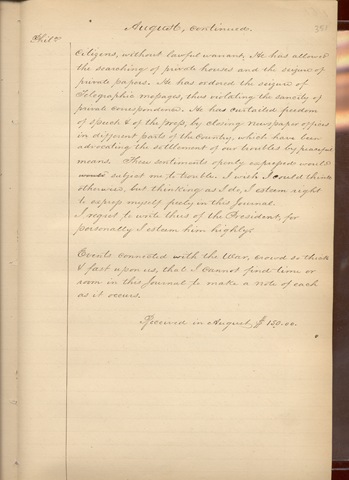
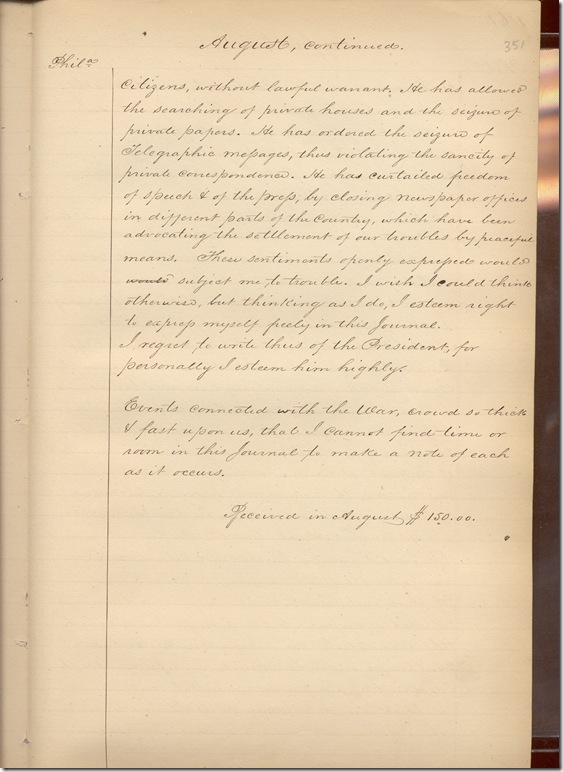
My business is dwindling down to nothing. I cannot lose sight of the fact that but for this odious war I would now have plenty of employment at increased prices. Aside from any personal or selfish feeling in the matter, I regard this war as most unholy. I think it madness to try and settle our troubles by the sword. The Union can only be held together by Equality, Kindness & brotherly love. In attempting to restore the Union by force of arms we may lose our liberties and be cursed with an odious military despotism. If we do overcome the south, we can only hold them by the strong arm of military power; what then becomes of the great principle underlying our form of government, enunciated in the Declaration of Independence “That Government derives its just powers from the consent of the governed.” Already has the President, exercised powers not granted by the Constitution. He has increased the standing army, in direct violation of that instrument. He has suspended the writ of Habeas Corpus. He has refused submission to the mandates of the Supreme Court. He has authorized one of his military subordinates, to declare the law of a Sovereign state (Missouri) unconstitutional & to call on its citizens to disregard it. He has authorized the arrest of peaceable citizens, without lawful warrant. He has allowed the searching of private houses and the seizure of private papers. He has ordered the seizure of Telegraphic messages, thus violating the sanctity of private correspondence. He has curtailed freedom of speech & of the press, by closing newspaper offices in different parts of the country, which have been advocating the settlement of our troubles by peaceful means. These sentiments openly expressed would subject me to trouble. I wish I could think otherwise, but thinking as I do, I esteem right to express myself freely in this Journal. I regret to write thus of the president, for personally I esteem him highly. 

Events connected with the War crowd so thick & fast upon us, that I cannot find time or room in this journal to make a note of each as it occurs.


Citation: John Henry Brown, autograph journal/account book. Philadelphia, 1844-1890. AMs 573/14.1