July 5, 1862: John Henry Brown’s Journal

John Henry Brown was a painter of portrait miniatures, living and working in Philadelphia. He had met Lincoln in August of 1860 when he was commissioned to paint Lincoln’s portrait for a supporter, but although Brown liked Lincoln personally, he did not agree with Republican policies.
1862-07-05

Transcript:

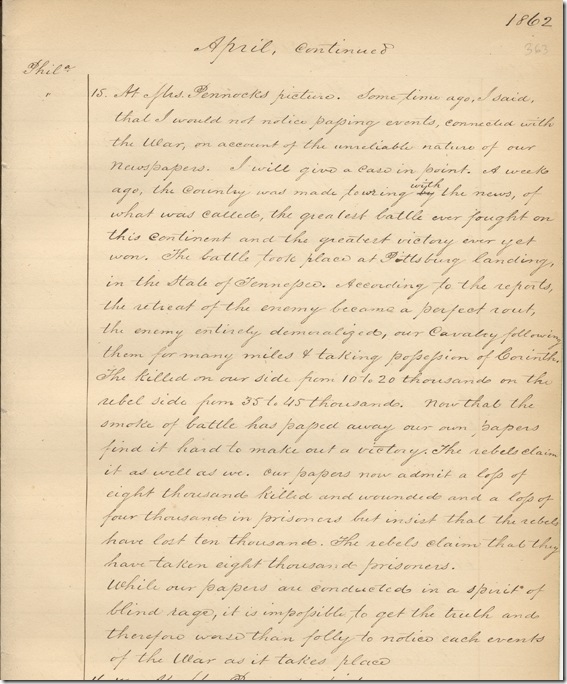
No painting. I have looked at a number of Houses lately for the new business. none to suit. Hard fighting at Richmond for eight days, our men driven to the protection of the gunboats on James river.


Citation: John Henry Brown, autograph journal/account book. Philadelphia, 1844-1890. AMs 573/14.1
May 11, 1862: John Henry Brown’s Journal

John Henry Brown was a painter of portrait miniatures, living and working in Philadelphia. He had met Lincoln in August of 1860 when he was commissioned to paint Lincoln’s portrait for a supporter, but although Brown liked Lincoln personally, he did not agree with Republican policies.

1862-05-11

Transcript:

Sunday. Norfolk & Portsmouth taken without bloodshed. The rebels blew up their iron monster the Merrimac.


Citation: John Henry Brown, autograph journal/account book. Philadelphia, 1844-1890. AMs 573/14.1
April 15, 1862: John Henry Brown’s Journal

John Henry Brown was a painter of portrait miniatures, living and working in Philadelphia. He had met Lincoln in August of 1860 when he was commissioned to paint Lincoln’s portrait for a supporter, but although Brown liked Lincoln personally, he did not agree with Republican policies.

1862-04-15

Transcript:

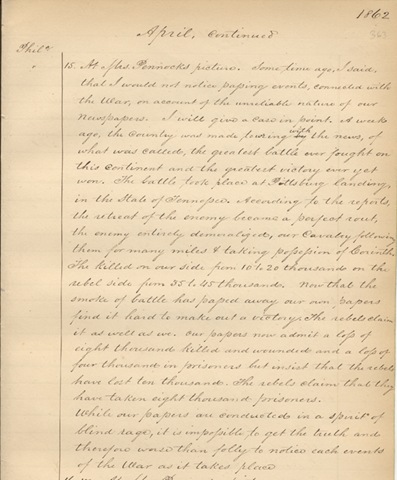
At Miss Pennocks picture. Some time ago I said that I would not notice passing events connected with the War, on account of the unreliable nature of our newspapers. I will give a case in point. A week ago, the country was made [touring?] with the news of what was called the greatest battle ever fought on this continent and the greatest victory ever won. The battle took place at Pittsburg landing, in the State of Tennessee. According to the reports, the retreat of the enemy became a perfect rout, the men entirely demoralized, our Cavalry following them for many miles & taking possession of Corinth. The killed on our side from 10 to 20 thousands on the rebel side from 35 to 45 thousand. Now that the smoke of battle has passed away our own papers find it hard to make out a victory. The rebels claim it as well as we. Our papers now admit a loss of eight thousand killed and wounded and a loss of four thousand in prisoners but insist that the rebels have lost ten thousand. The rebels claim that they have taken eight thousand prisoners.

While our papers are conducted in a spirit of blind rage, it is impossible to get the truth and therefore worse than folly to notice each event of the War as it takes place.


Citation: John Henry Brown, autograph journal/account book. Philadelphia, 1844-1890. AMs 573/14.1
April 14, 1862: John Henry Brown’s Journal

John Henry Brown was a painter of portrait miniatures, living and working in Philadelphia. He had met Lincoln in August of 1860 when he was commissioned to paint Lincoln’s portrait for a supporter, but although Brown liked Lincoln personally, he did not agree with Republican policies.

1862-04-14

Transcript:

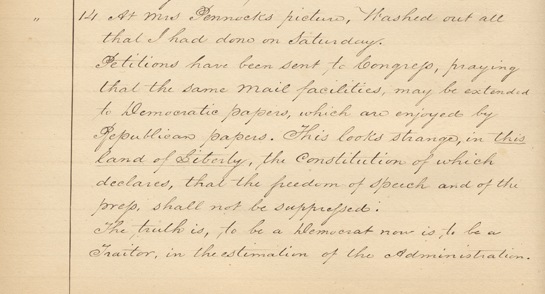
At Miss Pennocks picture, Washed out all that I had done on Saturday.

Petitions have been sent to congress praying that the same mail facilities may be extended to Democratic papers which are enjoyed by Republican papers. This looks strange in this land of liberty, the Constitution of which declares, that the freedom of speech and of the press shall not be abridged. The truth is, to be a Democrat now is to be a Traitor, in the estimation of the Administration.


Citation: John Henry Brown, autograph journal/account book. Philadelphia, 1844-1890. AMs 573/14.1

April 11, 1862: John Henry Brown’s Journal

John Henry Brown was a painter of portrait miniatures, living and working in Philadelphia. He had met Lincoln in August of 1860 when he was commissioned to paint Lincoln’s portrait for a supporter, but although Brown liked Lincoln personally, he did not agree with Republican policies.

1862-04-11

Transcript:

At Miss Pennocks picture.

Congress has abolished Slavery in the District of Columbia.


Citation: John Henry Brown, autograph journal/account book. Philadelphia, 1844-1890. AMs 573/14.1
March 26, 1862: John Henry Brown’s Journal

John Henry Brown was a painter of portrait miniatures, living and working in Philadelphia. He had met Lincoln in August of 1860 when he was commissioned to paint Lincoln’s portrait for a supporter, but although Brown liked Lincoln personally, he did not agree with Republican policies.

1862-03-26

Transcript:

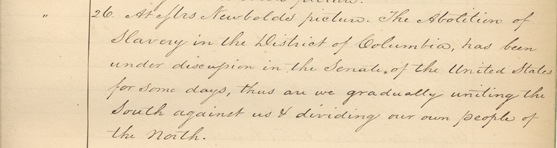
At Mrs. Newbolds picture.  The Abolition of Slavery in the District of Columbia has been under discussion in the Senate of the United States for some days, thus are we gradually uniting the South against us & dividing our own people of the North.


Citation: John Henry Brown, autograph journal/account book. Philadelphia, 1844-1890. AMs 573/14.1

March 19, 1862: John Henry Brown’s Journal

John Henry Brown was a painter of portrait miniatures, living and working in Philadelphia. He had met Lincoln in August of 1860 when he was commissioned to paint Lincoln’s portrait for a supporter, but although Brown liked Lincoln personally, he did not agree with Republican policies.

1862-03-19

Transcript:

At Mrs. Newbolds picture. 

If the newspapers are entirely truthful, then our Arms are almost daily crowned with success.


Citation: John Henry Brown, autograph journal/account book. Philadelphia, 1844-1890. AMs 573/14.1
March 11, 1862: John Henry Brown’s Journal

John Henry Brown was a painter of portrait miniatures, living and working in Philadelphia. He had met Lincoln in August of 1860 when he was commissioned to paint Lincoln’s portrait for a supporter, but although Brown liked Lincoln personally, he did not agree with Republican policies.

1862-03-11

Transcript:

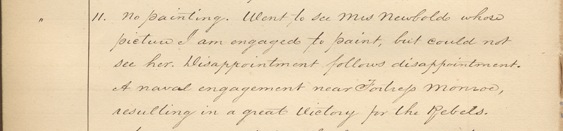
No painting. Went to see Mrs Newbold whose picture I am engaged to paint, but could not see her. Disappointment follows disappointment. A naval engagement near  Fortress Monroe, resulting in a great victory for the Rebels.


Citation: John Henry Brown, autograph journal/account book. Philadelphia, 1844-1890. AMs 573/14.1

March 7, 1862: John Henry Brown’s Journal

John Henry Brown was a painter of portrait miniatures, living and working in Philadelphia. He had met Lincoln in August of 1860 when he was commissioned to paint Lincoln’s portrait for a supporter, but although Brown liked Lincoln personally, he did not agree with Republican policies.

1862-03-07

Transcript:

At Charlotte Kilgours picture, finished it. The war news lately has been very favourable.


Citation: John Henry Brown, autograph journal/account book. Philadelphia, 1844-1890. AMs 573/14.1
February 22, 1862: John Henry Brown’s Journal

John Henry Brown was a painter of portrait miniatures, living and working in Philadelphia. He had met Lincoln in August of 1860 when he was commissioned to paint Lincoln’s portrait for a supporter, but although Brown liked Lincoln personally, he did not agree with Republican policies.

1862-02-22

Transcript:

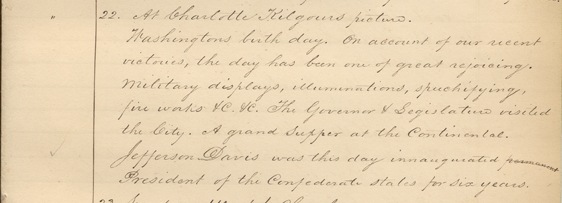
At Charlotte Kilgours picture.

Washington’s birth day. On account of our recent victories, the day has been one of great rejoicing. Military displays, illuminations, speechifying, fire works &c &c. The Governor & Legislature visited the City. A grand supper at the Continental. Jefferson Davis was this day inaugurated President of the Confederate States for six years.


Citation: John Henry Brown, autograph journal/account book. Philadelphia, 1844-1890. AMs 573/14.1