May 6, 1861: John Henry Brown’s Journal

John Henry Brown was a painter of portrait miniatures, living and working in Philadelphia. He had met Lincoln in August of 1860 when he was commissioned to paint Lincoln’s portrait for a supporter, but although Brown liked Lincoln personally, he did not agree with Republican policies.

1861-05-06

Transcript:

At Com: Conovers picture.

These are fearful times. A silent, but nevertheless perfect, reign of terror exists here. Those who do not approve of a settlement of our troubles, by the sword, are, for prudential reasons, obliged to remain very quiet. 

This prudential silence has created a seeming oneness of sentiment in the North, which really does not exist.


Citation: John Henry Brown (1818-1891), autograph journal/account book. Philadelphia, 1844-1890. AMs 574/14.1

May 4, 1861: John Henry Brown’s Journal

John Henry Brown was a painter of portrait miniatures, living and working in Philadelphia. He had met Lincoln in August of 1860 when he was commissioned to paint Lincoln’s portrait for a supporter, but although Brown liked Lincoln personally, he did not agree with Republican policies.

1861-05-04

Transcript:

At Com: Conovers picture.

Things are crowding so fast that it will be impossible to keep up with the news of each day. The reader of this must therefore, if anxious to know the daily events, turn to a file of newspapers or the written history of the times.


Citation: John Henry Brown (1818-1891), autograph journal/account book. Philadelphia, 1844-1890. AMs 574/14.1
April 27, 1861: John Henry Brown’s Journal

John Henry Brown was a painter of portrait miniatures, living and working in Philadelphia. He had met Lincoln in August of 1860 when he was commissioned to paint Lincoln’s portrait for a supporter, but although Brown liked Lincoln personally, he did not agree with Republican policies.

1861-04-27

Transcript:

At Miss Conover’s picture. Atlee still sick.

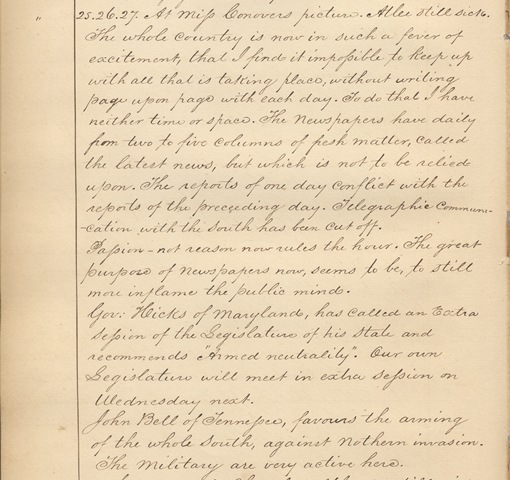
The whole country is now in such a fever of excitement, that I find it impossible to keep up with all that is taking place, without page upon page with each day. To do that I have neither time not space. The Newspapers have daily from two to five columns of fresh matter, called the latest news, but which is not to be relied upon. The reports of one day conflict with the reports of the preceding day. Telegraphic communication with the South has been cut off. Passion—not reason now rules the hour. The great purpose of newspapers now, seems to be to still more inflame the public mind.

Gov. Hicks of Maryland, has called an Extra session of the legislature of his state and recommends “Armed neutrality.” Our own Legislature will meet in extra session on Wednesday next.

John Bell of Tennessee, favours the arming of the whole South against Northern invasion.

The military are very active here.


Citation: John Henry Brown (1818-1891), autograph journal/account book. Philadelphia, 1844-1890. AMs 574/14.1
April 21, 1861: John Henry Brown’s Journal

John Henry Brown was a painter of portrait miniatures, living and working in Philadelphia. He had met Lincoln in August of 1860 when he was commissioned to paint Lincoln’s portrait for a supporter, but although Brown liked Lincoln personally, he did not agree with Republican policies.

1861-04-21

Transcript:

Sunday. At Church.

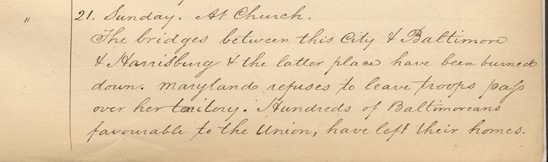
The bridges between this city & Baltimore  & Harrisburg & the latter place have been burned down. Maryland refuses to have troops pass over her territory. Hundreds of Baltimoreans favourable to the Union, have left their homes

Citation: John Henry Brown (1818-1891), autograph journal/account book. Philadelphia, 1844-1890. AMs 574/14.1
April 19, 1861: John Henry Brown’s Journal

John Henry Brown was a painter of portrait miniatures, living and working in Philadelphia. He had met Lincoln in August of 1860 when he was commissioned to paint Lincoln’s portrait for a supporter, but although Brown liked Lincoln personally, he did not agree with Republican policies.

1861-04-19

Transcript:

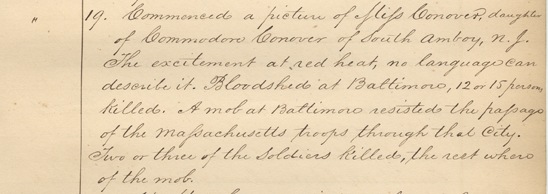
Commenced a picture of Miss Conover, daughter of Commodore Conover of South Amboy, N. J.

The excitement at red heat, no language can describe it. Bloodshed at Baltimore, 12 or 13 persons killed. A mob at Baltimore resisted the passage of the Massachusetts troops through that city. Two of three of the soldiers killed, the rest where of the mob.


Citation: John Henry Brown (1818-1891), autograph journal/account book. Philadelphia, 1844-1890. AMs 574/14.1
April 18, 1861: John Henry Brown’s Journal

John Henry Brown was a painter of portrait miniatures, living and working in Philadelphia. He had met Lincoln in August of 1860 when he was commissioned to paint Lincoln’s portrait for a supporter, but although Brown liked Lincoln personally, he did not agree with Republican policies.

1861-04-18

Transcript:

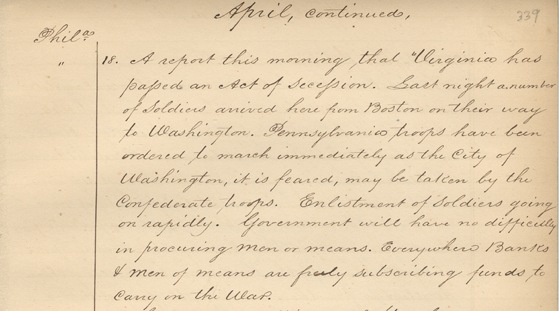
A report of this morning that Virginia has passed an Act of Secession. Last night a number of soldiers arrived here from Boston on their way to Washington. Pennsylvania troops have been ordered to march immediately as the City of Washington, it is feared, may be taken by the Confederate troops. Enlistment of soldiers going on rapidly. Government will have no difficulty in procuring men or means. Everywhere Banks & men of means are freely subscribing funds to carry on the War.


Citation: John Henry Brown (1818-1891), autograph journal/account book. Philadelphia, 1844-1890. AMs 574/14.1
April 17, 1861: John Henry Brown’s Journal

John Henry Brown was a painter of portrait miniatures, living and working in Philadelphia. He had met Lincoln in August of 1860 when he was commissioned to paint Lincoln’s portrait for a supporter, but although Brown liked Lincoln personally, he did not agree with Republican policies.

1861-04-17

Transcript:

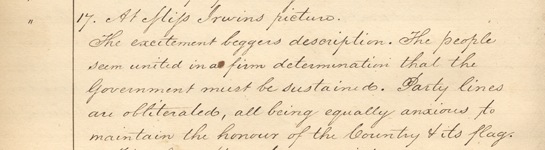
At Miss Irwin’s picture.

The excitement beggars description. The people seem united in a firm determination that the Government must be sustained. Party lines are obliterated, all being equally anxious to maintain the honour of this country & its flag.


Citation: John Henry Brown (1818-1891), autograph journal/account book. Philadelphia, 1844-1890. AMs 574/14.1
April 15, 1861: John Henry Brown’s Journal

John Henry Brown was a painter of portrait miniatures, living and working in Philadelphia. He had met Lincoln in August of 1860 when he was commissioned to paint Lincoln’s portrait for a supporter, but although Brown liked Lincoln personally, he did not agree with Republican policies.

1861-04-15

Transcript:

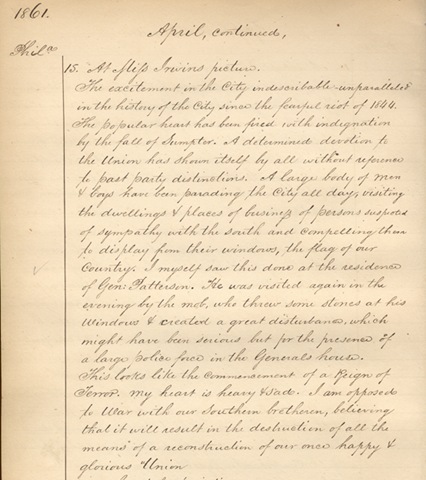
At Miss Irwin’s picture.

The excitement in the City indescribably unparalleled in this history of the city since the fearful riot of 1844. The popular heart has been fired with indignation by the fall of Sumpter. A determined devotion to the Union has shown itself by all without reference to past party distinctions. A large body of men & boys have been parading the City all day, visiting the dwellings & places of business of persons suspected of sympathy with the south and compelling them to display from their windows, the flag of our country. I myself saw this done at the residence of Gen: Patterson. He was visited again in the evening by the mob, who threw some stones at his windows & created a great disturbance, which might have been serious but for the presence of a large police force in the Generals house. This looks like the Commencement of a Reign of Terror. My heart is heavy & sad. I am opposed to War with our southern brethren, believing that it will result in the destruction of all the means of a reconstruction of our once happy & glorious union.


Citation: John Henry Brown (1818-1891), autograph journal/account book. Philadelphia, 1844-1890. AMs 574/14.1
April 14, 1861: John Henry Brown’s Journal

John Henry Brown was a painter of portrait miniatures, living and working in Philadelphia. He had met Lincoln in August of 1860 when he was commissioned to paint Lincoln’s portrait for a supporter, but although Brown liked Lincoln personally, he did not agree with Republican policies.


April 10-14, 1861

Transcript:

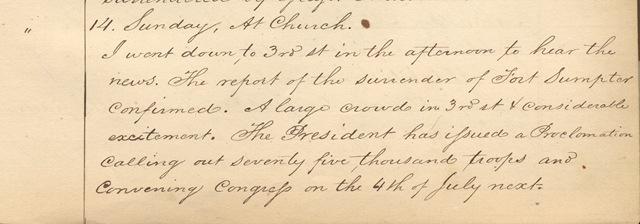
Sunday, At Church.

I went down to 3d st in the afternoon to hear the news. The report of the surrender of Fort Sumpter confirmed. A large crowd in 3d st & considerable excitement. The President has issued a Proclamation calling out seventy five thousand troops and convening Congress on the 4th of July next.

Citation: John Henry Brown (1818-1891), autograph journal/account book. Philadelphia, 1844-1890. AMs 574/14.1

April 13, 1861: John Henry Brown’s Journal

John Henry Brown was a painter of portrait miniatures, living and working in Philadelphia. He had met Lincoln in August of 1860 when he was commissioned to paint Lincoln’s portrait for a supporter, but although Brown liked Lincoln personally, he did not agree with Republican policies.

  Transcript:

April 10-14, 1861

Transcript:

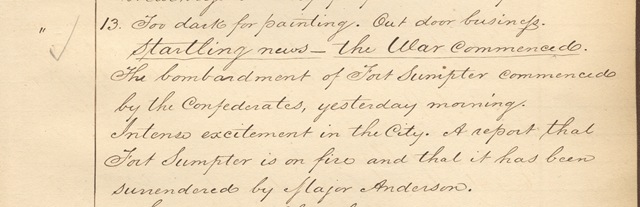
Too dark for painting. Out door business. Startling news—the War commenced. The bombardment of Fort Sumpter commenced by the Confederates, yesterday morning. Intense excitement in the City. A report that Fort Sumpter is on fire and that it has been surrendered by Major Anderson.

Citation: John Henry Brown (1818-1891), autograph journal/account book. Philadelphia, 1844-1890. AMs 574/14.1