December 31, 1862: Alexander Biddle to Julia Williams Rush Biddle

Alexander Biddle was a member of the prominent Philadelphia Biddle family and was married to Julia Williams Rush,  the granddaughter of Dr. Benjamin Rush.  Biddle served with the 121st Pennsylvania Volunteer Infantry, beginning in September 1862. Starting out as a major, he would participate at Fredericksburg and Gettysburg, among other engagements, and would leave the service as a lieutenant colonel. (He was commissioned, but never mustered, as colonel)

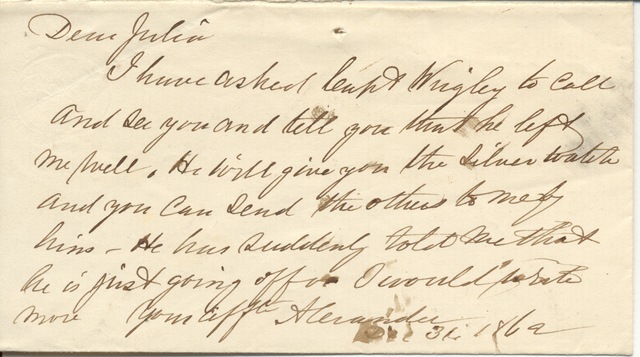
Rush IV-30-26 p1 A Biddle ALS to Julia William Rush, Dec. 31

Transcript:

Dear Julia

I have asked Capt Wrigley to call and see you and tell you that he left me well. He will give you the silver watch and you can send the other to me by him. He has suddenly told me that he is just going off or I would write more

Your aff

Alexander

Dec 31 1862

Citation: Alexander Biddle (1819-1899), autograph letter signed to Julia Williams Rush Biddle. 31 December 1862. Rush:IV:30:26

December 29, 1862: Alexander Biddle to Julia Williams Rush Biddle

Alexander Biddle was a member of the prominent Philadelphia Biddle family and was married to Julia Williams Rush,  the granddaughter of Dr. Benjamin Rush.  Biddle served with the 121st Pennsylvania Volunteer Infantry, beginning in September 1862. Starting out as a major, he would participate at Fredericksburg and Gettysburg, among other engagements, and would leave the service as a lieutenant colonel. (He was commissioned, but never mustered, as colonel)

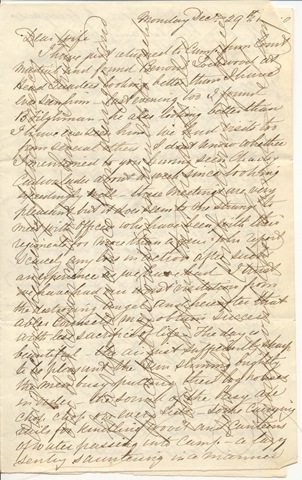
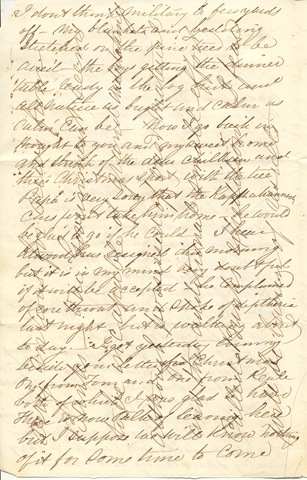
Rush IV-30-26 p1 A Biddle ALS to Julia William Rush, Dec. 29 Rush IV-30-26 p2 A Biddle ALS to Julia William Rush, Dec. 29 Rush IV-30-26 p3 A Biddle ALS to Julia William Rush, Dec. 29 Rush IV-30-26 p4 A Biddle ALS to Julia William Rush, Dec. 29

Transcript:

Monday Dec. 29th 1862

Dear Wife,

I have just returned to camp from Court Martial and found Benoni Lockwood at Head Quarters looking better than I have ever seen him – last evening too I found B Tilghman – he also looking better than I have ever seen him. We had visits too from several others I don’t know whether I mentioned to you having seen Charley Cadwalader about a week since looking exceedingly well – these meetings are very pleasant but it does seem to me strange to meet with officers who have been with their regiments who report scarcely any loss in action after such an experience as we have had. I trust we have had our worst visitation from the destroying angel and hereafter that abler counsels may obtain success with less sacrifice of life. The day is beautiful – the air just sufficiently sharp to be pleasant the sun shining brightly the men busy putting their log houses in order – the sound of the busy axe chop, chop on every side – some carrying rails for kindling wood and canteens of water passing into camp – a lazy sentry sauntering in a manner I don’t think military a few yards off. My blankets and bedding stretched on the pine trees to be aired – the boys getting the dinner table ready in the log hut and all nature as bright and calm as calm can be. Now I go back in thought to you and my sweet home and think of the dear children and their Christmas sport with the tree Papa is very sorry that the Rappahannock cars won’t take him home – he would be glad to go if he could…

Citation: Alexander Biddle (1819-1899), autograph letter signed to Julia Williams Rush Biddle. 29 December 1862. Rush:IV:30:26

December 28, 1862: Alexander Biddle to Julia Williams Rush Biddle

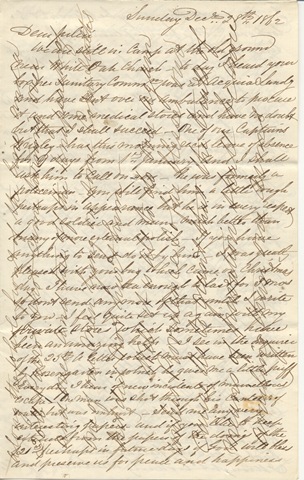
Alexander Biddle was a member of the prominent Philadelphia Biddle family and was married to Julia Williams Rush,  the granddaughter of Dr. Benjamin Rush.  Biddle served with the 121st Pennsylvania Volunteer Infantry, beginning in September 1862. Starting out as a major, he would participate at Fredericksburg and Gettysburg, among other engagements, and would leave the service as a lieutenant colonel. (He was commissioned, but never mustered, as colonel) Rush IV-30-26 p1 A Biddle ALS to Julia William Rush, Dec. 28 Rush IV-30-26 p2 A Biddle ALS to Julia William Rush, Dec. 28 Rush IV-30-26 p3 A Biddle ALS to Julia William Rush, Dec. 28 Rush IV-30-26 p4 A Biddle ALS to Julia William Rush, Dec. 28
Transcript:

Sunday Dec. 28th, 1862

Dear Julia,

We are all in Camp at the old ground near White Oak Church – to day I heard your box per Sanitary Comm. was at Acquia Landg. and have sent over out ambulance to procure it and some medical stores and have no doubt but that I shall succeed. One of our Captains Wrigley has this morning recd. leave of absence for 9 days from 1st January and I shall ask him to call on you. He was formerly a policeman. You will find him a little rough perhaps in appearance but he is in every respect a good soldier and man –much better than many of more external polish. If you have anything to send do it by him. I was greatly pleased with your bag which came on Christmas so don’t send me anymore of that until I write to you. I feel quite set up again with my private store which sometimes have been an amazing help. I see in the Inquirer of the 25th a letter which must have been written by Rosengarten in which he gives me a little puff Everyday I hear of new incidents of marvelous escape – one man was shot through his canteen of water but was unhurt. Send me any interesting papers and if you like to keep extracts from the papers of the doing of the 121st perhaps in future days if God will bless and preserve us for peace and happiness here on earth they may be pleasant to look over..

Citation: Alexander Biddle (1819-1899), autograph letter signed to Julia Williams Rush Biddle. 28 December 1862. Rush:IV:30:26

December 25, 1862: Alexander Biddle to Julia Williams Rush Biddle

Alexander Biddle was a member of the prominent Philadelphia Biddle family and was married to Julia Williams Rush,  the granddaughter of Dr. Benjamin Rush.  Biddle served with the 121st Pennsylvania Volunteer Infantry, beginning in September 1862. Starting out as a major, he would participate at Fredericksburg and Gettysburg, among other engagements, and would leave the service as a lieutenant colonel. (He was commissioned, but never mustered, as colonel)
Rush IV-30-26 p1 A Biddle ALS to Julia William Rush, Dec. 25 Rush IV-30-26 p2 A Biddle ALS to Julia William Rush, Dec. 25 Rush IV-30-26 p3 A Biddle ALS to Julia William Rush, Dec. 25 Rush IV-30-26 p4 A Biddle ALS to Julia William Rush, Dec. 25

Rush IV-30-26 p5 A Biddle ALS to Julia William Rush, Dec. 25 Rush IV-30-26 p6 A Biddle ALS to Julia William Rush, Dec. 25 Rush IV-30-26 p7 A Biddle ALS to Julia William Rush, Dec. 25 Rush IV-30-26 p8 A Biddle ALS to Julia William Rush, Dec. 25

Transcript [excerpt]:

Camp Near White Oak Church

Christmas Day. 1862

Dear Julia

I have your letter of 20th inst. and have your sweet Rainy day in Camp. It is very pretty and every line of it almost has a response in feeling surging with the changeful hours of a soldier’s life. Yesterday we sent 150 men out on picket duty – I was on court martial we disposed of one case and adjourned until tomorrow Today I rode over about 3 miles to a new landing on the indentation which runs into Belle Plains called here General Franklin’s new landing and went on board of a sutler’s boat but found him almost all sold out – the Lieut Col and I got some maple syrup chocolate and butter for the mess and transported it to camp – We don’t look much to seeing our sutler we think he don’t want to come, we don’t see why he can’t run a boat to the landing and give us notice – We hear that Chapman’s trunk is at Acquia and have sent for it – I fear the box of the sanitary commission will not get farther than Washington or at most than Acquia – Lewis might send it but unless there is someone to send it forward at every depot it stands but little chance. The best way to send me anything will be by Hulse – Zell – Lloyd – if they come back well – but don’t let it be large. Hulse you may trespass on most – A man named Daniel Holland I told to call on you who is going to return in 2nd January an officer’s servant – you may send a small pckge by him. Dear Wife I can say to you that you cant conceive how grateful I feel to our Heavenly Father for his merciful preservation of me on the 13th inst. Read the Herald of Tuesday the 23rd You will there find extracts from the Richmond paper and what they think of the attack on their right made by our left.

– Christmas Night –

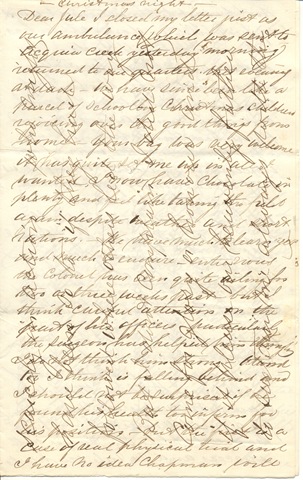
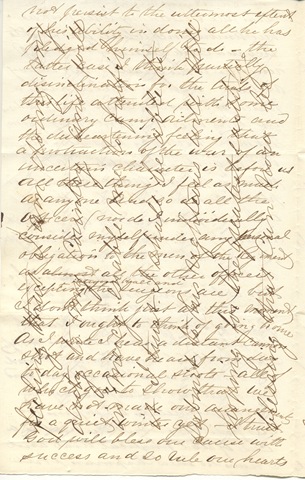
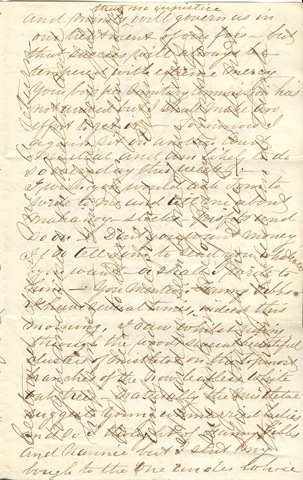
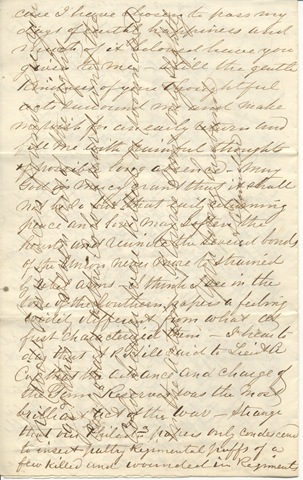
Dear Julia I closed my letter just as our ambulance (which was sent to Acquia Creek yesterday morning) returned to our quarters this evening at dark. We have since been like a parcel of Christmas schoolboy children rejoicing over the good things from home. Your bag was very welcome it has quite set me up in all I wanted, I now have chocolate in plenty and feel like taking the field again despite weather and short rations. We have much to learn yet and much to endure – entre nous the Colonel has been quite ailing for two or three weeks past – but I think careful attention on the part of his officers particularly the surgeon has helped him thoroughly. I do not think him strong – Atwood too I think is falling behind and I should not be surprised if he found his health too infirm for his position – but the first is a case of real physical trial and I have no idea how Chapman will not persist to the uttermost extent of his ability in doing all he has pledged himself to do – the latter case I think partially disinclination for the trials of this life attended with some ordinary camp ailments and the disheartening feeling that a protraction of the war of an uncertain character is before us all these things I feel as much as anyone and so do all the officers (nor do I individually consider myself under any personal obligation to the men of the Regiment as almost all the other officers excepting Atwood, Hall and the Surgeons all) but I don’t think just at this moment that I ought to think of going home. As I write I hear a distant cannon shot and have heard from day to day occasional shots – all of which goes to show that we have not made our arrangements for a quiet winter yet – I trust God will bless our cause with success and so rule our hearts and minds that no injustice will govern us in our treatment of our foes – but that success will always be tempered with extreme mercy…

Citation: Alexander Biddle (1819-1899), autograph letter signed to Julia Williams Rush Biddle. 25 December 1862. Rush:IV:30:26

December 24, 1862: Alexander Biddle to Julia Williams Rush Biddle

Alexander Biddle was a member of the prominent Philadelphia Biddle family and was married to Julia Williams Rush,  the granddaughter of Dr. Benjamin Rush.  Biddle served with the 121st Pennsylvania Volunteer Infantry, beginning in September 1862. Starting out as a major, he would participate at Fredericksburg and Gettysburg, among other engagements, and would leave the service as a lieutenant colonel. (He was commissioned, but never mustered, as colonel)Rush IV-30-26 p1 A Biddle ALS to Julia William Rush, Dec. 24 Rush IV-30-26 p2 A Biddle ALS to Julia William Rush, Dec. 24 Rush IV-30-26 p3 A Biddle ALS to Julia William Rush, Dec. 24 Rush IV-30-26 p4 A Biddle ALS to Julia William Rush, Dec. 24

Transcript (excerpt):

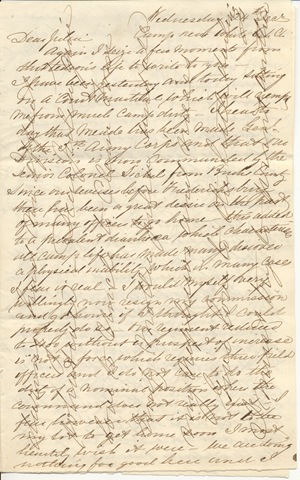
Wednesday 24th Dec

Camp near White Oak Ch

Dear Julia

Again I seize a free moment from this tedious life to write to you –

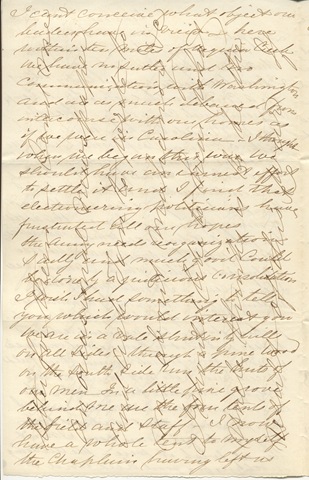
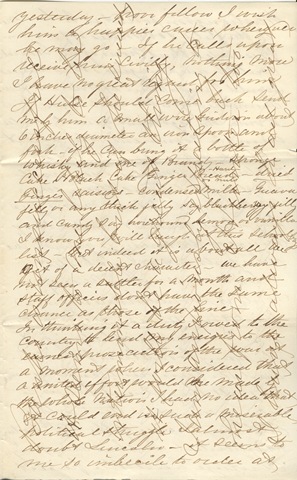
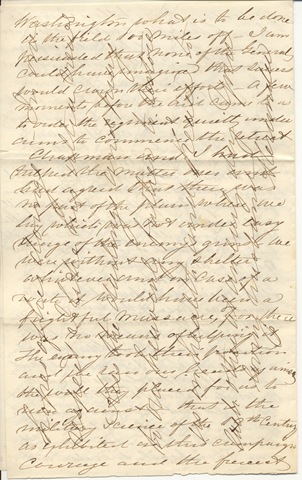
I have been yesterday and today sitting on a court martial which will exempt me from much camp duty. I hear to day that Meade has been made Genl. of the 5th Army Corps and that our Division is now commanded by the Senior Colonel Sickel from Bucks County Since our service before Fredericksburg there has been a great desire of many officers to go home – this added to a prevalent diarrhea which characterizes all camp life has made many discover a physical [inability?] which in many cases I fear is real – I would myself very willingly now resign my commission and go home if I thought I could properly do so. Our regiment reduced to 400 without a prospect of increase is not a force which requires three field officers and I do not care to do the duty of a nominal position where the command does not really exist I fear however that it is not to be my lot to get home soon I most heartily wish it were – We are doing nothing for good here and I  can’t conceive what object our leaders have in view here within ten miles of Acquia Creek…

Citation: Alexander Biddle (1819-1899), autograph letter signed to Julia Williams Rush Biddle. 24 December 1862. Rush:IV:30:26

December 21, 1862: Alexander Biddle to Julia Williams Rush Biddle

Alexander Biddle was a member of the prominent Philadelphia Biddle family and was married to Julia Williams Rush,  the granddaughter of Dr. Benjamin Rush.  Biddle served with the 121st Pennsylvania Volunteer Infantry, beginning in September 1862. Starting out as a major, he would participate at Fredericksburg and Gettysburg, among other engagements, and would leave the service as a lieutenant colonel. (He was commissioned, but never mustered, as colonel) Rush IV-30-26 p1 A Biddle ALS to Julia William Rush, Dec. 21 Rush IV-30-26 p2 A Biddle ALS to Julia William Rush, Dec. 21 Rush IV-30-26 p3 A Biddle ALS to Julia William Rush, Dec. 21 Rush IV-30-26 p4 A Biddle ALS to Julia William Rush, Dec. 21
Transcript (excerpt):

Philad. Dec 21st 1862

Camp near White Oak Ch

Head Quarters 121st Reg P.V.

Dear Julia

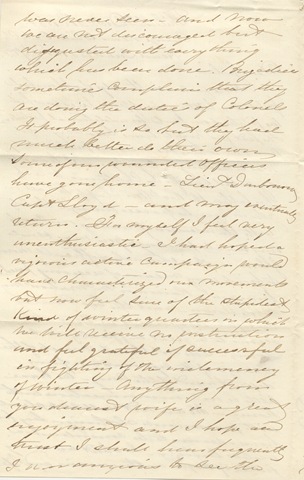
Here we are on the edge of a ploughed field in a little grove of pine trees in which we pitched our tents for additional protection. The last few nights have been very cold and one when we were on picket duty was exceedingly trying. I have to day asked one of our captains to ask his father the Rev. Mr Clapp to call on you in case he passes through the city with the intention of visiting our camp any small packages you may send by him – it is extremely difficult now to find any means of receiving parcels from you. Raisin or Mr. Mahon may come down – and the box Barclay brought may reach us but there seems to be great difficulty in so doing. I do not think much of the charge of the regiments – or of any department of the Army. We have little or no communications with home We are not well supplied with provisions or clothing – hay for horses seems to be considered a useless luxury. In short an army fuller of hope enthusiasm and life was never seen – and now we are not discouraged but disgusted with everything which has been done.

Citation: Alexander Biddle (1819-1899), autograph letter signed to Julia Williams Rush Biddle. 21 December 1862. Rush:IV:30:26

December 20, 1862: Letter to Emily Biddle

Rush IV 37-40 emily s biddle recipent

Transcript:

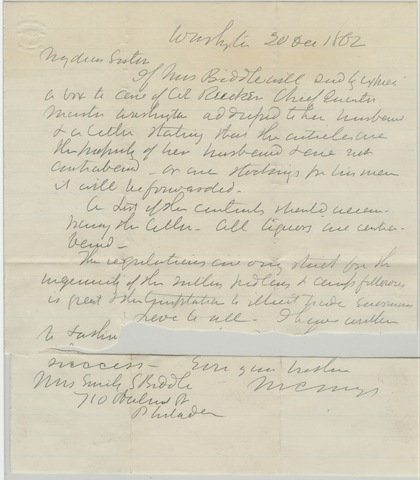
Washington 20 dec 1862

My dear sister

If Mrs. Biddle will send by express a box to care of Col. Rucker Chief Quarter Master Washington addressed to her husband a letter noting that the articles are the property of her husband & are not contraband-or are things for his men it will be forwarded.

A list of the contents should accompany the [illeg.]. All liquors are contraband.

The regulations are very strict for the ingenuity of the military pedlars and camp followers is great & the temptation to illicit trade [illeg.]

Love to all. I have written to father {the letter is torn here} success.

Ever your [sister?]

(illeg)

Mrs Emily S Biddle

710 Walnut Street

Philadelphia

Citation: Emily S. Biddle, recipient.  Washington, 20 December 1862. Rush 37:22

December 19, 1862: Alexander Biddle to Julia Rush Williams Biddle

Alexander Biddle was a member of the prominent Philadelphia Biddle family and was married to Julia Williams Rush,  the granddaughter of Dr. Benjamin Rush.  Biddle served with the 121st Pennsylvania Volunteer Infantry, beginning in September 1862. Starting out as a major, he would participate at Fredericksburg and Gettysburg, among other engagements, and would leave the service as a lieutenant colonel. (He was commissioned, but never mustered, as colonel)
Rush IV-30-26 p1 A Biddle ALS to Julia William Rush, Dec. 19 Rush IV-30-26 p2 A Biddle ALS to Julia William Rush, Dec. 19 Rush IV-30-26 p3 A Biddle ALS to Julia William Rush, Dec. 19

Transcript:

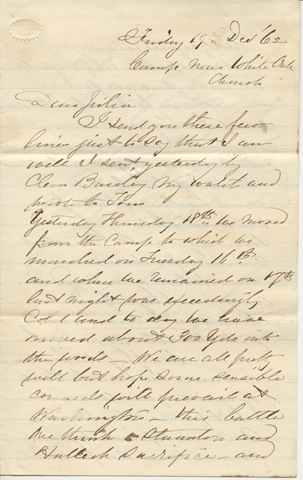
Friday 19th Dec ‘62

Camp Near White Oak Church

Dear Julia

I send you these few lines just to say that I am well I sent yesterday by Clam Barclay my walet and wrote to Tom

Yesterday Thursday 18th we moved from the Camp to which we marched on Tuesday 16th and where we remained on 17th last night was exceedingly cold and to day we have moved about 300 yds into the woods. We are all pretty well but hope some sensible counsels will prevail at Washington – this battle we think a [Stauntons?] and Halleck Sacrifice and totally unnecessary

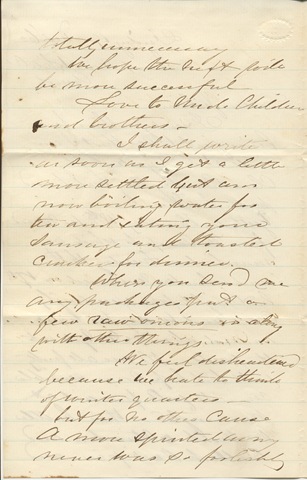
We hope the next will be more successful

Love to Uncle Children and brothers

I shall write as soon as I get a little more settled but am now boiling water for tea and eating your sausage and toasted crackers for dinner.

When you send me any packages put a few raw onions in along with other things

We feel disheartened because we hate to think of winter quarters – but for no other cause A more spirited army never was so foolishly exposed – and they will be ready again when required

Good by beloved wife Remember me always in your prayers to him who alone gives me safety in this world and in the next

Your loving husband

Alexander

Send me any interesting newspaper which attracts your attention – An occasional Harpers Weekly or Monthly

Citation: Alexander Biddle (1819-1899), autograph letter signed to Julia Williams Rush Biddle. 19 December 1862. Rush:IV:30:26

December 18, 1862: Letter to Julia Williams Rush Biddle

Rush IV-32-26 letter to Julia Williams Rush p1-6 Rush IV 32-36 Letter to Julia Biddle p2-5 Rush IV 32-36 Letter to Julia Biddle p2-5Rush IV-32-26 letter to Julia Williams Rush p1-6

Transcript:

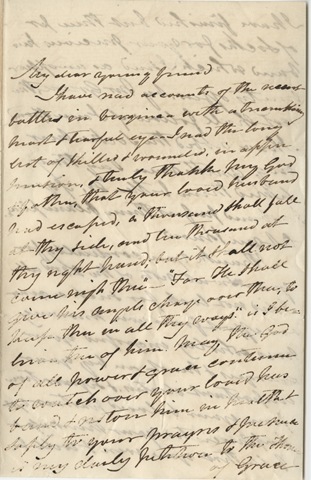
My dear young friend,

I have read accounts of the recent battles in Virginia with a trembling heart and thankful eye. I read the long list of killed and wounded in apprehension. I truly thank my God and Father, that your loved husband has escaped, a “thousand shall fall at thy side, and two thousand at thy right hand; but it shall not come nigh thee”—“For he shall give his angels charge over thou, to keep thee in all thy ways” is I believe true of him. May the God of all power and grace continue to watch over your loved husband and restore him in health and safety to your prayers of gratitude is my daily petition to the Throne of Grace.

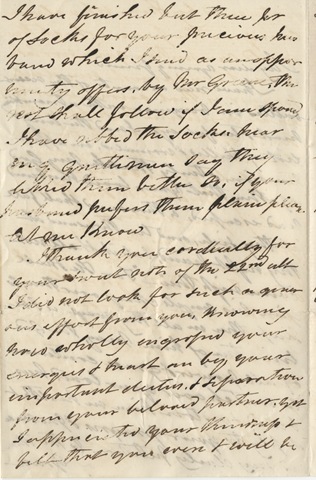
I have finished but three pairs of socks for your precious husband which I send as an opportunity offers. By His Grace, the rest shall follow if I am spared. I have ribbed the socks. I hear eng. gentleman say they liked them better so, if your husband prefers them plain please let me know.

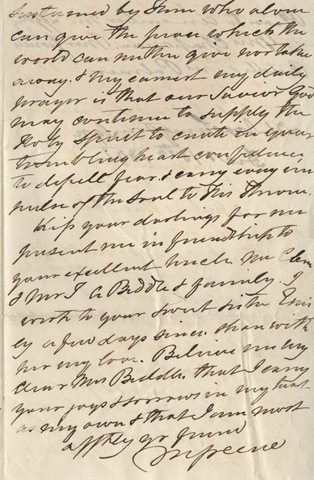
I thank you cordially for your sweet note of the 22nd as I did not look for such a generous effort from you, knowing how wholly engrossed your energies and heart are by your important duties and  separation from your beloved partner. I appreciated your thoroughness and felt that you even and will be sustained by Him who alone can give the [praise?] which the world can neither give nor take away and my earnest my daily prayer is that our Savior God may continue to supply the Holy Spirit to create in your trembling heart confidence to dispel fear and carry every impulse of the Soul to His Throne.

Kiss your darlings for me present me in friendship to your excellent Uncle Mr and Mrs J Biddle and family. I wrote to your  sweet sister Emily a few days since, share with her my love. Believe me my dear Mrs Biddle that I carry your joys and sorrows in my heart as my own and that I am more aptly your friend

(signature)

Please to do remember me aff[]ly to Mrs Chasserman, Mrs James Biddle, and Mrs Palmer

34 Washington Sqr

Dec 18th, 1962

34 Washington Sqr

Dec 18th 1862

Citation: Julia Williams Rush Biddle, recipient; Philadelphia, 18 December 1862. Rush IV:32:26
December 16, 1862: Alexander Biddle to Julia Rush Williams Biddle

Alexander Biddle was a member of the prominent Philadelphia Biddle family and was married to Julia Williams Rush,  the granddaughter of Dr. Benjamin Rush.  Biddle served with the 121st Pennsylvania Volunteer Infantry, beginning in September 1862. Starting out as a major, he would participate at Fredericksburg and Gettysburg, among other engagements, and would leave the service as a lieutenant colonel. (He was commissioned, but never mustered, as colonel) Rush IV-30-26 p1 A Biddle ALS to Julia William Rush, Dec. 16 Rush IV-30-26 p2 A Biddle ALS to Julia William Rush, Dec. 16 Rush IV-30-26 p3 A Biddle ALS to Julia William Rush, Dec. 16 Rush IV-30-26 p4 A Biddle ALS to Julia William Rush, Dec. 16

Transcript:

Camp in the woods about

2 miles North of the Rappahannock

Friday Dec. 16th 1862

Dear Wife

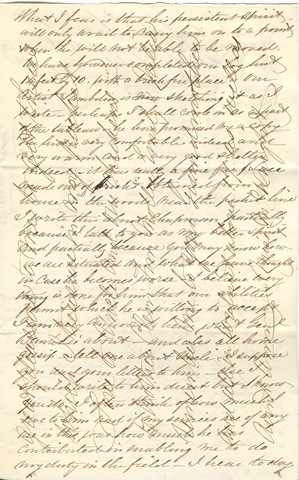
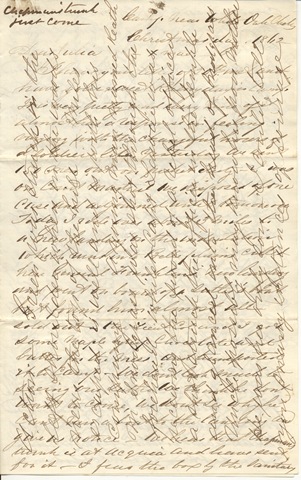
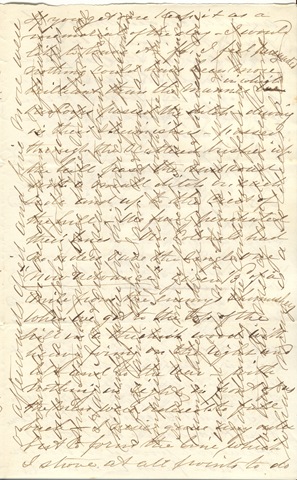
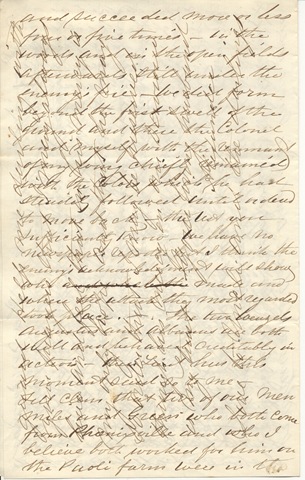
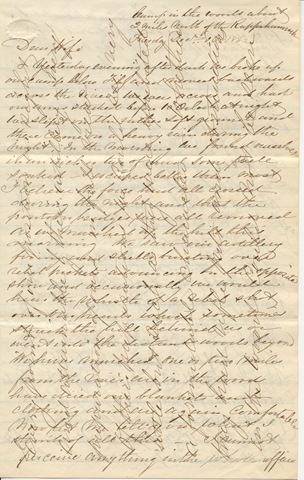
Yesterday evening after dark we broke up our camp below F’bg and moved backwards across the river. We were across and had our arms stacked before 10 Oclock at night We slept on the rather soft ground and there came on a heavy rain during the night. In the morning we found ourselves in an inch or two of mud some were soaked – I escaped better than most I believe the force had all crossed during the night and thus the pontoon bridge was all removed as we marched up the hill this morning We saw our artillery firing and shells bursting over rebel pickets advancing in the opposite shore and occasionally we would hear the whistle of a rebel shot over our heads which sometimes stuck the hill behind us or went into the distant woods beyond. We have marched one or two miles from the river, are in the wood have dried our blankets and clothing and are again comfortable. Now let me tell you what I think of all this. I cannot perceive anything in the whole affair save the most fool hardy attempt to force unknown obstructions that military experience has ever known / It may perhaps have been an effort to do something to make the enemy believe we were in earnest and so keep their forces attending to Banks but I cannot see anything so wise in their conduct

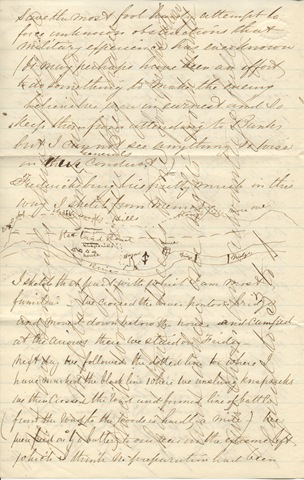
Fredericksburg lies pretty much in the way I sketch from memory

[sketch]

I sketch that part with which I am most familiar. We crossed the lower pontoon bridge and moved down below the house and camped at the arrows there we staid on Friday.

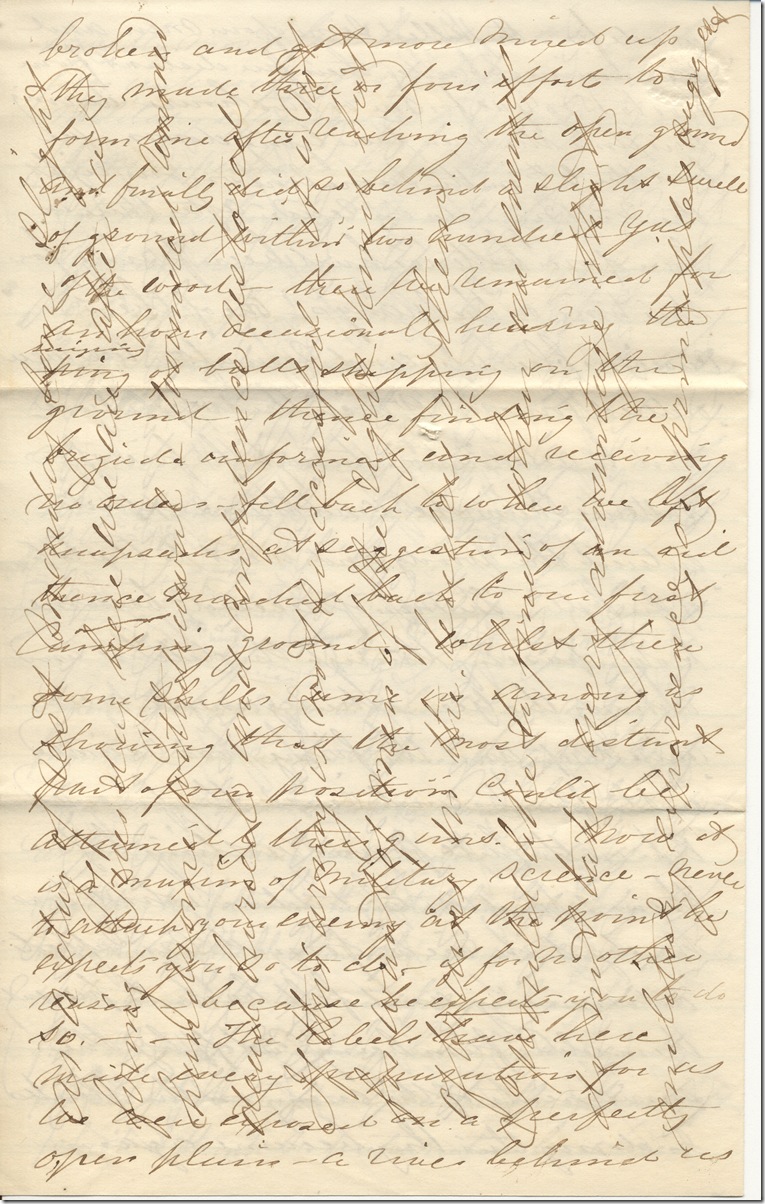
Next day we followed the dotted line to where I have marked the black line where we unslung knapsacks we then crossed the road and formed line of battle (from the road to the woods is hardly a mile) we were fired on by a battery to our rear on the extreme left which I think no preparation had been made for. They killed some of our men and we remained under their fire distant from 1000 to 1500 yds for one or two hours during this time the men were lying down. We had the 6th on the same line on our right the 2nd Brigade in rear after three or four of our batteries had been firing for this time on the enemy’s. One of their caissons blew up and soon after we were ordered forward which the whole line did to admiration through the fire of batteries skirmishers and their supports entered the woods and went to the left of the hill. The men of necessity became broken passing through the ditches and among the trees the regiments were mixed up and the firing was resumed on the flanks and rear they formed line in the hill formed nothing below them had no instruction what was the object in view formed no supports advancing and fell back to prevent themselves from being cut off by the movements of the enemy on the flanks In doing so they became again broken and got more mixed up They made three or four efforts to form line after reaching the open ground and finally did so behind a slight swell of ground within two hundred yds of the wood. There we remained for an hour occasionally hearing the ping of balls skipping on the ground – thence finding the brigade uninformed and receiving no orders fell back to where we left knapsacks at suggestion of an aid thence marched back to out first Camping ground whilst there some shells came in among us showing that the most distant part of out position could be attained by their guns. Now it is a maxim of military science – never to attack your enemy at the point he expects you so to do – if for no other reason – because he expects you to do so. The Rebels have here made every preparation for us we were exposed on a perfectly open plain – a river behind us Every point of our position in sight and attainable by their artillery – Every preparation of ours in full view

Of their preparations we could see very little but such as they were exhibited a formidable character. Whether they had rifle pits and obstructions in the woods could not be seen Yet our Generals have judged it military to send us into thick woods where they have had three weeks time for preparation and were one night’s work would give them an advantage fully equal to 3 to 1

Our 576 did go in spite of batteries and all possibilities and only came out when they could see nothing more to do and no other direction what was not certain capture. We lost 164 to do it. Balaclava was no better – and for the General I think as little creditable

Sunday seemed mutually agreed on as a day of rest Monday some slight firing – Tuesday here we are after a handsome withdrawal, wounded removed dead buried and confidence restored

If this army is not successful it is not for want of men of the right kind but of brains in the leaders of them

I would like to find when one enemies do not take every advantage that military experience or principle suggested

Citation: Alexander Biddle (1819-1899), autograph letter signed to Julia Williams Rush Biddle. 16 December 1862. Rush:IV:30:26