February 19, 1862: John Henry Brown’s Journal

John Henry Brown was a painter of portrait miniatures, living and working in Philadelphia. He had met Lincoln in August of 1860 when he was commissioned to paint Lincoln’s portrait for a supporter, but although Brown liked Lincoln personally, he did not agree with Republican policies.

1862-02-19

Transcript:

At Miss Kilgours picture.

The Presidents second son, Willie, died last night, at the White House.


Citation: John Henry Brown, autograph journal/account book. Philadelphia, 1844-1890. AMs 573/14.1

October 4, 1861: Abraham Lincoln Warrant to Affix Seal to Treaty

AMs 563-24_1

Transcript:

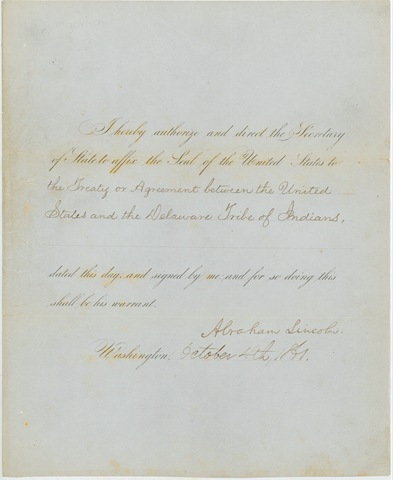
I hereby authorize and direct the Secretary of State to affix the Seal of the United States to the Treaty or Agreement between the United States and the Delaware Tribe of Indians, dated this day, and signed by me, and for so doing this shall be his warrant.

Abraham Lincoln

Washington, October 4th, 1861


Citation: United States. President (1861-1865 : Lincoln) Warrant. Washington, D. C., 4 October 1861. AMs 563/24.1

October 1, 1861: Abraham Lincoln, Plan of a Military Campaign

AMs 545-21_1

AMs 545-21_3

AMs 545-21_5

Transcription:

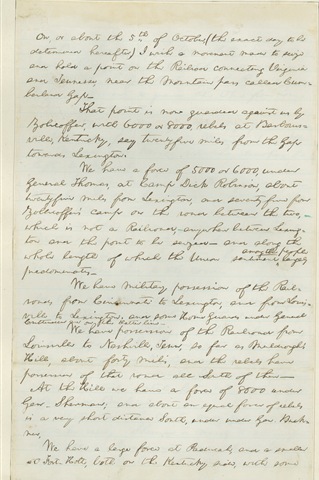
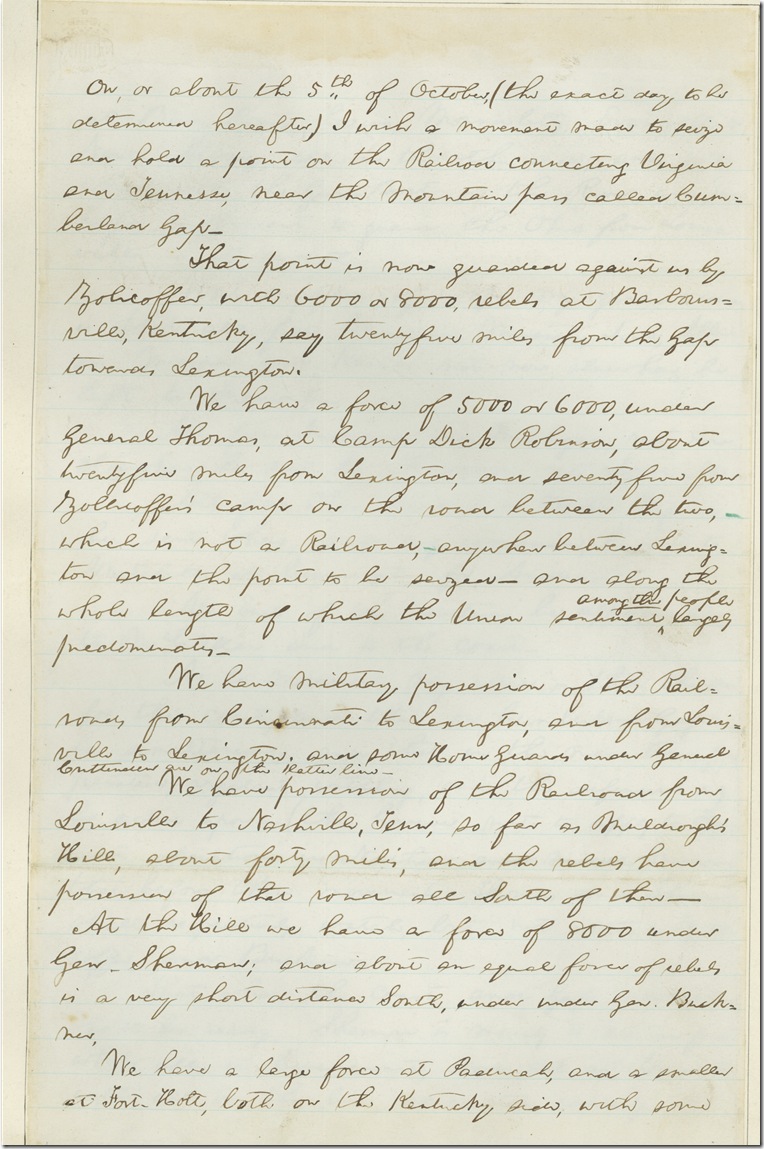
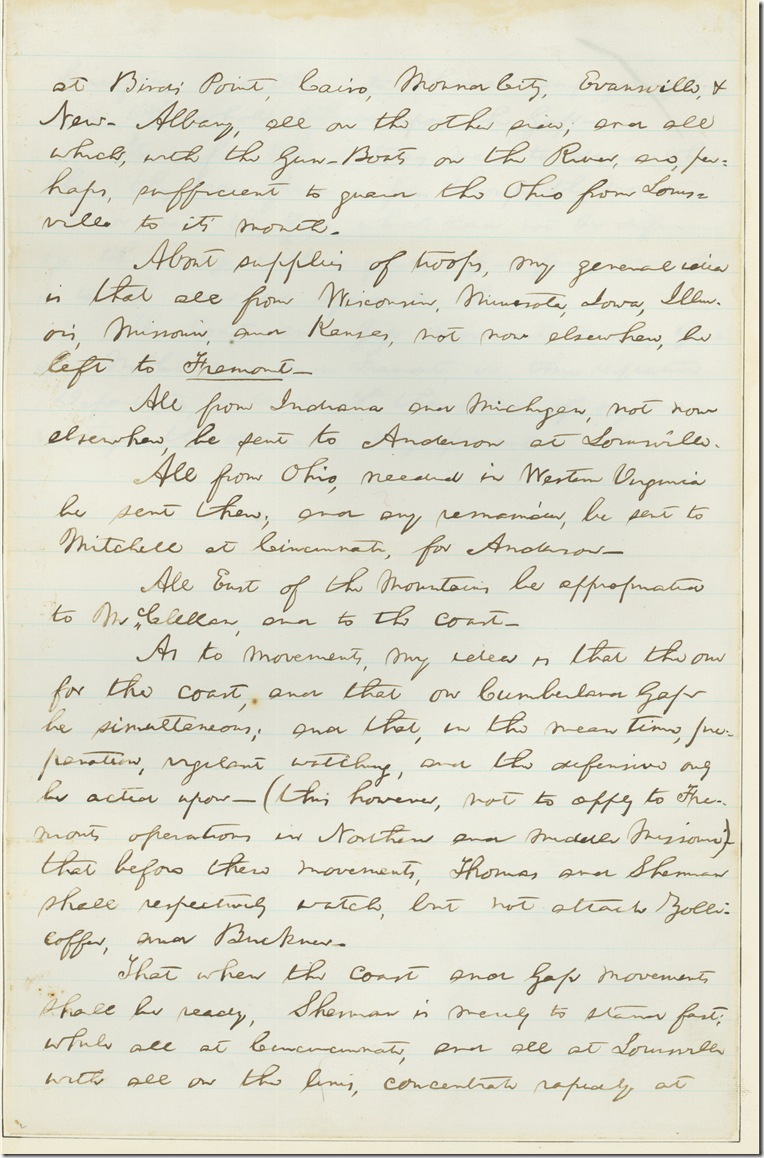
On, or about the 5th. of October, (the exact day to be determined hereafter) I wish a movement made to seize and hold a point on the Railroad connecting Virginia and Tennesse, near the Mountain pass called Cumberland Gap.

That point is now guarded against us by Zolicoffer, with 6000 or 8000, rebels at Barboursville, Kentucky, say twentyfive miles from the Gap towards Lexington.

We have a force of 5000 or 6000, under General Thomas, at Camp Dick Robinson, about twentyfive miles from Lexington, and seventyfive from Zollicoffer’s camp on the road between the two, which is not a Railroad, anywhere between Lexington and the point to be seized—and along the whole length of which the Union sentiment among the people largely predominates.

We have military possession of the Railroads from Cincinnati to Lexington, and from Louisville to Lexington, and some Home Guards under General Crittenden are on the latter line.

We have possession of the Railroad from Louisville to Nashville, Tenn, so far as Muldrough’s Hill, about forty miles, and the rebels have possession of that road all South of there. At the Hill we have a force of 8000 under Gen. Sherman; and about an equal force of rebels is a very short distance South, under under [sic] Gen. Buckner.

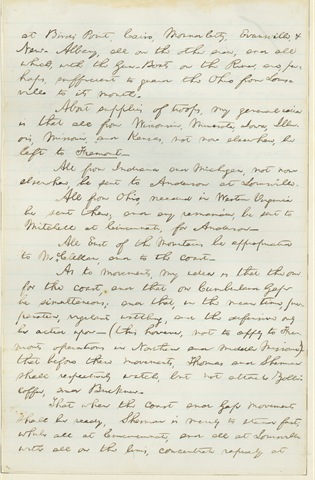
We have a large force at Paducah, and a smaller at Fort-Holt, both on the Kentucky side, with some at Bird’s Point, Cairo, Mound City, Evansville, & New-Albany, all on the other side; and all which, with the Gun-Boats on the River, are, perhaps, sufficient to guard the Ohio from Louisville to it’s mouth.

About supplies of troops, my general idea is that all from Wisconsin, Minesota, Iowa, Illinois, Missouri, and Kansas, not now elsewhere, be left to Fremont.

All from Indiana and Michigan, not now elsewhere, be sent to Anderson at Louisville.

All from Ohio, needed in Western Virginia be sent there; and any remainder, be sent to Mitchell at Cincinnati, for Anderson.

All East of the Mountains be appropriated to McClellan, and to the coast.

As to movements, my idea is that the one for the coast, and that on Cumberland Gap be simultaneous; and that, in the mean time, preparation, vigilant watching, and the defensive only be acted upon—(this however, not to apply to Fremonts operations in Northern and middle Missouri)—that before these movements, Thomas and Sherman shall respectively watch, but not attack Zollicoffer, and Buckner.

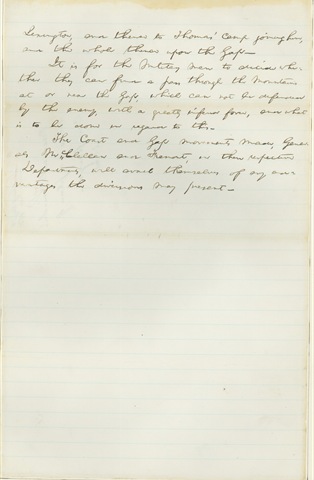
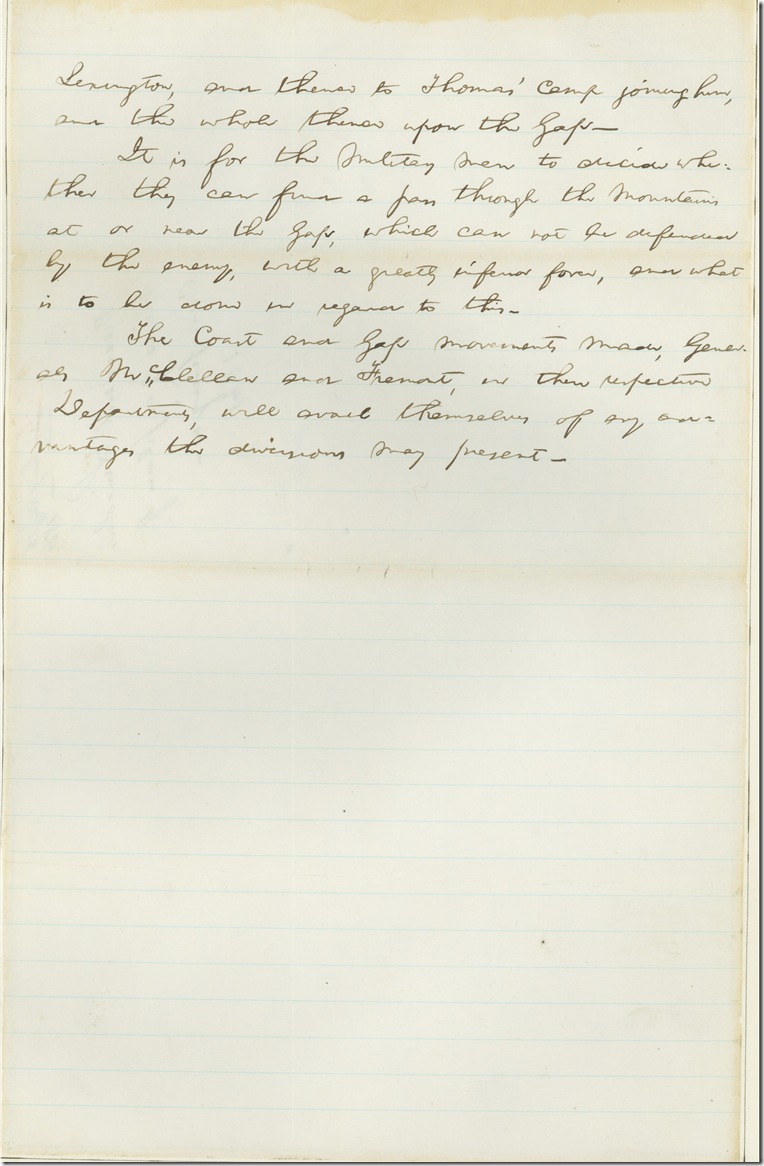
That when the coast and Gap movements shall be ready, Sherman is merely to stand fast; while all at Cincincinnati [sic], and all at Louisville with all on the lines, concentrate rapidly at Lexington, and thence to Thomas’ camp joining him, and the whole thence upon the Gap.

It is for the Military men to decide whether they can find a pass through the mountains at or near the Gap, which can not be defended by the enemy, with a greatly inferior force, and what is to be done in regard to this.

The Coast and Gap movements made, Generals McClellan and Fremont, in their respective Departments, will avail themselves of any advantages the diversions may present.


Citation: Abraham Lincoln, Plan of a military campaign. Washington, D.C., [ca. 1 Oct. 1861]. AMs 545/21

July 29, 1861: Abraham Lincoln Letter to the Kentucky Delegation

 AMs 527-22_1

AMs 527-22_4

Transcript:

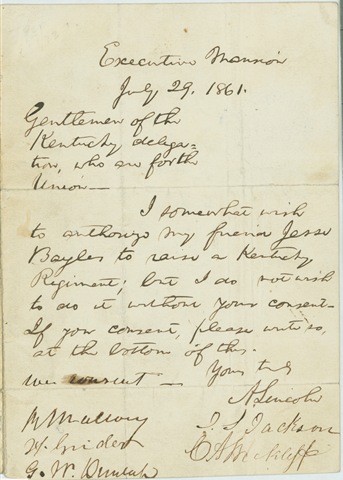
Executive Mansion July 29, 1861.

Gentlemen of the Kentucky delegation, who are for the Union—I somewhat wish to authorize my friend Jesse Bayles to raise a Kentucky Regiment; but I do not wish to do it without your consent. If you consent, please write so, at the bottom of this. Yours truly

A. Lincoln

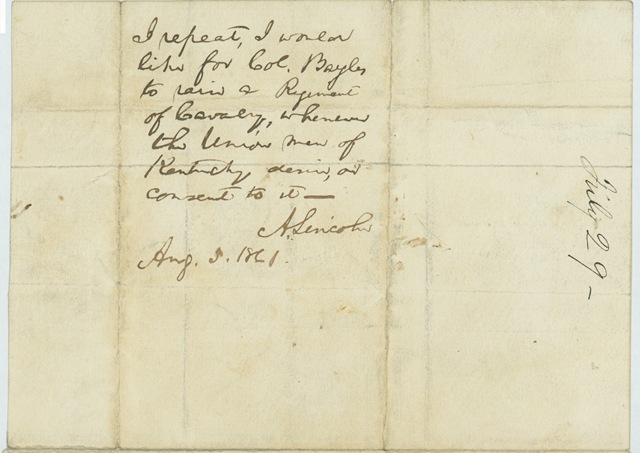
I repeat, I would like for Col. Bayles to raise a Regiment of Cavalry, whenever the Union men of Kentucky desire, or consent to it.

Aug. 5. 1861. A. Lincoln


Citation: Abraham Lincoln (1809-1865), autograph letter signed to the Kentucky delegation. 29 July 1861. AMs 527/22

May 10, 1861: Mark Delahay to Abraham Lincoln

Mark Delahay was an early supporter of the Republican party and long-time friend of Lincoln’s although others would accuse him of ineptitude and using Lincoln for his own gain. In 1861 Lincoln would name Delahay as Surveyor-General of Kansas.

AMs 527-4 Mark William Delahay to Abraham Lincoln

AMs 527-4_4

Transcript:

May 10th 1861

Dear Lincoln,

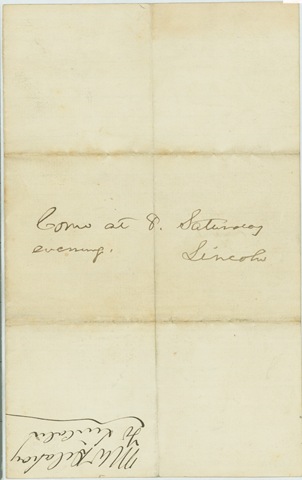
I would be very glad to get to see you about two matters of business, and to be importunate at a time when your whole time is occupied with big matters, is very distasteful and unpleasant to me. But it is of great importance to our People and myself that I should see you before I leave for home. if you can, will you oblige me by naming an hour between now and Monday when I can see you

Truly your friend

M W Delahay


Citation: Mark William Delahay (1817-1879),correspondence with Abraham Lincoln. Washington D.C., 10 May 1861. AMs 527/4

March 11, 1861: Charleston Mercury

top

Transcript (excerpt):

The Charleston Mercury, Charleston, S.C., Monday, March 11, 1861

Page 1, Upper Half

The Abolition Regime

Our Washington Correspondence.

Washington, March 7.

Douglas’ Opinion of the Inaugural – His Object in Interpreting it as a Peace Document – Crittenden nominated to the Supreme Court – Why Blair was made Postmaster General – Visits of the Delegations – Speeches working up the Feelings of the People to the War Point – Good bye to the Readers of The Mercury, etc., etc.

Every tongue is busy commenting on the inaugural. The papers are filled with quotations giving the opinions of the press in all directions. There is little agreement except in this – that all coincide as to the fact that it either means war or it does not mean war. The inference is that it was intended to mean both – the one and the other, according to circumstances. Mr. Douglas, in the Senate yesterday, expressed his belief, after a careful study of the mysterious document, that is was friendly and conciliatory. Now, it is known that Douglas was at first puzzled by it. He is still puzzled, his friends say, and had an object in putting a peaceful interpretation upon it, viz: to draw out a Republican translation.

Citation: Charleston Mercury. Charleston, S.C., 11 March 1861. Gift of Steven and Susan Raab. AN .C477

March 9, 1861: Abraham Lincoln to Gideon Welles

This brief note summoned the Secretary of the Navy to talk about the pressing problem of Fort Sumter. When Lincoln was sworn in as President on March 4, 1861, he thought that Fort Sumter was well supplied and that no intervention would be necessary to uphold the status quo. The next day (March 5) Lincoln saw a report from Fort Sumter, indicating that supplies would soon be exhausted and that it would require “twenty thousand good and well-disciplined men” to resupply the fort in the face of Confederate opposition. On March 9, Lincoln consulted with select cabinet and military officials (hence this note to Welles) and then convened a full cabinet meeting to consider the issue.

AMs 527-15-1_1

Transcript:

Executive Mansion

March 9, 1861

Will the Sec. of Navy please call on me at once.

Yours,

A. Lincoln


Citation: Abraham Lincoln, autograph letter signed to Gideon Welles. Washington, D.C., 9 March 1861.AMs 527/15.1