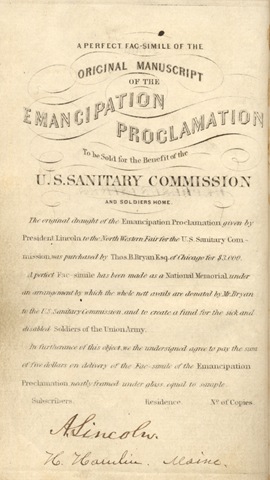
January 18, 1864: Subscription Book for Facsimiles of the Emancipation Proclamation

AMS 432-28 Emancipation proclamation subscription book

Abraham Lincoln donated the original manuscript of the Emancipation proclamation to the 1863 Chicago Sanitary Fair where it was purchased by Thomas B. Bryan.  Bryan had facsimiles made and sold to benefit the Sanitary Commission and the Soldiers Home.  The item shown here is the title page for a subscription book collecting orders for the facsimile, with Abraham Lincoln and vice-president Hamlin as the first two subscribers. Lincoln received the first two lithographed copies from Bryan on January 18, 1864.

United States Sanitary Commission.Subscription book for facsimiles of the Emancipation Proclamation, [1863]. AMs 432/28

January 12, 1864: Abraham Lincoln Writes on the Transcontinental Railroad

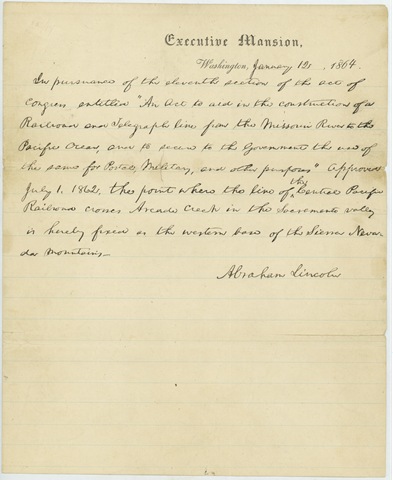
AMs 527-17_1

Transcript:

Executive Mansion,

Washington, January 12, 1864.

In pursuance of the eleventh section of the act of congress entitled “An Act to aid in the construction of a Railroad and Telegraph line from the Missouri River to the Pacific Ocean, and to secure to the Government the use of the same for Postal, Military, and other purposes” Approved July 1, 1862, the point where the line of the Central Pacific Railroad crosses Arcade creek in the Sacramento valley is hereby fixed as the western base of the Sierra Nevada mountains. Abraham Lincoln

Abraham Lincoln

Jan 12th 1864

Fixing Base of Sierra Nevada Mountains at Arcade Creek


Citation:  Abraham Lincoln (1809-1865), autograph document signed. Washington, D.C., 12 January 1864. AMs 527/17.1

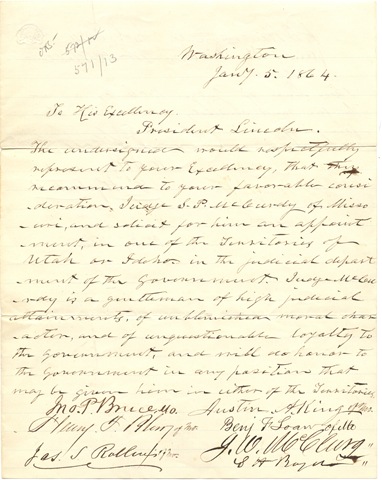
January 5, 1864: Letter from Missouri Delegation to Lincoln

 AMs 571-13 p1 Austin Augustus King with Missouri delegation and others AMs 571-13 p2 Austin Augustus King with Missouri delegation and AMs 571-13 p3 Austin Augustus King with Missouri delegation and AMs 571-13 p4 Austin Augustus King with Missouri delegation and

Transcription:

Washington Jany 5.1864

To his Excellency

President Lincoln

The undersigned would respectfully represent to Your Excellency, that they recommend to your favorable consideration Judge S. P. McCurdy of Missouri and solicit for him an appointment in one of the Territories of Utah or Idaho in the judicial department of the government. Judge McCurdy is a gentleman of high judicial attainment, of unblemished moral character, and of unquestionable loyalty to the government, and will do honor to the government in any position that may be given him in either of the Territories.

Austin A. King of Mo.

Jno P. Bruce, Mo.

Henry T. Blow of Mo.

Jas. S. Rollins of Mo.

Benj. F. Loan of Mo

G. W. McClurg “ “

S. H. Boyd “ “

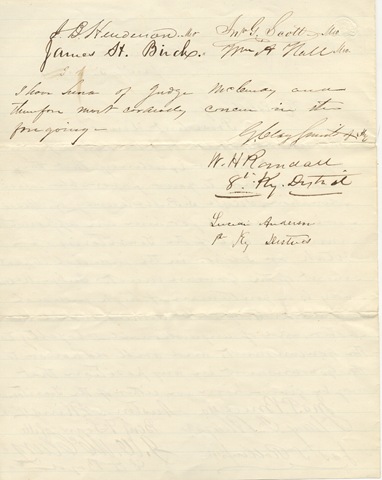
J. B. Henderson, Mo

James H. Birch

Jno G. Scott, Mo

Wm A Hall Mo.

I have heard of Judge McCurdy and therefore most cordially concur in the foregoing—

G. Clay Smith of Ky.

W. H. Randall

8th Ky. District

Lucian Anderson

1st Ky District


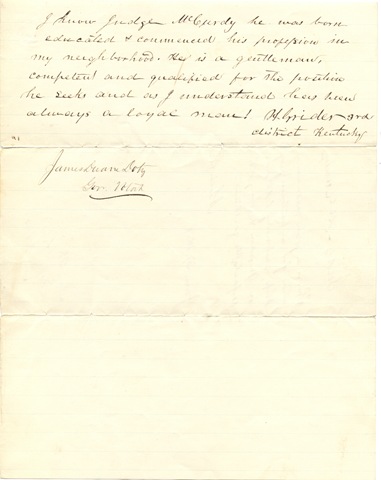
I know Judge McCurdy he was born educated + commenced his profession in my neighborhood. He is a gentleman, competent and qualified for the position he seeks and as I understand has been always a loyal man! H Grider 3d District Kentucky

James Duane Doty

Gov. Utah


This is a good recommendation for a territorial Judgeship, embracing both sides in Missouri & many other respectable gentlemen. A. Lincoln

Jan. 27, 1864

Jan 28 64 Rec’d office I. B. Kean Ct. Clerk

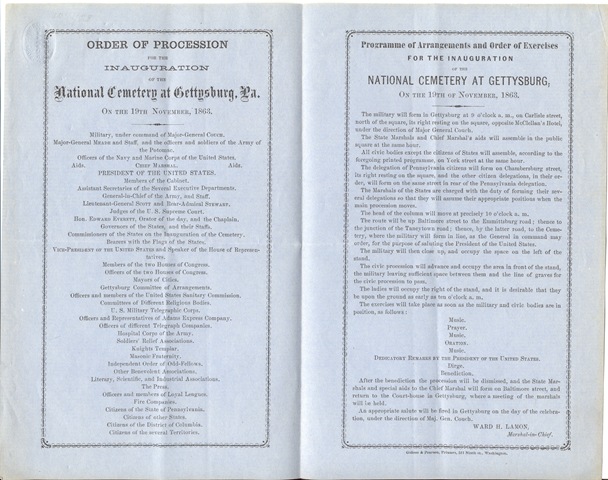
November 19, 1863: Order of Procession at Gettysburg Cemetery

Faced with the death of over 3100 Union soldiers at Gettysburg, the north responded with the creation of a national cemetery, inaugurated on November 19, 1863. This leaflet for the inauguration gives the order for the procession to the cemetery and a brief outline of the program, including an “Oration” (to be given by Edward Everett) and Lincoln’s “Dedicatory Remarks” (the soon-to-be-famous Gettysburg Address). The participant list underscores the scope and scale of the occasion—it includes not only military but also Masons, Oddfellows, benevolent organizations, and citizens (including women) from numerous states.

A 863or 600dpi


Citation: Order of procession for the inauguration of the National Cemetery at Gettysburg Pennsylvania. Washington, D.C.: Gideon & Pearson, [1863]. A 863or

October 24, 1863: Abraham Lincoln to Gen. Henry Halleck

AMs 1059-24_1 AMs 1059-24_2

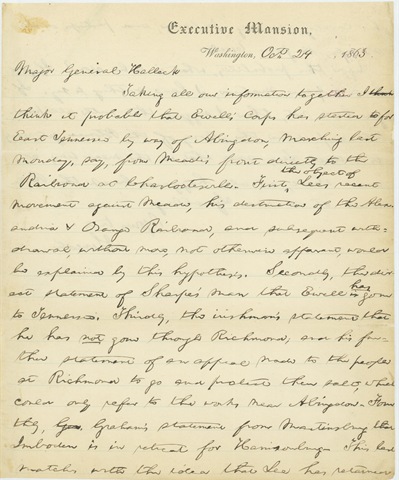
Executive Mansion
Major General Halleck. Washington, Oct 24, 63.

Taking all our information together I think it probable that Ewell’s corps has started for East Tennessee by way of Abingdon, marching last Monday, say, from Meade’s front directly to the Railroad at Charlottesville. First, the object of Lee’s recent movement against Meade, his destruction of the Alexandria & Orange Rail road, and subsequent withdrawal, without more, not otherwise apparent, would be explained by this hypothesis. Secondly, the direct statement of Sharpe’s man that Ewell has gone to Tennessee. Thirdly, the Irishman’s statement that he has not gone through Richmond; and his further statement of an appeal made to the people at Richmond to go and protect their salt, which could only refer to the works near Abingdon. Fourthly, Graham’s statement from Martinsburg that Imboden is in retreat for Harrisonburg. This last matches with the idea that Lee has retained his cavalry, sending Imboden, and perhaps other scraps, to join Ewell.

Upon this probability, what is to be done? If you have a plan matured, I have nothing to say. If you have not, then I suggest that with all possible expedition the Army of the Potomac get ready to attack Lee; and that, in the mean time, a raid shall, at all hazzards, break the Railroad at or near Lynchburg, Yours truly

A. Lincoln

Citation: Abraham Lincoln, autograph letter signed to Henry W. Halleck. Washington, D.C., 24 October 1863. AMs 1059/24

January 1, 1863: Emancipation Proclamation

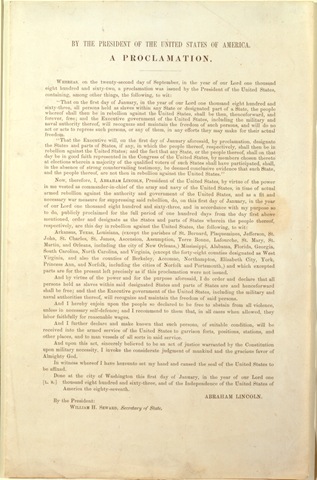
The Emancipation Proclamation took effect on January 1, 1863.
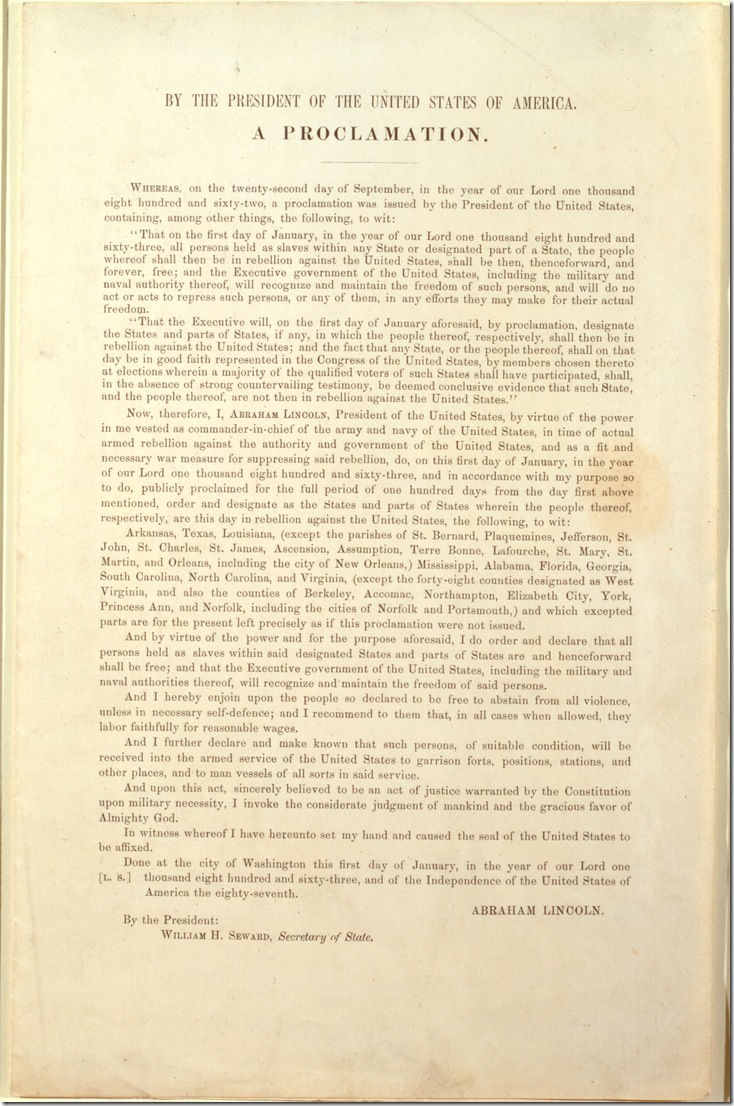
A 863b Emancipation Proc

Transcription:

By the President of the United States of America.

A Proclamation.

Whereas, on the twenty-second day of September, in the year of our Lord one thousand eight hundred and sixty-two, a proclamation was issued by the President of the United States, containing, among other things, the following, to wit:

“That on the first day of January, in the year of our Lord one thousand eight hundred and sixty-three, all persons held as slaves within any State or designated part of a State, the people whereof shall then be in rebellion against the United States, shall be then, thenceforward, and forever free; and the Executive Government of the United States, including the military and naval authority thereof, will recognize and maintain the freedom of such persons, and will do no act or acts to repress such persons, or any of them, in any efforts they may make for their actual freedom.

“That the Executive will, on the first day of January aforesaid, by proclamation, designate the States and parts of States, if any, in which the people thereof, respectively, shall then be in rebellion against the United States; and the fact that any State, or the people thereof, shall on that day be, in good faith, represented in the Congress of the United States by members chosen thereto at elections wherein a majority of the qualified voters of such State shall have participated, shall, in the absence of strong countervailing testimony, be deemed conclusive evidence that such State, and the people thereof, are not then in rebellion against the United States.”

Now, therefore I, Abraham Lincoln, President of the United States, by virtue of the power in me vested as Commander-in-Chief, of the Army and Navy of the United States in time of actual armed rebellion against the authority and government of the United States, and as a fit and necessary war measure for suppressing said rebellion, do, on this first day of January, in the year of our Lord one thousand eight hundred and sixty-three, and in accordance with my purpose so to do publicly proclaimed for the full period of one hundred days, from the day first above mentioned, order and designate as the States and parts of States wherein the people thereof respectively, are this day in rebellion against the United States, the following, to wit:

Arkansas, Texas, Louisiana, (except the Parishes of St. Bernard, Plaquemines, Jefferson, St. John, St. Charles, St. James Ascension, Assumption, Terrebonne, Lafourche, St. Mary, St. Martin, and Orleans, including the City of New Orleans) Mississippi, Alabama, Florida, Georgia, South Carolina, North Carolina, and Virginia, (except the forty-eight counties designated as West Virginia, and also the counties of Berkley, Accomac, Northampton, Elizabeth City, York, Princess Ann, and Norfolk, including the cities of Norfolk and Portsmouth,) and which excepted parts, are for the present, left precisely as if this proclamation were not issued.

And by virtue of the power, and for the purpose aforesaid, I do order and declare that all persons held as slaves within said designated States, and parts of States, are, and henceforward shall be free; and that the Executive government of the United States, including the military and naval authorities thereof, will recognize and maintain the freedom of said persons.

And I hereby enjoin upon the people so declared to be free to abstain from all violence, unless in necessary self-defence; and I recommend to them that, in all cases when allowed, they labor faithfully for reasonable wages.

And I further declare and make known, that such persons of suitable condition, will be received into the armed service of the United States to garrison forts, positions, stations, and other places, and to man vessels of all sorts in said service.

And upon this act, sincerely believed to be an act of justice, warranted by the Constitution, upon military necessity, I invoke the considerate judgment of mankind, and the gracious favor of Almighty God.

In witness whereof, I have hereunto set my hand and caused the seal of the United States to be affixed.

Done at the City of Washington, this first day of January, in the year of our Lord one [L.S.] thousand eight hundred and sixty three, and of the Independence of the United States of America the eighty-seventh.

By the President: ABRAHAM LINCOLN
WILLIAM H. SEWARD, Secretary of State.

Citation: U. S. President, 1861-1865 (Lincoln). By the president of the United States of America. A proclamation. [Washington, D.C., 1863]. A 863b
September 30, 1862: Abraham & Mary Lincoln Letters of Recommendation for Thomas Stackpole

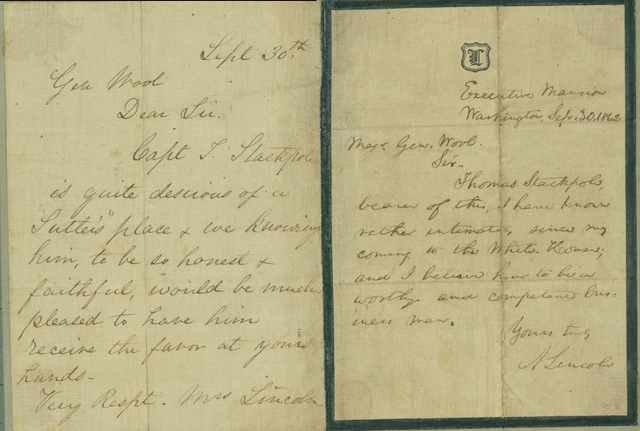
These two letters are recommendations for Thomas Stackpole to receive a sutler position in the army. Stackpole was a White House doorkeeper and watchman and was a favorite of Mrs. Lincoln.

AMs 353-12_4 copy

Transcription:

Executive Mansion

Washington, Sep. 30. 1862

Majr. Gen. Wool.
Sir—

Thomas Stackpole, bearer of this, I have known rather intimately since my coming to the White-House; and I believe him to be a worthy and competent business man. Yours truly

A Lincoln

Sept. 30th

Gen. Wool

Dear Sir

Capt. T. Stackpole is quite desirous of a “Sutler’s” place + we knowing him, to be honest + faithful, would be much pleased to have him receive the favor at your. Hands.

Very Resp. Mrs. Lincoln

Citation: Abraham Lincoln and Mary Lincoln, autograph letters signed to John E. Wool. 30 Sept. 1862. AMs 353/12

July 22, 1862: Abraham Lincoln’s Notes on Recruiting Black Soldiers

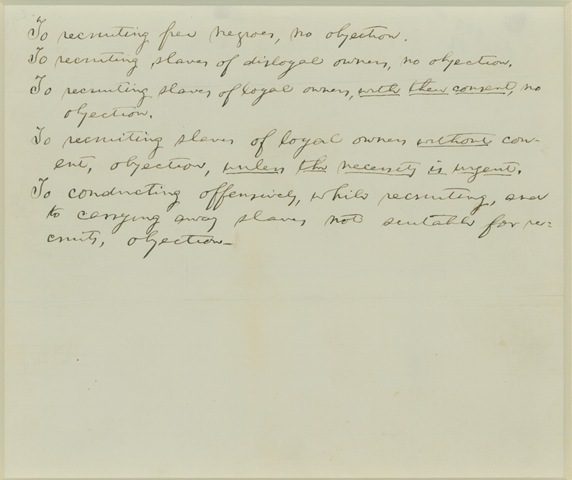
Basler suggests these undated notes may have been written around the time of the July 22 cabinet meeting.

AMs 354-10_1

Transcript:

To recruiting free negroes, no objection.

To recruiting slaves of disloyal owners, no objection.

To recruiting slaves of loyal owners, with their consent, no objection.

To recruiting slaves of loyal owners without consent, objection, unless the necessity is urgent.

To conducting offensively, while recruiting, and to carrying away slaves not suitable for recruits, objection.

Citation: Abraham Lincoln, notes on recruiting Negroes: autograph manuscript. Washington, D.C., [1862 July 22?].  AMs 354/10

May 17, 1862: Abraham Lincoln Letter and Photograph for Mary Motley

Mary Motley was the daughter of John Lothrop Motley, a historian and U.S. Minister to the Austrian Empire during the Lincoln administration.

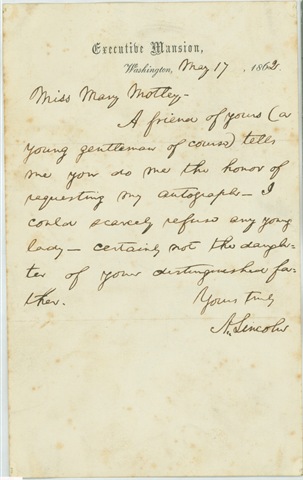
 AMs 776-27-1_1  

Transcript:

Executive Mansion,

Washington, May 17, 1862.

Miss Mary Motley—

A friend of yours (a young gentlemen of course) tells me you do me the honor of requesting my autograph. I could scarcely refuse any young lady—certainly not the daughter of your distinguished father. Yours truly A. Lincoln


Citation: Abraham Lincoln, autograph letter signed to Mary Motley. Washington, D.C., 17 May 1862. AMs 776/27.1

March 4, 1862: Lincoln’s Recommendation for Edward Burke

 AMs 353-11 p1 Edward Burke letters of rec 

Transcript:

Executive Mansion,

Washington, March 4. 1862
Whom it may concern

Edward Burke, the bearer of this, was at service in this Mansion for several months now last past; and during all the time he appeared to me to be a competent, faithful, and very genteel man. I take no charge of the servants about the house; but I do not understand that Burke leaves because of any fault or misconduct.

A. Lincoln

If Mr Newton can do any thing for Edward Burke, the bearer of this, I will be obliged to him I think him worthy O H Browning


Citation: Abraham Lincoln, letter of recommendation for Edward Burke. Washington, D. C.; 4 March 1862. AMs 353/11.1